Trading Time for Fuel express
A space tug with an ion engine accelerates slowly, but it sips fuel. To get from one orbit to another, you have to solve a tricky problem: how long to fire the engine and where to point it. Usually, the goal is to find the fastest transfer for a given spacecraft mass. The authors of the new study flipped the question: they ask what the maximum starting mass could be if the transfer time is already fixed.
They call this the maximum initial mass problem. Mathematically, it's a sibling of the fastest-transfer problem, but with the sign reversed. It turns out that every fastest path has a corresponding mass-limit counterpart, and vice versa. That means you can reuse known solutions to build new trajectories — more smoothly and reliably.
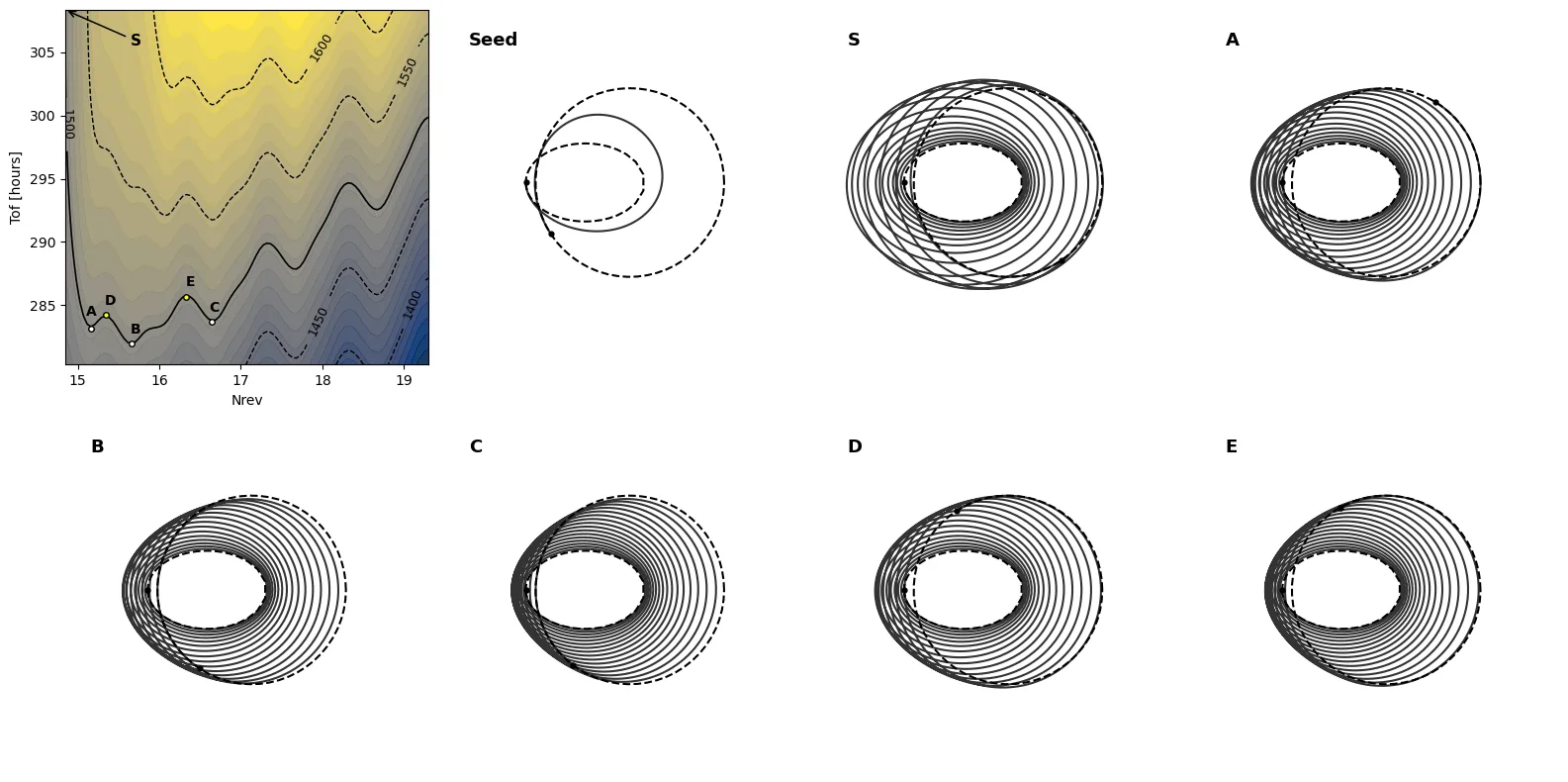
The method was tested on a classic scenario: moving a satellite from a highly elliptical orbit to geostationary orbit (a circular orbit at about 36,000 km altitude). The calculations not only confirmed the known fastest path but also uncovered additional solution branches. Some of these had previously been mistaken for fastest paths, but they turned out to be the slowest among the possible options for the same initial mass.
Original abstract
as written by the authors arXiv:2606.29289
We introduce the maximum-initial-mass problem as a standalone optimal-control formulation for low-thrust trajectory design and analyze its structure within Pontryagin's framework. For fixed transfer time and final state, the formulation seeks the largest initial mass from which the transfer is feasible, and its necessary conditions imply a full-throttle control law in the nondegenerate case together with the standard primer-vector steering direction. We then establish a correspondence between extremals of the maximum-initial-mass and minimum-time problems, showing that each minimum-time extremal induces a maximum-initial-mass extremal on the associated time interval, and conversely. This viewpoint also clarifies the role of the terminal Hamiltonian condition in indirect formulations of minimum-time problems, which we interpret as a gauge choice rather than an independent necessary condition in the setting considered. Finally, we show that the maximum-initial-mass framework provides a smooth and effective continuation strategy for multiple-revolution low-thrust transfers. Applied to a benchmark GTO-to-GEO transfer, the approach recovers the global minimum-time solution, reveals additional extremal branches, and makes explicit that some trajectories previously reported in the literature correspond to local maxima of transfer time along iso-M curves rather than to local minima.
An ion engine produces thrust by accelerating charged particles with an electric field. The thrust is tiny, about the weight of a sheet of paper on your palm, but it can run for months and saves fuel by a factor of tens compared to chemical engines.
In Andy Weir's novel The Martian, the ion engine of the spacecraft Hermes runs for years, slowly but steadily accelerating the interplanetary ship — a perfect example where mass and fuel economy matter more than speed.