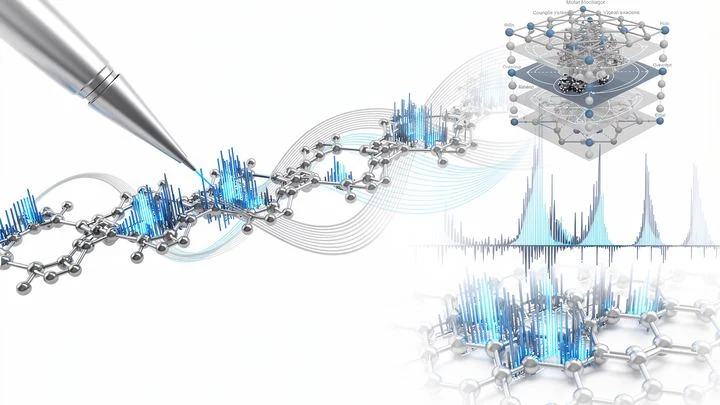
The protagonist of Hamiltonian mechanics is the Hamiltonian function, i.e., the total energy of the system expressed in terms of coordinates and momenta. Unlike the Newtonian approach, where force causes acceleration, here energy reigns. A pair of Hamilton's equations (the first linking velocity to momentum, the second linking change in momentum to force) turns mechanics into the geometry of phase space: each state is a point, and evolution is a line on the energy landscape. This perspective clarifies why energy, momentum, and other quantities are conserved.
History
The idea grew out of geometric optics. William Rowan Hamilton in 1833 applied the optical-mechanical analogy to rewrite Newton's laws in terms of energy. Later, Henri Poincaré used Hamiltonian methods to analyze the stability of the Solar System, laying the foundation for chaos theory. Emmy Noether proved that every continuoussymmetry of a Hamiltonian system corresponds to a conserved quantity — a result that cemented the foundation of all modern physics.
How it works
The Hamiltonian function H generates a vector field in phase space. The integral curves of this field are the system's trajectories. If H does not depend explicitly on time, energy is conserved. In the quantum picture, the Hamiltonian becomes an operator that determines the evolution of the wave function via the Schrödinger equation. Canonical transformations here become unitary transformations, and Liouville's theorem becomes the unitarity of quantum evolution.
In practice
Calculating satelliteorbits, modeling quantum computers, synthesizing new materials with desired properties.
Fun fact
The formalism turned out to be so elegant that it crossed over into quantum mechanics almost unchanged: the Hamiltonian operator became the main tool for describing particles and fields.
As planets orbit the Sun, they don't just follow their paths: they give each other a slight tug. It's like a dance where each partner feels the movements of the others. Scientists set out to determine how strongly this mutual attraction alters the planets' trajectories.
It turns out there are small corrections that were previously overlooked.
When a fluid flows around an obstacle, it spawns vortices and shock waves. Describing their behavior means solving a nonlinear equation in which the flow velocity depends on itself. Classical supercomputers spend days on this, while quantum computers have barely been used: their native language is linear operations, but fluids are inherently nonlinear.
A quantum particle moves in a circle, passing through several stations. At each station, something happens to it — for example, its properties change slightly. After completing a full circle, the particle returns, but its state is no longer exactly what it was at the start.
The neutron, one of the building blocks of the atomic nucleus, could, according to the equations, have a noticeable electric dipole moment: that is, behave like a tiny magnet. In reality, however, this effect is almost absent, creating a puzzle known as the strong CP problem.
When a particle carries a large amount of internal energy, like a massive spinning top, its motion can be split into a fast part and a slow part. The fast part is a jitter that barely affects the big picture. Physicists have developed a method to discard this jitter and keep only the slow, meaningful motion. It's like skimming the foam off boiling soup to see the clear broth underneath.
Every river has an estuary — the place where its waters meet the sea. Spacetime, too, has its own 'shore': it is called future infinity, and it lies where all signals, light, and gravitational waves ultimately go.
Quantum spin chains resemble a line of people passing along a secret handshake: each turns to a neighbor, and how firmly they clasp palms determines how the wave runs through the entire chain. In the ideal Heisenberg chain, quantum magnetism’s bedrock, all handshakes are equal.
A space tug with an ion engine accelerates slowly, but it sips fuel. To get from one orbit to another, you have to solve a tricky problem: how long to fire the engine and where to point it. Usually, the goal is to find the fastest transfer for a given spacecraft mass.
Imagine a book being simultaneously copied by trillions of scribes. As long as most of them check against the original, the narrative remains meaningful. But once control weakens, the text accumulates typos, which multiply until the manuscript turns into gibberish.
A network of tiny magnets seeks the state with the lowest total energy: that's roughly what the quantum Max Cut problem looks like, one of the toughest in physics. Scientists have been hunting for its solution since the days of Werner Heisenberg.
You can think of a political system as a vast galaxy — a gravitationally bound system of stars, gas, and dust. In this analogy, parties are the stars, radiating the light of public activity, while their supporters are dark matter, the invisible substance that emits no electromagnetic radiation but whose mass holds the whole structure…
Right after the Big Bang, space was a hot plasma — a mix of charged particles and light. In such a medium, electric currents couldn't flow on their own: a 'potential difference' was needed to push electrons relative to photons.
A handful of sand falls onto a table: each grain rolls down until it rests in a hollow. That's how a potential works: the table's surface tells the grains where to go. But in a river with whirlpools, there's no single basin everything flows into. Water swirls, returns, and meanders. For such systems, the usual map of 'pits and hills' doesn't apply.
In the scorching heart of a dying star, an invisible stream is born — a neutrino gas. The particles race through matter almost without stopping, but when their density is enormous, they start to feel each other. Old calculations described this as a jostle in a crowd: each shove changes direction, but no connection arises between passersby.
Time in physics is like a conductor setting the tempo for the whole orchestra. But in the quantum world, there's no single baton: each particle can live by its own clock. Usually, we simplify the picture and assume time flows the same for everyone.
A quantum particle traveling around a closed ring leaves two distinct 'records' along its path. The first is like a fingerprint on a doorknob: it remains unchanged no matter how many times you turn the knob, and it only tells you about the shape and material.
An ordinary magnet always carries two poles — north and south. Split it in half, and each piece immediately grows its own pair. But deep in particle theory lives a strange notion: the monopole — a particle carrying just one magnetic charge, a lone pole without a partner.
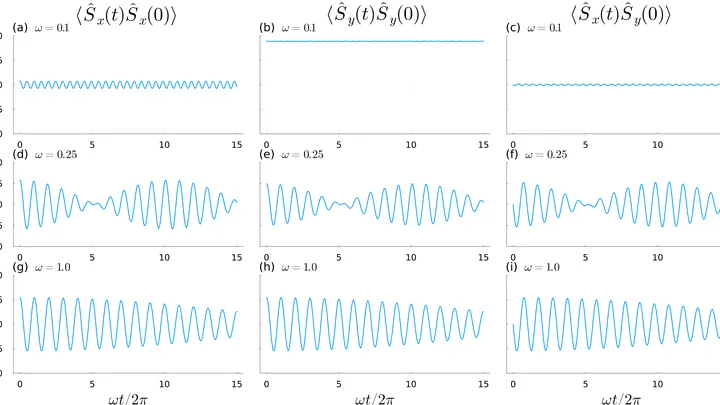
Two quantum particles are linked by an invisible thread: one loses energy, the other gains it, but the total remains unchanged. If you watch only the first, its oscillations don't fade — the rhythm is steady, like that of a cosmic pulsar, even though it seems that entropy and chaos are increasing.
Gravity is a cosmic net: massive bodies stretch it, and lighter objects roll along its curves. But in the world of atoms, this net begins to tremble chaotically, producing infinite values in the equations. Spacetime curvature ceases to be smooth.
Usually, quantum corrections to gravity explode into infinities.
In the quantum world, light and matter constantly exchange energy. Previously, they were described statically, like frozen poses. The new approach follows the dance itself: the transitions between states, like a continuous sequence of movements.
A driver turns the steering wheel to make the car turn. The quantum world also has its own "steering wheels"—external parameters that are slowly varied to shuttle particles from one place to another.
A pencil dropped on the floor hits with its entire surface at once. But if the floor were quantum, made of countless vibrating grains of sand, the pencil would never touch a single point.
Water churns behind a rock in a river, air swirls behind an airplane wing: it seems like completely random motion. But the authors of the study found a rigid kitchen recipe in this chaos.
They decomposed the fluid's rotation (angular momentum) into two independent parts.
Take two heavy balls and place them a meter apart: they attract each other with a force that weakens by a factor of four when you double the distance. Newton discovered this law, and it works in a room, in the solar system, in a galaxy. But does it still hold when we're talking about hundreds of millions of light-years?
Astronomers found a way to test this directly.
In everyday life, time flows on its own, like a river past its banks. But in quantum gravity, things are different: time does not flow; it emerges from relations between objects, like a pattern in a carpet that is only visible when viewed from a certain spot.
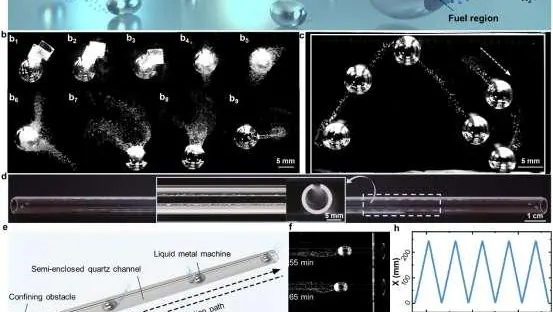
A droplet of liquid metal glides along a narrow channel like mercury from a broken thermometer. It needs no motor — the fuel is a chemical reaction with the surrounding liquid. But what happens when the droplet hits a wall? Previously, such machines were studied in open spaces, and in tight channels they behave differently.
Two people read the same book, but one turns the page first and then looks at the text, while the other does the opposite. It would seem the result is the same. But in the quantum world, the order of operations changes everything.
This work examines models that output sequences of symbols, like a ticket machine.
A hawk soars over a field, its wings tracing an intricate dance. Each flap, each tilt is not random but a combination of simple motions that can be broken down into components. Collective behavior in the air may seem intuitive, but behind it lies strict mechanics.
Scientists recorded the hawks' movements using cameras that track the position of every point on the wing and tail.
An electron inside a crystal is like a traveler walking through a city with winding streets. Its direction of motion constantly changes depending on where it is. Physicists call this feature the geometric Berry phase, and it determines how a material conducts electricity or responds to a magnetic field.
The world of physics works like a music box: there's a speed knob. Turn it slowly, and the melody is strict — balls roll along trajectories (classical mechanics). Speed it up — the notes blend into a chord: a particle is in many places at once, all probabilities (quantum regime).
The secret of switching is in the parameter κ.
We are used to thinking that events have causes, objects exist independently, and signals cannot outpace the speed of light. Quantum mechanics, which describes the Standard Model of particles, challenges all these assumptions at once — as if a recipe couldn't use all seven ingredients.
A single photon passes through two slits and leaves an interference pattern on a screen. Quantum mechanics describes this process with a wave function, but what happens to the particle itself?
At the hilltop of classical physics, a particle is frozen in unstable equilibrium. The slightest nudge — and it rolls down with increasing speed. In the quantum universe, no nudge is needed: the uncertainty principle itself acts as an all-pervading wind, blowing the particle off the peak.
A woven basket holds its shape not because it has a rigid frame, but because each strand is interlaced with its neighbors. Pull one out, and the pattern unravels, leaving a heap of twigs. Quantum mechanics, according to a new paper, works the same way: its elementary objects do not exist independently, but only in interweaving with each other.