In the mid-18th century, Leonhard Euler and Joseph-Louis Lagrange independently derived the equation that became the heart of analytical mechanics. They showed that all of Newtonian mechanics can be rewritten in the language of energy. The key idea: the system's trajectory is the solution for which the integral (total value) of the Lagrangian over time is extremal (usually minimal). This is called the principle of least action. Analogy: nature chooses the most economical path, just as water flows along a winding riverbed, minimizing energy loss.
History
In 1744, Leonhard Euler, studying the brachistochrone problem (the curve of fastest descent), arrived at an equation that minimizes the functional integral. Nearly half a century later, Joseph-Louis Lagrange in his 'Analytical Mechanics' (1788) used the calculus of variations to rethink all of classical mechanics, formulating the equations of motion through the Lagrangian. This made it possible to eliminate forces and accelerations, replacing them with energy and generalized coordinates. Later, William Rowan Hamilton developed this idea into the principle of least action, and Carl Gustav Jacobi connected it with optics.
How it works
The equation is used to derive equations of motion in complex systems: multi-body mechanisms, fields, relativistic particles. Its range of validity: applies to systems where forces can be derived from a potential (conservative forces with a generalized potential) and where there are no nonholonomic constraints. It falls outside its scope in the presence of dissipation (friction) or when taking into account quantum effects, where its modification in the form of Feynman path integrals is used.
In practice
Applied in robotics to calculate the motions of manipulators and in animation for realistic simulation of cloth and hair.
Fun fact
The Euler–Lagrange equation works not only in mechanics but also in electrodynamics, field theory, and even economics—everywhere where the concept of an optimal path exists.
The quantum vacuum is not empty: it is permeated by entanglement linking distant regions. But when physicists tried to compute this entanglement, it turned out to be infinite. The culprit: particles with very low energy that can smear out over arbitrarily large volumes. They are like waves with no shores to contain them.
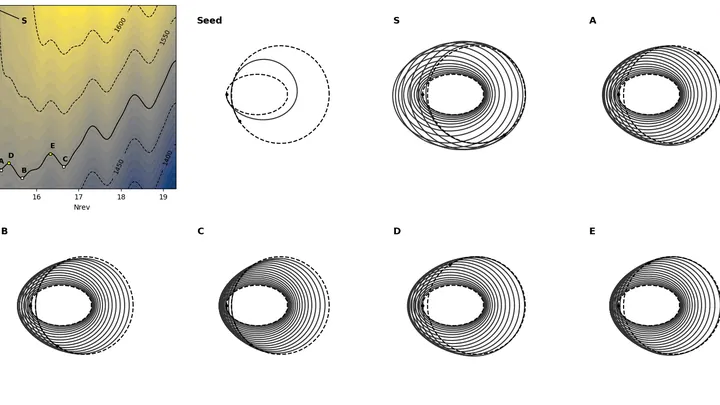
A space tug with an ion engine accelerates slowly, but it sips fuel. To get from one orbit to another, you have to solve a tricky problem: how long to fire the engine and where to point it. Usually, the goal is to find the fastest transfer for a given spacecraft mass.
Two electrically charged spheres attract each other with a certain force. If you replace their charges with magnetic poles, a spring scale shows exactly the same force. Black holes, it turns out, behave the same way — except instead of springs, the fabric of spacetime itself does the work.
Gravity is a cosmic net: massive bodies stretch it, and lighter objects roll along its curves. But in the world of atoms, this net begins to tremble chaotically, producing infinite values in the equations. Spacetime curvature ceases to be smooth.
Usually, quantum corrections to gravity explode into infinities.
The shape of a riverbed precisely follows the equation describing the growth of a universe with negative curvature. In the lab, water flowing over sand spontaneously carves a cross-section that matches the solution for the Anti-de Sitter model.
A river tends toward a shape that maximizes bottom friction.
A black hole is like a giant whirlpool in a river — space and time swirl around it and get pulled inward. Mathematically, this whirlpool is described by the Kerr solution, but it has remained a mystery why perturbations on such a background split into independent parts.
The Moon can have its own tiny moon — like a nesting doll, but in space. The outer doll is a planet, the middle one is a moon, the inner one is a small moon-satellite, or submoon. Ньютон showed that all bodies attract each other, and gravity holds them together.