Impulse is a fundamental concept in mechanics that quantifies the effect of a force applied over time. It is defined as the integral of force with respect to time, and it directly equals the change in momentum of an object. This relationship is known as the impulse-momentum theorem, and it provides a powerful framework for analyzing collisions, impacts, and any situation where forces act for a brief duration.
History
The concept of impulse is rooted in the work of Isaac Newton, who formulated the second law of motion in terms of the rate of change of momentum. The explicit formulation of impulse as a distinct quantity developed later, with contributions from figures like Jean le Rond d'Alembert and Leonhard Euler in the 18th century.
How it works
When a force acts on an object, it changes the object's momentum. The impulse is the cumulative effect of that force over the time interval it acts. Mathematically, impulse (J) equals the average force multiplied by the time duration, or the integral of force over time. The theoremstates that this impulse equals the final momentum minus the initial momentum. This is particularly useful because it allows you to calculate the effect of a force without needing to know the details of how the force varies with time.
In practice
Impulse is crucial in engineering design, such as in airbags that extend the time of a collision to reduce the force on occupants, and in sports science to analyze the effectiveness of a kick or throw.
Fun fact
The impulse-momentumtheorem is why a glass can survive a fall on a carpet but not on a hard floor: the carpet increases the time over which the momentum changes, reducing the force.
Units by system: SI: kgms · CGS: gcms · Planck: m pc
Stated relations:follows from →velocity · follows from →mass
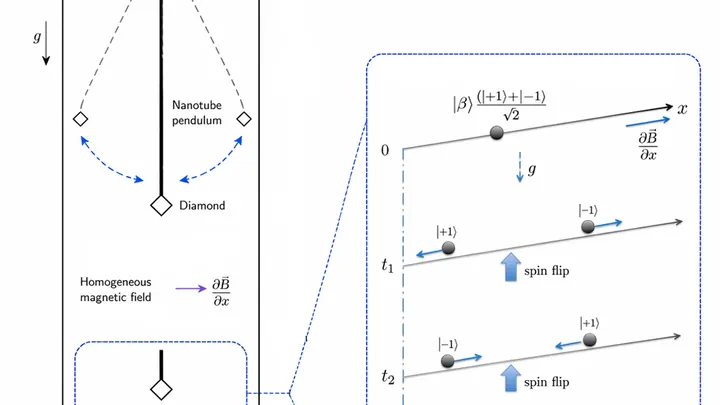
A quantum detector is like a sensitive pendulum suspended in empty space. If a sharp gravitational wave passes by, you might expect the pendulum to swing. But the calculation shows otherwise: the wave doesn't swing it: it damps any existing oscillations.
If you accelerate an observer to near-light speed, the emptiness around them stops being cold. A thermal glow emerges — an effect predicted in 1976 and named after William Unruh. For earthly accelerations, this glow is vanishingly faint, like a whisper at a rock concert.
According to Einstein's general theory of relativity Albert Einstein, a massive rotating body drags the fabric of spacetime along with it, much like a spoon twirled in a jar sets thick honey flowing.
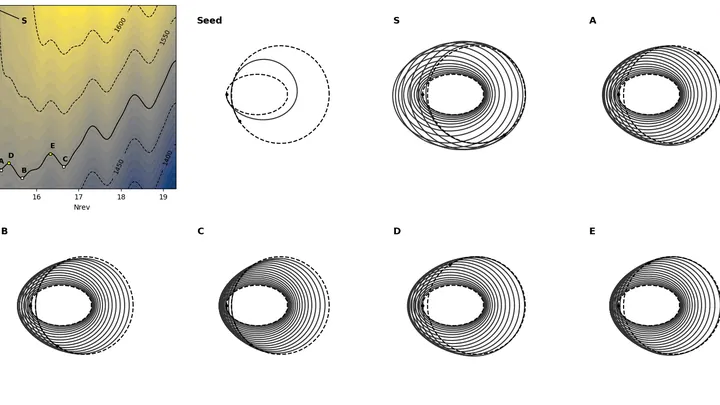
A space tug with an ion engine accelerates slowly, but it sips fuel. To get from one orbit to another, you have to solve a tricky problem: how long to fire the engine and where to point it. Usually, the goal is to find the fastest transfer for a given spacecraft mass.
A single particle can be in two places at once — that's superposition. But any interaction, like a shout, instantly 'collapses' this uncertainty. It was long thought that even gravity could interfere.
A thermostat keeps a room at 20 degrees. Open a window in winter, and it kicks on the heat to restore equilibrium. The brain does something similar: it constantly predicts what will happen a moment ahead and corrects itself when wrong. That's how it learns.
Two balls suspended on threads swing side by side. Each moves on its own, but between them is an invisible thread — the attraction of masses. If gravity is quantum, it could bind them into a single whole: nudge one, and the other responds, even without contact.
A raindrop falling to the ground strikes with a certain force. But what if the drop isn't round but elongated like a cigar or flattened like a pancake? It turns out that shape is everything: the impact force can vary by more than a factor of ten just because of how the drop looks at the moment of impact.
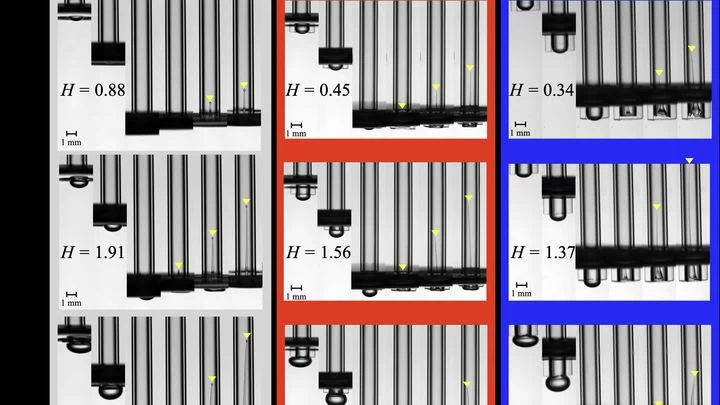
A drop falls into a glass, and a tiny jet, a thin fountain, shoots up from the surface for an instant. Something similar happens with a bubble stuck to the wall of a tube when you yank the tube downward. Water around the bubble rushes in, and a jet fires from its top. The speed of this jet depends on the bubble's shape — how much it bulges, like an umbrella dome.
An ordinary sensor is like a scale that always shakes a little on its own. Even in total silence and at zero temperature, every particle jitters — this is quantum jitter, and it limits the precision of any measurement.