Three Fates of a Planet Meeting a Black Hole ✛
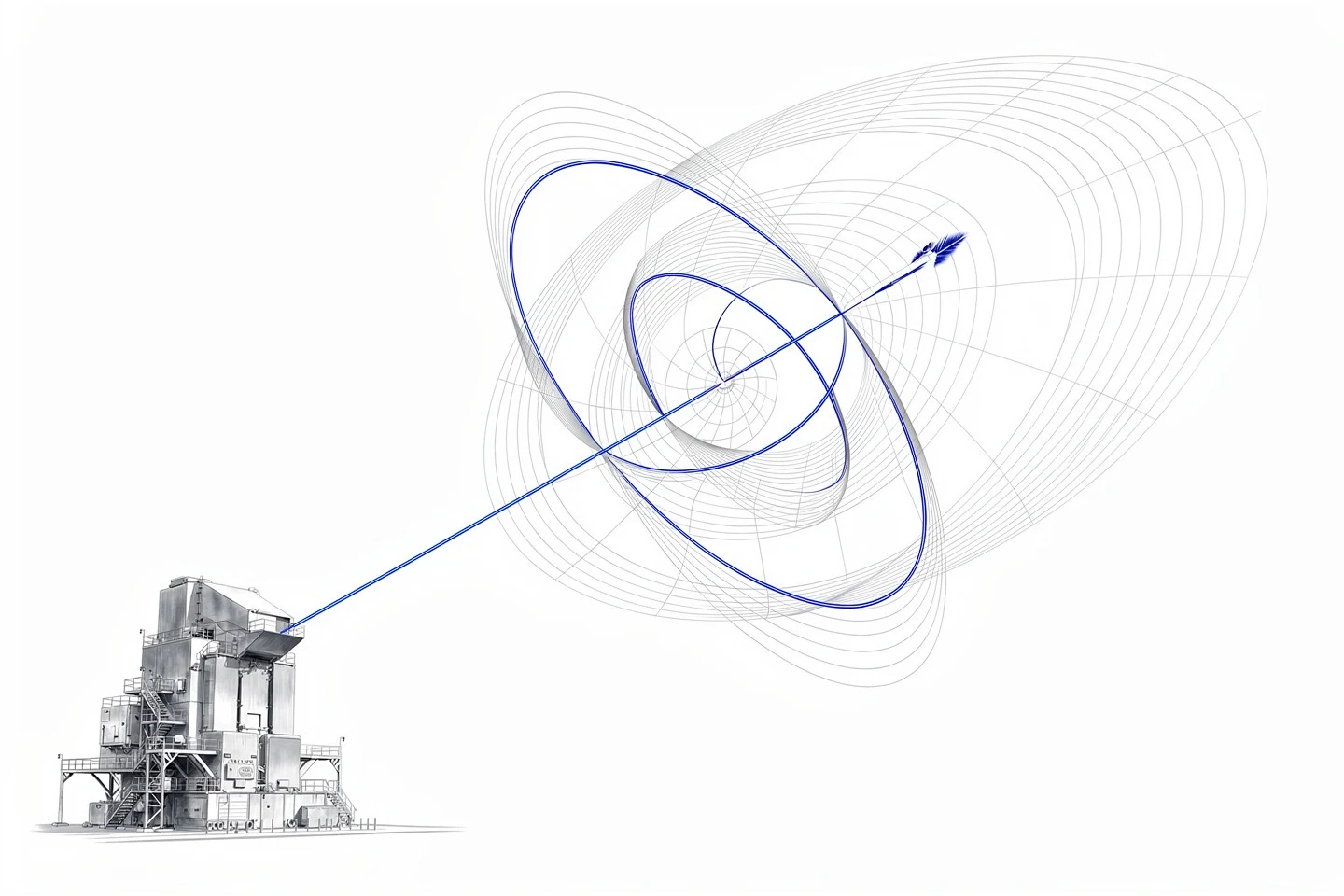
Astronomers have long known the distant star TOI-2796, orbited by a Jupiter-sized exoplanet hugging close to its sun. What happens if a primordial black hole — an invisible superdense relic born in the first moments after the Big Bang (an idea first championed by Georges Lemaître)—comes hurtling past? Think of a dancing couple, and suddenly a hefty stranger barges through. He might yank them apart, cut into the circle, or whisk one away — gravity plays similar tricks in space.
Researchers crunched the numbers to explore three possible fates. In the first, a black hole 15 times the mass of the Sun essentially “punched” the planet out of the system — within two weeks, it was gone. In the second, a heavier black hole, 500 solar masses, settled into orbit around the star, forming a stable three-body waltz. But the real surprise came from the third: using a neural network, they uncovered a case where a black hole of 300 solar masses outright “stole” the planet — the two snuggled into a tiny pair and drifted away from the host star together.
This isn’t just cosmic daydreaming. If primordial black holes really exist, their flybys could leave fingerprints in planetary orbits that future telescopes like James Webb might spot. Maybe one of these gravitational “dances” will unravel oddball motions in some worlds and shed light on the nature of dark matter.
If a black hole three hundred times heavier than the Sun sliced through the Solar System along Earth’s orbit, our planet would likely be hurled into interstellar emptiness, and lost forever in the dark.