Black hole formation is the astrophysical process by which a black hole is created. The most common pathway is the gravitational collapse of a massive star at the end of its life. When a star with more than about 20 solar masses exhausts its nuclear fuel, it can no longer support itself against gravity, and its core collapses. If the core's mass exceeds the Tolman-Oppenheimer-Volkoff limit (about 2-3 solar masses), no known force can halt the collapse, and a black hole forms. Other pathways include the merger of two neutron stars, which can produce a black hole if the combined mass exceeds the limit, and the direct collapse of gas clouds in the early universe, which may produce supermassive black holes.
History
The theoretical possibility of black holes was predicted by general relativity in 1915, with Karl Schwarzschild finding the first exact solution in 1916. The specific astrophysical process of stellar collapse to a black hole was worked out in the 1930s by J. Robert Oppenheimer and Hartland Snyder, who showed that a sufficiently massive star would inevitably collapse to a point.
How it works
The collapse proceeds when the pressure from nuclear fusion can no longer counteract the inward pull of gravity. The core implodes in milliseconds, reaching densities comparable to nuclear matter. If the resulting neutron star is too massive, it continues to collapse. General relativity predicts that once matter is compressed within its Schwarzschild radius, it inevitably forms a singularity, an object with an event horizon from which nothing, not even light, can escape. The newly formed black hole is initially characterized by its mass and spin, which are determined by the properties of the collapsing star or merging objects.
In practice
Understanding black hole formation is crucial for interpreting gravitational wave signals from merging black holes, for modeling the evolution of galaxies (which harbor supermassive black holes at their centers), and for studying the most extreme states of matter in the universe.
Fun fact
The first direct detection of gravitational waves in 2015 was from the merger of two black holes, providing the first direct evidence that black holes exist in binary systems and merge.
A neutron star is the ultra-dense remnant of a supernova: the mass of the Sun packed into a sphere the size of a city. For billions of years, it travels through space, gathering around itself invisible matter, dark matter, which emits no light but pulls with gravity.
Imagine a factory capable of producing a million parts per hour, yet it only makes a hundred. That's roughly how our Universe behaves when viewed through the lens of entropy — a measure of disorder that, according to physics, must only increase. The main "machines" of this factory are supermassive black holes.
The universe teems with the invisible: about 85% of matter neither emits nor absorbs light. This hidden mass, first suspected by Vera Rubin from the anomalously fast rotation of galaxies, we call dark matter.
Emptiness can surprise you. In general relativity, there is a solution where space itself gives birth to a black hole — literally from a point. It all starts at the moment when the event horizon (the surface from which not even light can escape) appears with zero radius and immediately begins to grow.
If you squeeze a handful of sand, it gets denser, but at some point the grains press against each other: there's no more room to compress. Some theorists think space behaves similarly at ultra-small distances: it has a limit to divisibility, a kind of 'grain.' In this new study, that principle was applied to the birth of black holes in the early universe — the very ones that…
Imagine an interpreter at a crucial negotiation suddenly switching to another language, and the meaning of everything changes. That's roughly what neutrinos do in the depths of a dying star. These invisible particles are born in enormous numbers when a star's core compresses into a city-sized lump. But on their way out, neutrinos can change their type — physicists call this flavor transformation.
When a massive star exhausts its fuel, the core collapse can spawn a supernova and a neutron star, but with enough mass, nothing halts the crush — a black hole is born.
Stars tens of times heavier than our Sun don't die as thought before. Computer models show that their core often doesn't ignite a supernova, but quickly collapses into a black hole. Imagine a soufflé: the center suddenly sinks, and almost all the batter falls into the funnel, with just a few drops splashing out.
Light from a distant source passing near a neutron star bends like a flashlight beam in a funhouse mirror. Astrophysicists ran a numerical experiment: they traced rays backward from the observer to the star and looked at what picture a telescope would see.
Dark matter is the invisible framework of the Universe. It doesn't emit light, but its gravity keeps galaxies from flying apart. A new hypothesis: dark matter consists of dark photons — ghostly particles that are invisible under ordinary conditions.
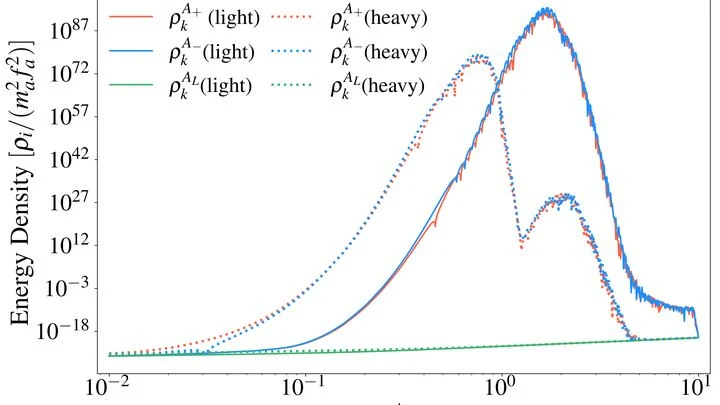
Supermassive black holes at the centers of galaxies appeared so quickly after the Big Bang that astronomers are scratching their heads. The solution lies in the trembling of an invisible axion field.
A homogeneous dust sphere begins to contract under its own gravity. Inside it, like a rescue bubble, a region of negative pressure inflates: the de Sitter bubble. It expands, slows down near the very edge of the fall, and freezes at the Schwarzschild radius.