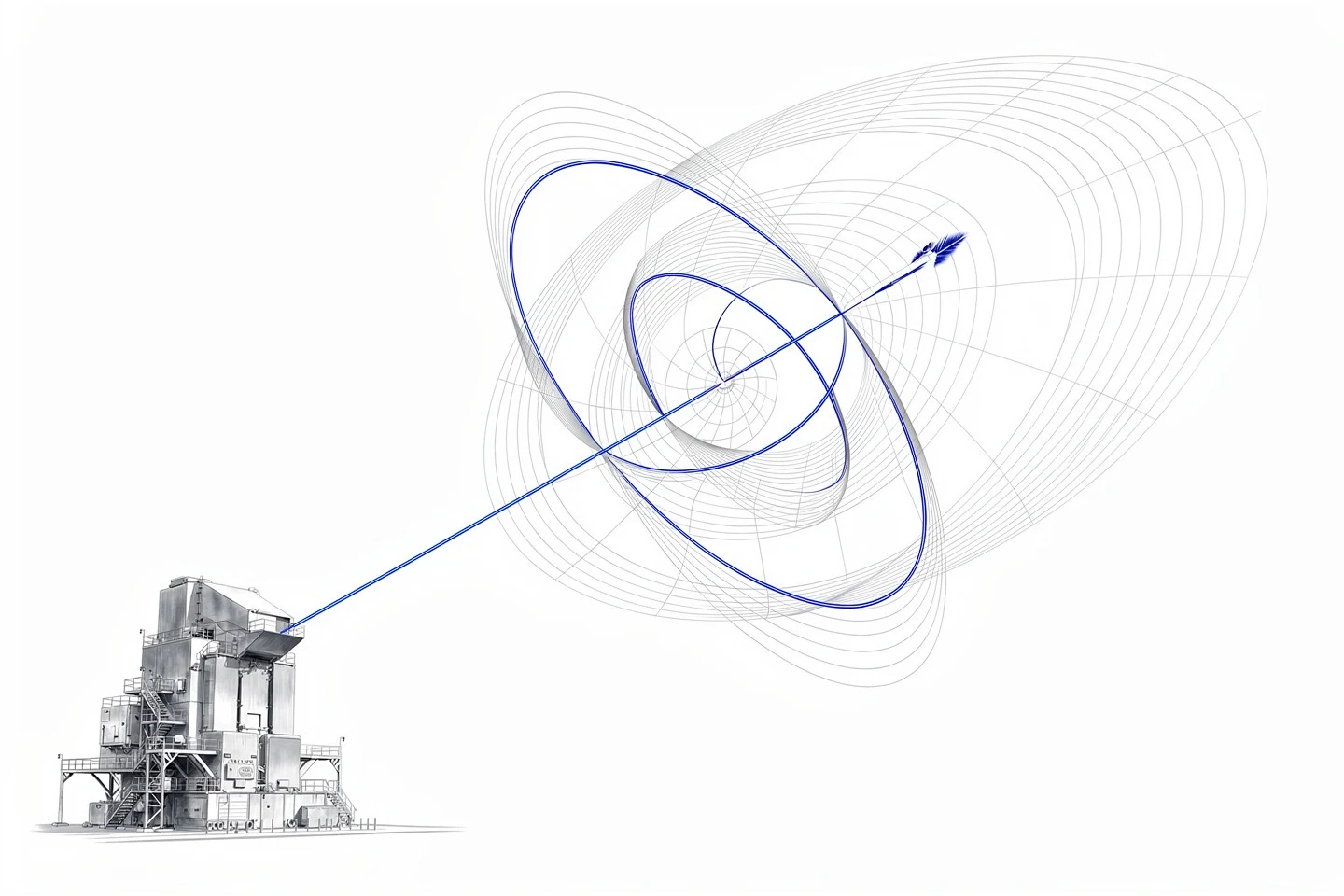
Three scenarios of an exoplanet encountering a primordial black hole ✛
Context
Primordial black holes (black holes), formed in the first moments after the Big Bang, an idea proposed by Georges Lemaître, remain one of the main candidates for dark matter. Their existence could explain the hidden mass of the Universe, as indicated by Vera Rubin through galaxy rotation. If such objects pass through planetary systems, they can leave gravitational "fingerprints" — from subtle orbital anomalies to complete system disruption. Understanding these scenarios is crucial for interpreting future observational data, including gravitational microlensing and gravitational waves, as well as for testing Stephen Hawking's predictions about black hole evaporation.
Methods
The study used direct numerical integration of the three-body problem with the adaptive LSODA solver, which automatically switches between Adams and backward differentiation methods. The system modeled consisted of a Sun-like star (TOI-2796), its hot Jupiter (TOI-2796 b), discovered by the transit method and confirmed by spectroscopy, and a hypothetical primordial black hole (PBH) with masses ranging from 15 to 500 solar masses. Initial conditions were varied to cover different impact parameters. To search for rare scenarios such as planet capture, a neural network was trained on 475 simulations, which allowed finding a configuration with the formation of a PBH–planet binary system.
Results
Over 100 days of simulation, three outcomes emerged. With a PBH of 15 solar masses, the planet was ejected from the system, moving to a distance of more than 2 AU in just 16 days. In the scenario with a PBH of 500 solar masses, a stable triple system formed: the PBH orbited the star (TOI-2796) at a distance of about 1 AU with a period of approximately 5 days, with the orbit slightly expanding over time. Finally, the neural network revealed a case with a 300-solar-mass PBH, where the planet (TOI-2796 b) was captured by the black hole into a compact pair with a semi-major axis of 0.0194 AU and an orbital period of 15 days; during the simulation, this pair moved away from the star to 51.5 AU. These numbers demonstrate the sensitivity of the outcome to the mass and trajectory of the PBH.
Implications
The results show that primordial black holes can act not only as destroyers but also as architects of planetary systems. The capture scenario suggests the possibility of hidden populations of planets orbiting PBHs far from stars, which could explain some anomalies in the distribution of exoplanets. If PBHs constitute part of dark matter, such events could leave observable traces, such as unusually high eccentricities in isolated planets. This also opens a new approach to testing Vera Rubin's hypothesis of invisible mass through the dynamics of planetary bodies.
Future development
Further research may include accounting for relativistic effects, such as the emission of gravitational waves during close encounters, and modeling the long-term evolution of captured systems. With the launch of new observatories like James Webb and the future Vera Rubin telescope, it will become possible to search for predicted orbital distortions in nearby exoplanets. Additionally, studying cometary clouds around stars perturbed by PBH flybys could provide additional observational clues.
Impact
The impact spans exoplanet observational astronomy exoplanets and dark matter cosmology: searching for orbital anomalies in planets could become a new method for detecting PBHs, complementing microlensing and gravitational wave observations.
Next steps
The immediate next step is to extend the simulations to longer timescales using high-accuracy integrators to verify the stability of triple systems and to estimate the probability of different outcomes depending on PBH parameters.
Key open problems
The work is directly connected to the puzzle of dark matter: if PBHs exist, they could explain the hidden mass, but their nature remains unconfirmed. Moreover, the three-body problem in the context of planetary systems illustrates chaotic dynamics that can lead to unexpected architectures observed in many exoplanets, and raises the question of the role of initial conditions in forming stable systems.
The knowledge machine's view
This section is addressed to the author of the paper and their colleagues. Neighbouring works were found by meaning-based search across our archive, not by word overlap. We do not review: we show the field around the work.
What the work does
This work numerically simulates the passage of a primordial black hole (PBH) through a solar-type star system with a hot Jupiter. Using the adaptive LSODA solver for the three-body problem, the study varies PBH masses (15–500 solar masses) and impact parameters. Three outcomes are obtained: planet ejection, formation of a triple system, and capture of the planet by the PBH, leading to a compact pair, with the latter scenario discovered via a neural network.
Where its strength is
The work demonstrates that PBHs can not only disrupt but also reshape planetary systems, including the exotic capture of a planet. Using a neural network to search for rare configurations is a strong methodological move that can be applied in future studies.
Where it could go next
- It might be interesting to compare the obtained scenarios with results from simulations of close PBH flybys in other planetary systems: the archive contains a review of a work where a PBH reshapes a system with multiple planets, and such a comparison could help identify common patterns.based on: The Third Wheel: How a Primordial Black Hole Reshapes a Planetary System arXiv:2607.03724
- There is also a review nearby on PBH interactions with a star, covering capture and accretion scenarios; it might be interesting to extend your model to the case where the PBH does not merely fly by but becomes bound to the star, and see how that affects the planet's fate.based on: Smoldering Ember in a Star’s Heart: Two Apocalypse Scenarios arXiv:2606.02700v1
Worth trying
- Investigate how often planet capture occurs under various mass and velocity distributions of PBHs, using the trained neural network for rapid parameter scanning.
- Assess the observational signatures of a captured planet: for instance, microlensing from a PBH–planet pair or possible radiation from gas accretion onto the PBH.
- Compare the outcome statistics with analytical estimates from three-body scattering theory to identify parameter regions where numerical modeling is necessary.
Why this may matter
If PBHs constitute part of dark matter, their interactions with planetary systems may leave observable traces, from orbital anomalies to isolated rogue planets. Understanding such processes is important for interpreting future microlensing data and for testing hypotheses about the nature of dark matter.
Nearby works in our archive
- The Third Wheel: How a Primordial Black Hole Reshapes a Planetary Systemsimilarity 0.67
- Smoldering Ember in a Star’s Heart: Two Apocalypse Scenariossimilarity 0.63
- How the First Black Holes Are Bornsimilarity 0.63
- A White Hole in the Lens: What the Telescope Will Seesimilarity 0.63
- The Gentle Boiling of the Cosmossimilarity 0.62
- Little Red Dots and Giant Black Holessimilarity 0.61
The closest work in the archive sits at 0.67 by meaning — the usual level for our corpus.
Original abstract
as written by the authors arXiv:2607.03724v1
We present numerical three body simulations of a primordial black hole (PBH) encounter with the TOI 2796 system, which hosts a hot Jupiter. Over 100 days, we identify three outcomes: (i) ejection of the planet; (ii) a bound triple system (a approx. 1 au, P approx. 5 days); and (iii) capture of the planet by the PBH into a binary (0.0194 au, 15 days) that escapes the star. These results highlight the rich dynamical diversity of PBH encounters and their potential role in shaping planetary systems.
If a 300-solar-mass primordial black hole passed through the Solar System at Earth's orbital distance, the consequences would be catastrophic: our planet would likely be ejected into interstellar space, sending us on an eternal journey in darkness.
Key numbers
- distance in capture scenario: 51.5 AU
- triple system period: ~5 days
- semi-major axis of captured pair: 0.0194 AU
- simulation time: 100 days
- number of training runs: 475