Cosmic Jazz: Three Finales of an Encounter with a Black Hole ✛
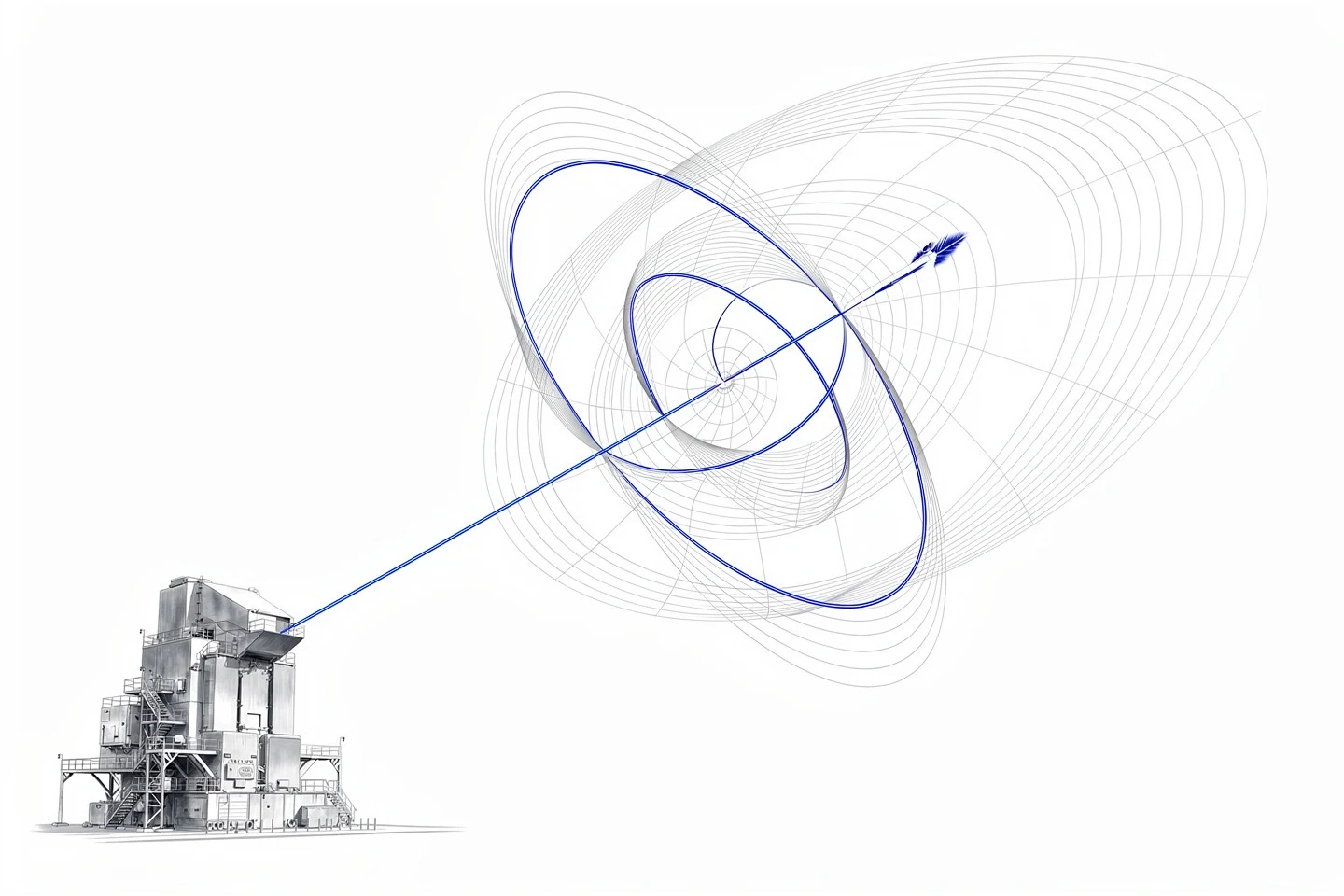
The universe teems with the invisible: about 85% of matter neither emits nor absorbs light. This hidden mass, first suspected by Vera Rubin from the anomalously fast rotation of galaxies, we call dark matter. Among the prime suspects are primordial black holes, born in the deafening chaos of the Big Bang, an idea that traces back to Georges Lemaître. If they truly wander through the interstellar darkness, their gravitational touches could be like musical phrases in a complex jazz score. Precisely such a cosmic jam session was modeled by astrophysicists, taking the system TOI-2796 — a solar-type star and its hot Jupiter TOI-2796 b, discovered by the transit method and confirmed by spectroscopy. Into this cozy system they invited an uninvited third: a primordial black hole with a mass from 15 to 500 suns.
A hundred days of computational improvisation with the adaptive LSODA solver — and three jazz variations were born. The first turned out sharp and dramatic: when the 15-solar-mass hole came too close, the planet, like a missed note, was flung away. In just 16 days it flew beyond 2 astronomical units, leaving its parent star forever. This is an outro into solitude — a scenario that explains the emergence of wandering orphan planets. The second variant, with a massive 500-sun hole, spawned a surprisingly harmonious triple system. The black hole entered a stable orbit around the star at about 1 AU with a period of roughly 5 days, and over time this trio only slightly expanded. The gravitational chord proved stable.
The third scenario was found with the help of an artificial neural network's ear, trained on 475 simulations. With a mass of 300 suns, the primordial black hole didn't just graze the planet — it stole it. TOI-2796 b ended up captured in a tight pair with a semi-major axis of just 0.0194 AU and a period of 15 days, and then this dark binary system began moving away from the star, reaching 51.5 AU by the end of the run. Thus is born an invisible companion, wandering through the Galaxy in a silent duet.
Such gravitational polyphony is not just academic entertainment. It directly touches on the main riddle of cosmology: if primordial black holes make up even a fraction of dark matter, their flybys should leave observable imprints. Traditional searches via gravitational microlensing already provide hints, but now we can look for planets with inexplicably high eccentricities or whole swarms of comet clouds disturbed by an invisible maestro. And given the prediction by Stephen Hawking about the quantum evaporation of black holes, the search for their planetary companions becomes even more intriguing — for such systems may not be eternal. The James Webb Space Telescope and the future Vera Rubin Observatory are already scanning the skies, while gravitational wave detectors catch echoes of close encounters. Perhaps, it is the orbital anomalies of exoplanets that will become a new tool for reading the ancient musical score left by dark matter.
Researchers will continue their numerical jam sessions, adding relativistic overtones and extending simulation time to gauge how long such stolen worlds survive. Each new run is another beat in a symphony where the notes are planets, and the conductor is invisible. And who knows what other variations the chaos of three bodies conceals?
In the capture scenario, planet TOI-2796 b circled the black hole on an orbit with a radius of 0.0194 AU — three times tighter than Mercury's orbit.