Digital Vision for a Fusion Reactor express
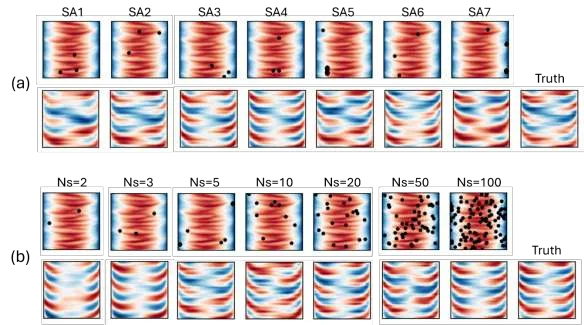
Inside a fusion reactor, plasma rages — a gas heated to millions of degrees. There are no direct windows, and cameras and sensors quickly fail. Engineers see only fragments of information: a few sensors at scattered points. It's like trying to grasp a symphony from the sound of three microphones in a vast hall.
The new machine learning model takes these sparse signals and reconstructs the full picture — all fields, temperatures, and densities at once. First, it compresses the measurement history over time. Think of a translator listening to speech and capturing the meaning, not individual words. Then, from this compressed representation, the model unfolds a detailed three-dimensional map of the plasma.
Tests on high-fidelity simulation data showed that signals from simple density sensors can recover several plasma characteristics at once. This isn't just filling in a picture — the model captures physical relationships between quantities. Such an approach could become the foundation for digital twins of the reactor. They provide real-time insights into what's happening inside and help keep the plasma stable.
Original abstract
as written by the authors arXiv:2607.04390
Plasma in nuclear fusion reactors is only partially observable: diagnostics are constrained by limited access, cost, and the harsh plasma environment, while high-fidelity simulations remain prohibitively costly at reactor-relevant scales to address the observability gap. This paper presents an ML model for reconstructing full-domain plasma states from a small number of accessible measurements. The model combines temporal encoding of sparse sensor histories with spatial decoding into complete plasma-field maps. Demonstrations using high-fidelity kinetic simulation data show that multiple coupled plasma quantities can be reconstructed from only a few density sensors, with robustness to sparse and randomly located probes. The approach provides a route toward diagnostic augmentation, real-time state estimation, and data-driven digital twins for fusion-relevant plasmas.
Plasma in a fusion reactor is ten times hotter than the Sun's core, and its magnetic confinement is often compared to trying to squeeze jelly with your fingers.
The technology resembles the 'mental scanning' from Peter F. Hamilton's novels, where full consciousness is reconstructed from a few neural signals.