Data compression is the art and science of representing information with fewer bits than the original. It is a foundational technology in the digital age, enabling everything from streaming video to storing genomes. The core idea is to exploit redundancy: most real-world data contains patterns, repetitions, or statistical regularities that can be described more compactly than the raw data itself. Compression algorithms find these patterns and encode them, allowing the original information to be reconstructed (losslessly) or approximated (lossily) from the compressed form.
History
The field began with Claude Shannon's 1948 paper 'A Mathematical Theory of Communication,' which laid the groundwork for information theory and introduced the concept of entropy as a measure of information. Early practical algorithms like Huffman coding (1952) and Lempel-Ziv (1977) followed.
How it works
Compression works by modeling the data's structure. Lossless methods, like Huffman coding or LZ77, build a dictionary of frequent symbols or phrases and replace them with shorter codes. Lossy methods, like JPEG or MP3, discard information that the human eye or ear is insensitive to, using transforms (e.g., discrete cosine transform) to concentrate energy into a few coefficients. In physics and signal processing, compression often connects to information theory: the minimum number of bits needed to describe a signal is its entropy, and compression approaches this limit by removing statisticalredundancy.
In practice
Data compression is used in virtually every digital medium: image formats (JPEG, PNG), audio (MP3, FLAC), video (H.264), and file archivers (ZIP). In scientific research, it enables efficient storage and transmission of massive datasets, such as those from particle accelerators or genomic sequencers.
Fun fact
The 'zip bomb' is a compressed file designed to expand to an enormous size when decompressed, exploiting the fact that highly repetitive data can be compressed to almost nothing.
An X-ray flash tears through matter in billionths of a second. To remember it, physicists make atoms briefly absorb the light and then release it back. But pulling out a photon on command is like grabbing the right book from a shelf when the shelves move on their own.
The usual approach is to move several absorbers with extreme precision, like a well-coordinated orchestra.
In a three-dimensional scene, each point is like a candy whose color changes depending on the viewing angle. To describe this play of shades, dozens of numbers are stored for each point — a special mathematical function invented by Joseph Fourier. Memory fills up instantly.
An ordinary road map with traffic is a heap of numbers. Sending them all as is takes too long. But you can reduce the volume without losing the gist. Researchers found a clever solution: first redraw the map so that streets become points, and intersections become bridges between these points.
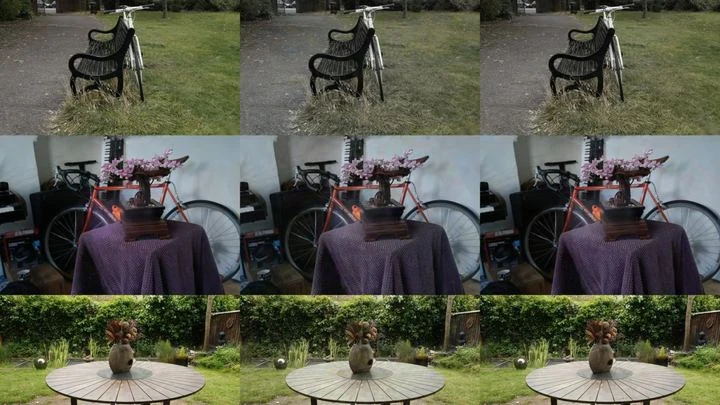
Three-dimensional worlds are made of millions of semi-transparent specks, like a giant tapestry woven from glowing droplets. Transmitting such a canvas usually takes ages and a beefy data pipe. SpeedyGS squeezes it into a tiny file, and it unfurls in a flash, like yanking a drawstring from a pouch.
Training a large neural network across hundreds of compute nodes is like making soup as a team: each 'chef' tastes the dish and tells the others what to adjust.
In 1948, engineer Claude Shannon laid the foundations of information theory. The Nyquist–Shannon theorem gave the first answer: to avoid losing a signal, you need at least twice as many measurements as the fastest feature in the signal. In 2006, the method of compressed sensing relaxed this requirement.
A classical computer sorts data like a person meticulously sifting through grains of sand of different colors. A quantum processor takes its cue from nature: just as a droplet of water splits sunlight into a rainbow, revealing all hues at once, this new algorithm instantly grasps the essence of vast information arrays.
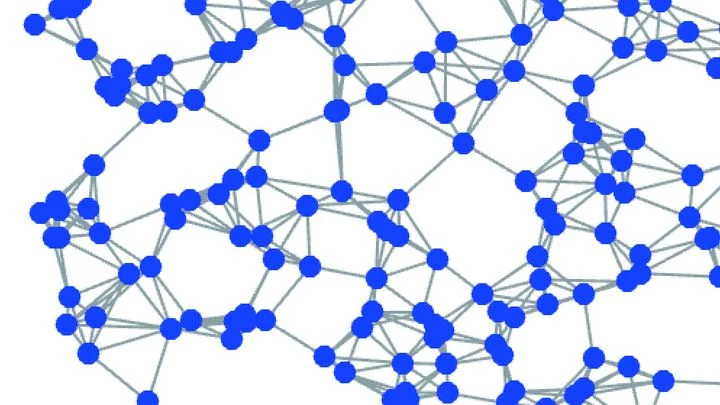
A dense social network: everyone is connected to almost everyone else, and in this web it's hard to see who really matters. Too many threads — computers choke, simulations stall. Scientists have figured out how to prune such networks without losing what's essential.
The idea is to remove connections that don't participate in shortest paths.
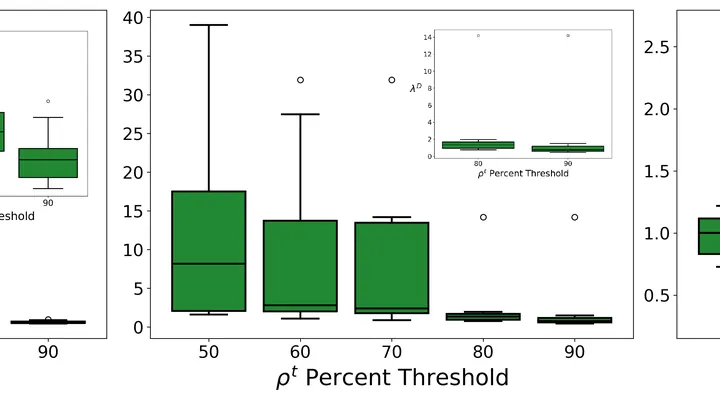
A magnetic film divided into tiny arrow-shaped cells behaves like a crowd in a square. While it's cold, all arrows point in the same direction — perfect order. Heat the film, and the arrows start darting around like pedestrians who have lost their purpose. Somewhere between these extremes, there is a moment when the system stops being uniform but hasn't yet dissolved into random noise.
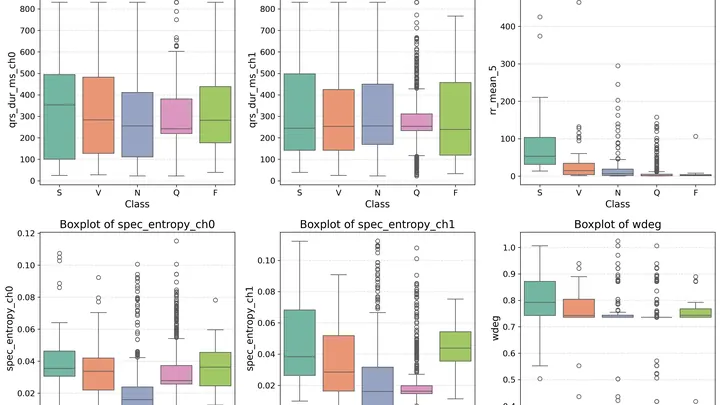
An electrocardiogram is like a musical score, where each note is a heartbeat. A doctor hears the melody and spots the off-notes — arrhythmia. But listening to the score for hours is tiring, so a smart monitor is placed by the patient's bedside.