A quantum snapshot is a reconstructed picture of a quantum state, built from many individual measurements. Unlike a classical photograph that captures a single moment, a quantum state cannot be observed directly without disturbing it. Instead, researchers perform repeated measurements on identically prepared systems, each yielding a partial piece of information, and then combine these pieces to infer the full quantum state. This process is known as quantum state tomography.
History
Quantum statetomography was introduced in the 1970s, with early theoretical work by Ulrich Fano and practical formulations by others in the 1980s. The term 'tomography' was borrowed from medical imaging, reflecting the idea of reconstructing a whole from many projections.
How it works
The reconstruction relies on measuring the system in different bases (e.g., position, momentum, or spin along various axes). Each measurement gives a probability distribution that constrains the possible state. By collecting enough statistics across complementary bases, one can solve for the density matrix—the mathematical object that fully describes the quantum state. The result is a 'snapshot' that captures both the amplitudes and phases of the state's components.
A quantum snapshot of a single photon's polarization requires measuring it in at least three different bases, but the photon is destroyed in the process, so the snapshot is always a statistical reconstruction, never a direct image.
A courtroom interpreter catches every word, every breath, every whisper in the corner. They have no right to miss a detail, because the meaning of the whole conversation depends on it. Quantum state tomography works in much the same way: it reconstructs the full quantum state of a system from a set of measurements, leaving no detail out.
Quantum systems made of many particles are the basis of future computers and secure networks. But the more particles there are, the harder it is to understand how they are arranged: the number of possible states grows like an avalanche. The usual approach, measuring everything, takes an incredibly long time.
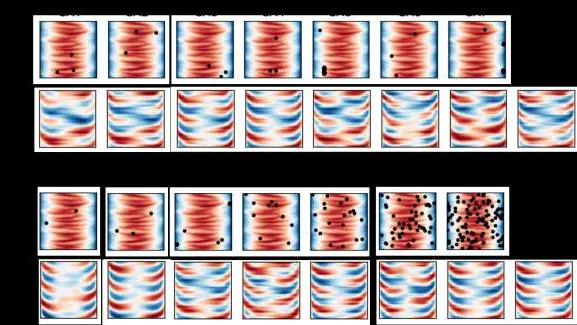
A handful of coins drops onto a table — heads and tails land wherever they please. The same goes for an instantaneous snapshot of a quantum chain: in some places a particle is present, in others it is not. But behind the disorder lurks a precise angle.
In this work, a chain of particles closed into a ring was considered. It was divided into four arcs: two were measured, two were left untouched.
Inside a fusion reactor, plasma rages — a gas heated to millions of degrees. There are no direct windows, and cameras and sensors quickly fail. Engineers see only fragments of information: a few sensors at scattered points. It's like trying to grasp a symphony from the sound of three microphones in a vast hall.
A glass chip, threaded with 128 optical waveguides, has been turned into a kind of quantum pinball machine. The role of balls is played by photons — quanta of light, and instead of mechanical flippers, microheaters control the routes, instantly altering the optical paths.
A drummer stays silent, but from the pauses you can tell where he didn’t hit. Similarly, physicists built an image by catching not light, but moments of absolute darkness. The picture emerged from silence.
In the experiment, they shone light from an ordinary lamp onto the object.
In quantum theory, a particle can run along two paths at once. When measured, we catch it on just one. According to Niels Bohr, all other possibilities vanish instantly — like a branch snapped off a trunk. Yet Hugh Everett insisted: the tree of reality grows all its branches at once, and we only see the one we’re on.
Creating light with an exact number of photons is like stamping exactly 100,000 flawless coins. Until now, physicists could only control dozens of particles. The 'optical lathe' technology breaks this barrier: virtual lenses, like milling cutters, eliminate 'blurriness' and ensure each bunch contains exactly the specified number of photons. Counting becomes perfect.
Light consists of portions — photons. Max Planck was the first to understand that light is emitted in quanta. Today, we can guide single photons. When such a photon encounters a fast shutter, it cannot be sliced — half a photon doesn't exist. Instead, a quantum mixture of states with different photon numbers emerges: zero, one, two, three..
Light passing through a birefringent crystal changes its polarization depending on wavelength. This profile is like a mosaic assembled from rare flashes, where each shard hints at the shape of its neighbors.