The Music of Neutron Stars with Exotic Interiors express
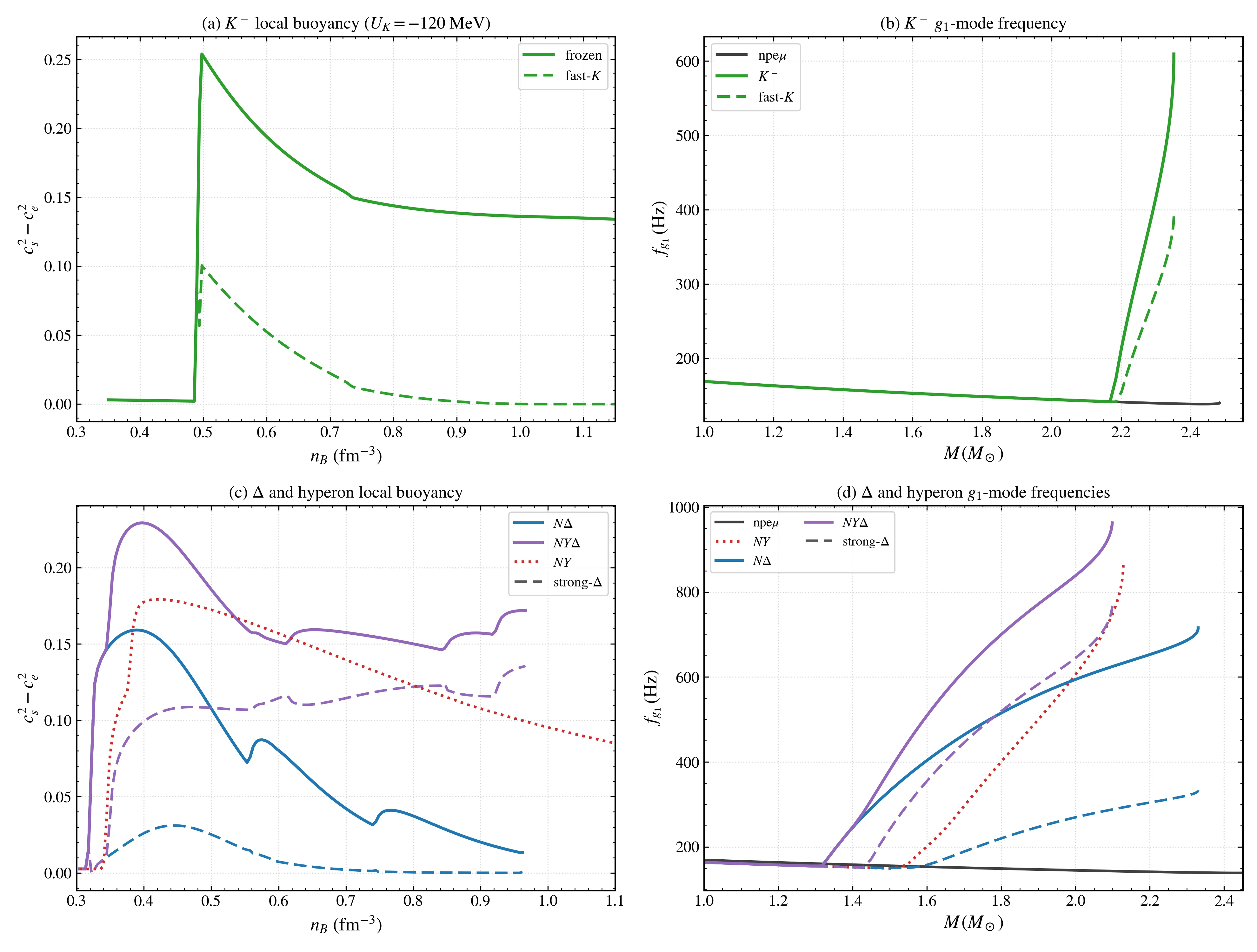
A neutron star is a boiling cauldron the size of a city but with the mass of one and a half Suns. Deep inside, matter is squeezed so hard that atomic nuclei lose their meaning. Strange forms of matter are born there: a kaon condensate (similar to a superfluid) and neutron stars with hyperons (heavy particles).
The authors took the BigApple equation of state and, for the first time in full general relativity, calculated how such a star oscillates. They tracked the g₁-mode — a special type of oscillation where the buoyancy of the star's layers plays the main role. It turned out that if kaons quickly convert from neutrons and protons, the star retains up to 44% of its buoyancy, and the oscillation frequency remains higher than that of a normal star. Meanwhile, the damping time grows by tens of times.
So the exotic interior changes the star's music, but hearing it will be tough. We need more sensitive detectors or luckier events.
A neutron star spins so fast that its 'day' can last milliseconds, while g₁-mode oscillations are slow internal waves with periods of fractions of a second.
In Robert Forward's novel Dragon's Egg, life is described on the surface of a neutron star, where gravity is billions of times stronger than Earth's, and nuclear reactions occur in fractions of a second.