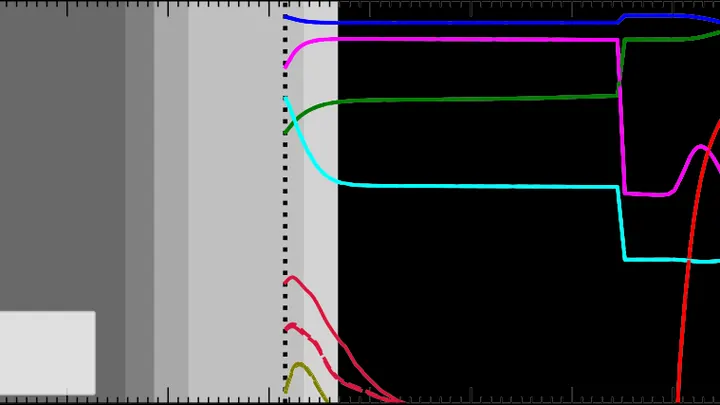
Accretion rate is the amount of matter falling onto a compact object — such as a neutron star, black hole, or white dwarf — per unit time. In the context of supernovae, it specifically refers to the rate at which the collapsed core (a proto-neutron star) accretes material from the infalling outer layers of the dying star. This rate is a critical parameter in determining the dynamics of the explosion: it influences the neutrino luminosity, the revival of the stalled shock wave, and the ultimate fate of the core — whether it becomes a neutron star or collapses further into a black hole.
History
The concept of accretion onto a collapsed core has been central to supernova theory since the 1960s, with key developments by Stirling Colgate, Richard White, and later by Hans Bethe and James Wilson in the 1980s, who emphasized the role of neutrino heating and accretion in the explosion mechanism.
How it works
During a core-collapse supernova, the inner core collapses to nuclear densities and bounces, sending a shock wave outward. The shock stalls due to energy losses from neutrino emission and photodisintegration of heavy nuclei. The accretion rate onto the proto-neutron star determines how much fresh material continues to fall through the shock, providing energy and neutrinos that can re-energize the shock. If the accretion rate is high, the shock may be revived, leading to a successful explosion; if it drops too low, the shock remains stalled and the core may collapse into a black hole.
In practice
Accretion rate is a key input in numerical simulations of supernovae and in models of X-ray binaries and active galactic nuclei, where it determines the observed luminosity and spectral properties.
Fun fact
In the first second after a supernova core collapse, the accretion rate can exceed one solar mass per second — a rate that would consume the entire Earth in about 20 minutes.
Units by system: SI: kgs · CGS: gs · Planck: m planckt planck · natural: gev2
A little monster hides in a dwarf galaxy, and its neighbor feeds it. The satellite galaxy is slowly merging with a massive companion, and gas from the outer regions falls toward the center, where a black hole sits. By cosmic standards, it is not large: only 800 to 5000 solar masses, but its appetite is ferocious.
A sculptor shapes mountains from magnetic fields and heat, but the stone resists. A neutron star, the ultra-dense remnant of a supernova explosion, in a binary system pulls matter from its companion star. This infalling matter heats the star's crust unevenly, while the magnetic field tugs from within.
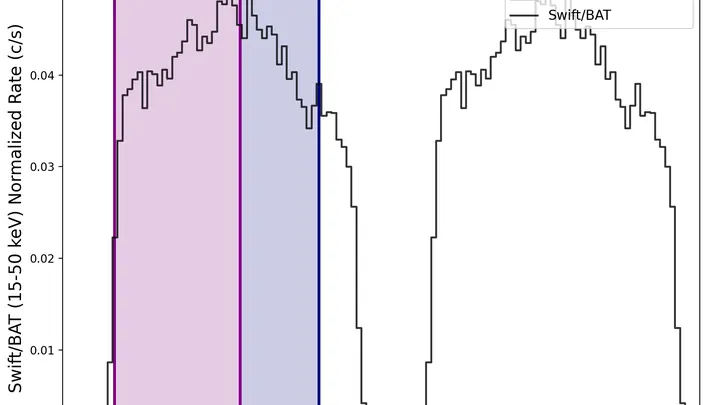
The light of a distant lighthouse does not go out all at once: first it flares brightly, then slowly fades into darkness. That is how the X-ray pulsar 4U 0115+63 behaves — a neutron star that periodically brightens when gas from a companion ordinary star falls onto it.
A whirlpool gulps down water, but splashes most of it back out. That's roughly how a black hole behaves when too much matter falls onto it. In a new study, astrophysicists ran 32 computer simulations to understand how a black hole's parameters — mass, spin, and "appetite"—control these cosmic fountains.
A supernova explosion blasts off the outer layers of a dying star. What remains is the core — a neutron star, packed into a sphere the size of a city. The existence of such stars was predicted back in 1934 by Fritz Zwicky.
The collapse of a star's core is like compressing a spring: matter falls inward, and a neutron star is born at the center. But the fall is never perfectly smooth. In the boiling outer layers, random eddies transfer angular momentum to the infalling gas, and a disk swirls around the central object.
This disk is no calm river. It pulses, strengthening and fading.
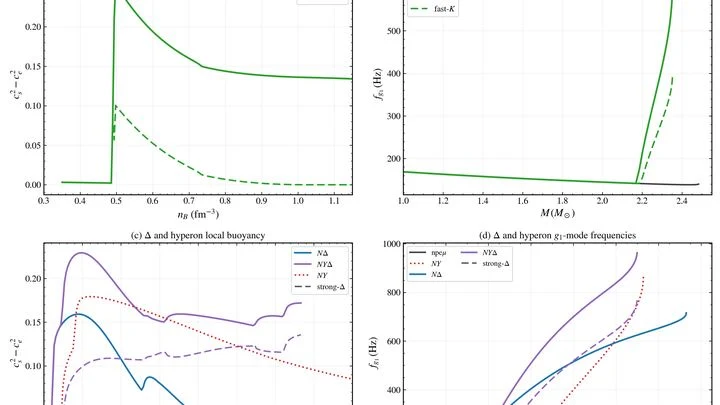
A neutron star is a boiling cauldron the size of a city but with the mass of one and a half Suns. Deep inside, matter is squeezed so hard that atomic nuclei lose their meaning. Strange forms of matter are born there: a kaon condensate (similar to a superfluid) and neutron stars with hyperons (heavy particles).
The early universe at redshift z>7 was an arena of rampant growth: black holes with masses up to a billion solar masses already blazed as quasars, devouring gas at monstrous rates. How these giants managed to grow in such a short time is one of astrophysics' sharpest puzzles.
Think of a merry-go-round: it's easier to spin a light one, harder to spin a heavy one. Neutron stars, the ultra-dense remnants of exploded stars, behave in a similar way. Astronomers looked at fifty binary systems where one neutron star orbits another and noticed: the heavier the star, the longer its spin period. The link isn't strict, but it's statistically noticeable.
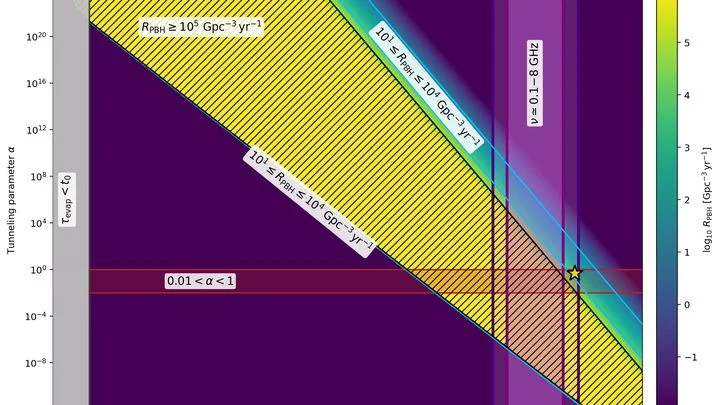
In the first moments after the Big Bang, the universe was filled with a hot, nearly uniform plasma. But in some places, the density could randomly be slightly higher. If such a clump gained critical mass, it collapsed into a black hole: this is how primordial black holes were born.
A giant baby planet is still pulling in leftover building material from its surrounding cloud. That's the scene the Hubble Space Telescope captured when it aimed its cameras at an object catalogued as SR 12 c. This companion planet orbits a young star at a wide distance — farther out than Neptune is from the Sun.
Somewhere in the galactic bulge, a massive star lies dormant, ready to trade quiet burning for collapse. Its core will exhaust its fuel, and in a fraction of a second, a neutron star or black hole will be born, releasing 10⁵⁸ neutrinos — almost all the energy of the explosion.
Imagine an interpreter at a crucial negotiation suddenly switching to another language, and the meaning of everything changes. That's roughly what neutrinos do in the depths of a dying star. These invisible particles are born in enormous numbers when a star's core compresses into a city-sized lump. But on their way out, neutrinos can change their type — physicists call this flavor transformation.
Gravitational waves — ripples in spacetime predicted by Einstein — have exposed an abyss: black holes with masses between 60 and 120 solar masses are almost never born.
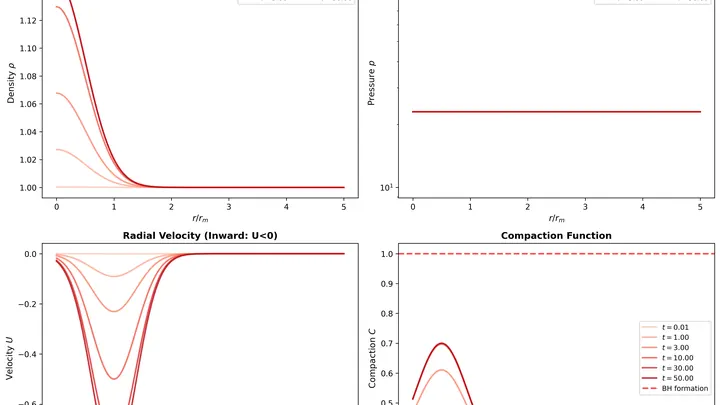
Stars tens of times heavier than our Sun don't die as thought before. Computer models show that their core often doesn't ignite a supernova, but quickly collapses into a black hole. Imagine a soufflé: the center suddenly sinks, and almost all the batter falls into the funnel, with just a few drops splashing out.
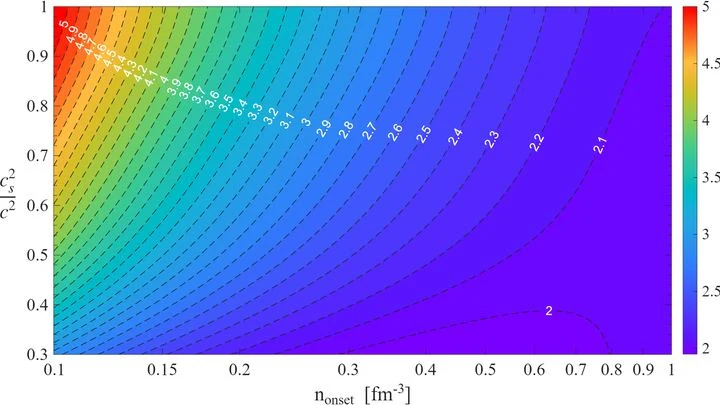
The density at the center of a neutron star is so extreme that a teaspoon of its material would weigh as much as a mountain. Physicists have long tried to figure out how massive such a star can get before it collapses into a black hole.
A neutron star is the dead core of a star that once exploded, compressed to the size of a city. If a normal star is nearby, the neutron star siphons matter from it like a vacuum cleaner. This matter falls onto the surface and forms a crust — a solid layer of neutron-rich atomic nuclei.
The mystery of how black holes grew so fast in the early Universe might be solved by quasi-stars. These are giant gas cocoons with a black hole tucked inside. Matter falling into the hole heats up and blasts out so much light that it prevents the cocoon from collapsing. Such an object weighs thousands of Suns and outshines an entire galaxy.
Some black holes are remnants from the Big Bang. Usually they fade via a slow radiation leak — predicted by Stephen Hawking. But a quantum switch could invert them into white holes, explosively releasing all energy like popcorn kernels that suddenly pop.
In its youth, Earth resembled a beehive: it grew by sticking together from countless rocky chunks. When the main construction was over, a late swarm of meteorites rained down on the young planet — the so-called late veneer. These impacts, scientists thought, brought platinum, gold, and other rare metals to Earth's upper layers.
Two dim stars whirl so close together that one siphons material off the other, like a spoon delicately skimming foam from broth. Astronomers have for the first time calculated the fate of such pairs — ultracool and brown dwarfs, the coldest and dimmest inhabitants of the galaxy. Previously, it was thought that mass exchange between them was impossible: they were too fragile.
Neutrinos are tiny particles that barely interact with matter. They pass straight through a star like bullets through fog. When a massive star is gearing up to explode, its core contracts, temperatures soar, and neutrinos start streaming out.
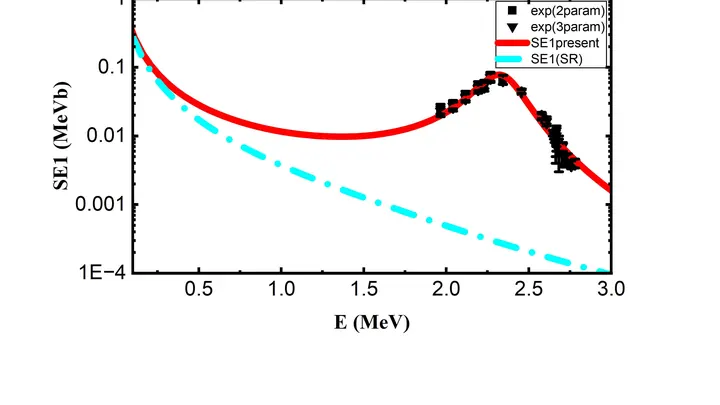
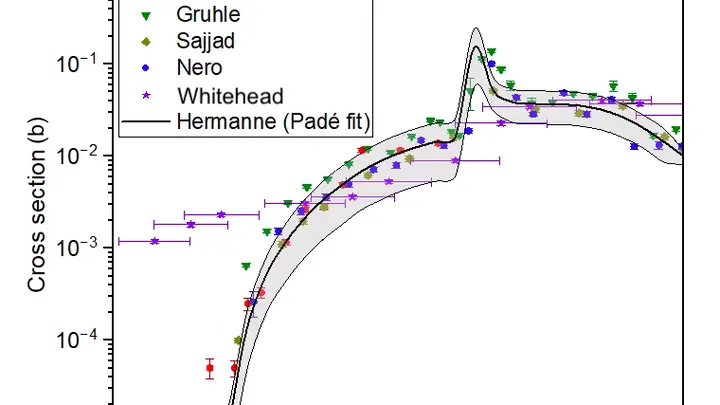
Deep inside a dying star, just before it goes supernova, nuclear reactions determine which chemical elements will be scattered across the cosmos. One such reaction is the collision of an oxygen nucleus with a proton, producing a nitrogen nucleus and an alpha particle (a helium nucleus).
At the Large Hadron Collider, protons are smashed into lead nuclei. At the moment of impact, hundreds of new particles are born, and some of them fly out in narrow beams — jets. Inside such a jet, like in a dense stream, protons and neutrons can stick together to form larger nuclei, for example a deuteron — the nucleus of heavy hydrogen.
On a deserted road at night, a streetlight flickers rarely but at full power. That's how WZ Sge-type stars behave: they smolder barely noticeably for years, then suddenly flare hundreds of times brighter. Astronomers decided to check what happens in their gas disks during quiescence, and found almost emptiness.
The Large Hadron Collider doesn't just smash protons: it also collides entire atomic nuclei. When two nuclei smash together at tremendous speed, they create a tiny blob of matter so hot that protons and neutrons melt into a 'soup' of quarks and gluons.
Long before that, Fritz Zwicky predicted that a supernova explosion gives birth to a tiny neutron star. Years later, Jocelyn Bell Burnell caught its pulses, discovering pulsars.
Black holes are cosmic drains, gravitational funnels that pull in matter from their surroundings. This process, called accretion, doesn't always go smoothly: some of the infalling gas can be ejected back as narrow relativistic jets — jets.
In the binary system 4U 1700-37, the massive supergiant star HD 153919 sheds a powerful stellar wind. This wind, like an invisible stream, rushes toward its compact companion — likely a neutron star. As it falls, the matter heats to millions of degrees and flares in X-rays.
In the dark clouds of interstellar gas where stars are born, matter gathers into dense knots — future cradles of stars. Astronomers measure distances between these knots from sky photographs, but a photograph is flat while the cloud is volumetric. Converting from plane to volume is not as simple as it seems.
Light from a distant source passing near a neutron star bends like a flashlight beam in a funhouse mirror. Astrophysicists ran a numerical experiment: they traced rays backward from the observer to the star and looked at what picture a telescope would see.
Aluminum-26 is an isotope that doesn't live long by cosmic standards: only about a million years. When a massive star explodes as a supernova, it flings this aluminum into space. Later, it decays, emitting gamma rays that telescopes can catch.
The authors recalculated how much aluminum-26 a star with 20 solar masses should eject.
In the 2010s, astronomers noticed something remarkable: supermassive black holes at the centers of galaxies, despite vast differences in size and brightness, fall onto a single straight line when you plot their millimeter emission against X-ray emission and mass.
Just as in a crowded room each new person sharply increases the pressure on the walls, in a neutron star increasing density leads to a rise in internal resistance. But even this resistance has an absolute ceiling.
The ATIC balloon rose over Antarctica and caught particles older than Earth itself. Among them are atomic nuclei from sulfur to chromium, and the higher their energy, the larger their fraction compared to iron. The standard 'leaky box' model predicted the opposite: heavy nuclei should dissolve like salt in water. But the data stubbornly rose.