Hyperons are a family of baryons (particles made of three quarks) that contain at least one strange quark, making them heavier than protons and neutrons. They are produced in high-energy collisions and exist only fleetingly before decaying via the weak force. Hyperons play a crucial role in astrophysics: inside neutron stars, extreme densities may force protons and neutrons to convert into hyperons, softening the equation of state and affecting the star's maximum mass.
History
The first hyperon, the Lambda baryon, was discovered in 1947 by Rochester and Butler in cosmic ray cloud chamber photographs, leading to the concept of strangeness.
How it works
Hyperons are bound states of three quarks, with the strange quark replacing one of the up or down quarks found in ordinary nucleons. The strange quark's larger mass raises the hyperon's rest energy. They are created when sufficient energy is available to produce strange quark-antiquark pairs, and they decay through weak interactions, which is why they live relatively long (about 10^-10 seconds) compared to strongly decaying particles.
In practice
Hyperon physics is used to test quantum chromodynamics (QCD), study CP violation in particle physics, and model the interior of neutron stars.
Fun fact
The presence of hyperons in neutron stars could make them more compressible, potentially explaining why some observed neutron stars are less massive than theoretical predictions without hyperons.
Stated relations:part of →quark · case of →fermion
The map of dense nuclear matter resembles a road map: lines of phase transitions cross at critical points, like highways at intersections. Until now, only two intersections were known on such a map: the nuclear liquid-gas and deconfinement, where hadrons dissolve into quarks.
A neutron star is what remains after a massive star explodes. Its matter is compressed so tightly that a teaspoonful would weigh billions of tons. Under such conditions, protons and neutrons can rearrange, and new particles (hyperons, similar to neutrons but containing a 'strange' quark) can appear.
A neutron star is the remnant of an exploded star, compressed so tightly that a teaspoon of its material would weigh as much as a mountain. Inside such an object, protons and neutrons are packed tightly together, and under enormous pressure, hyperons, particles containing a strange quark, can appear.
Three billiard balls scatter across the table after a strike: their trajectories depend only on the initial push. But in the world of atomic nuclei, things are more complex: particles sense each other on the fly, even if they are not bound together. For a long time, physicists could only measure pairwise interactions, while what happens when three meet remained behind the scenes.
In the distant Cigar Galaxy, there is an unusual beacon. It doesn't shine in the usual sense: its rays are born in a scorching cloud around a black hole that is devouring matter from a companion star. Such objects are called ultraluminous X-ray sources. Their X-ray brilliance is so intense that it outshines entire galaxies.
This cloud, the corona, is like a boiling cauldron.
Some 123 parsecs from Earth, in the constellation Corona Australis, drifts the neutron star RX J1856.5-3754. Its diameter is about 12 kilometers, smaller than Moscow's Ring Road, but its surface temperature reaches 460 000 kelvin. The star emits a slow, almost inaudible exhalation.
A neutron star is a boiling cauldron the size of a city but with the mass of one and a half Suns. Deep inside, matter is squeezed so hard that atomic nuclei lose their meaning. Strange forms of matter are born there: a kaon condensate (similar to a superfluid) and neutron stars with hyperons (heavy particles).
A handful of sand in your fist: the grains press against each other, and your hand can't squeeze any further. Ordinary matter behaves similarly. But in a neutron star, compression is billions of times stronger — atoms are crushed, electrons are squeezed into protons, and nearly all space is filled with neutrons.
A billiard ball clicks against another in complete darkness. The sound of the impact and the clatter of balls dropping into pockets: that's all you hear. This is roughly how physicists study the interactions of elementary particles at energies that no terrestrial accelerator can reproduce.
In June 2024, the CHIME radio telescope recorded over 700 radio bursts per hour from source FRB 20240114A. Such a hyperactive repeater releases in one hour nearly all the magnetic energy of a typical magnetar (a neutron star with an ultra-strong field).
Deep inside a neutron star, matter is squeezed so tightly that familiar protons and neutrons give way to new players. Hyperons are born there — particles that harbor a strange quark.
The interiors of neutron stars are a realm of degenerate matter. Here, protons condense into a superconducting condensate, threaded by quantum vortices. Imagine tiny magnetic tops: each carries a quantum of magnetic flux and glides through the electron fluid.
For a long time, astronomers searched for the 'factories' of the most energetic cosmic rays — particles that carry the macrocosm compressed to the size of an atomic nucleus. Colossal star-forming regions like Cygnus OB2, where winds from young giants collide, were prime suspects.
A neutron star is a city squeezed to the size of a metropolis, where matter is packed to the limit. At the very center of such a city, a redevelopment may begin: familiar neutrons and protons give way to quark plasma — free quarks, the building blocks of almost everything around us.
A neutron star is a gravitational lens that focuses our attempts to glimpse dark matter. Through its ultra-dense matter, like exotic glass, we search for the axion — an elusive particle that could explain the hidden mass of the universe.
The Universe is a genius chef, and the Big Bang is its perfect recipe. Hydrogen rose fluffy, helium melted tender, but lithium-7 seems oversalted: theory predicts three times more than astronomers find in the oldest stars. This imbalance, the 'lithium problem,' has spoiled cosmologists' appetite for decades.
Inside a neutron star, matter is squeezed so hard that atomic nuclei stop being separate clumps. Neutrons and protons get closer together, and their innards, quarks, begin to feel their neighbors through the walls of their 'bags'.
A neutron star is a sphere about the size of a small city but with a mass of one and a half Suns.
Inside the proton, life is boiling. Quarks don't just sit there: they're glued together by carrier particles called gluons (from the word glue). Usually, this glue is spread evenly, like butter on a skillet. But when energies become enormous, gluons start clumping together. This is the gluon condensate — an ultra-dense state of the gluon field.
In the first moments after the Big Bang, matter and antimatter should have been created in equal amounts. But today we see only matter — stars, planets, ourselves. Where did the antimatter go? One clue hides in nearly elusive particles: right-handed neutrinos. The usual story is that their decays create a slight bias in favor of matter.
For a long time, a void yawned in the family of ultra-dense remnants of dead stars. Neutron stars, swift city-sized tops, rarely weigh more than two Suns. Black holes start at about five solar masses. Between them lies a 'gap' where for decades no object could be found.
A handful of sand weighing as much as a small mountain: that's roughly what strangelets are like: tiny clumps of 'strange' quark matter where particles are squeezed to unimaginable densities. In a new study, astrophysicists tested whether such objects could exist in nature and what they would look like.
A drop of cream in a glass of milk. Shake it, and the fat doesn't spread evenly: it clumps into denser blobs that move differently from the rest of the liquid. Quarks inside mesons, tiny particles that live for mere fractions of a second, behave in much the same way.
A meson consists of a quark and an antiquark, and they are rarely equals.
A light bulb that doesn't burn out but flares brighter and brighter until it blows the whole fixture apart. That's roughly how the most massive stars in the universe die. When a star's core heats up to billions of degrees, pairs of particles (electrons and their antimatter counterparts, positrons) begin to form.
Ordinary matter consists of atoms, and atoms are made of nuclei and electrons. But in a neutron star, gravity compresses matter so strongly that electrons are squeezed into protons, and almost everything turns into a dense packing of neutrons. It's like one giant atomic nucleus the size of a city.
Inside a neutron star, the density doesn't change smoothly but drops abruptly at sharp cliffs — density staircases. At these steps, the void suddenly births pairs: neutrinos and antineutrinos.
Heavy particles, which physicists call baryons, are like tiny families of three quarks. The common baryons are protons and neutrons, which make up everything around us. But there are also exotic relatives: instead of light quarks, they harbor charm or bottom quarks — heavy and short-lived.
If an atomic nucleus is a family, then in an ordinary helium house live two protons and two neutrons, holding hands tightly. Now imagine that one family member is an oddball who loves to wander far from home.
In proton collisions at the Large Hadron Collider, physicists have for the first time caught a particle with two charm quarks. It is called Ξcc+ (pronounced "ksi-ksi-plus") and resembles a bead with not one but two heavy nuclei.
In the binary system Cygnus X-3, right here in our Galaxy, a black hole and a giant star whirl so tightly together that the star loses matter: it's swept away by a powerful wind. Jets blast out from near the black hole; recently, a telescope caught photons from them, each carrying the energy of a flying mosquito.
In the first instants after the big bang, the universe was a quantum vacuum where pairs of particles and antiparticles, virtual "guests" from physical nothingness, spontaneously appeared and almost immediately annihilated.
The proton is not a solid ball. Its charge, mass, and other properties are distributed differently in space, and each property has its own radius. Physicists have long been able to measure where the proton's charge is concentrated and where its mass lies.
In 2019, gravitational-wave detectors caught a signal from the merger of distant objects. One was a black hole of 23 solar masses. The other weighed just 2.5 solar masses — and that's weird.
Usually, neutron stars don't get heavier than two solar masses: beyond that, they collapse into a black hole.
Somewhere above our heads, every second, a proton accelerated to energies millions of times greater than those at the Large Hadron Collider slams into the atmosphere. It strikes an air molecule, and a cascade is born — a wide atmospheric shower of thousands of particles.
Saturn's system 300 million years ago resembled a crowded dance floor. The most massive moon, Titan, began to migrate, and this movement threw its neighbors off balance. One moon crashed into Titan; the debris swirled into a vortex, gathering into Hyperion.
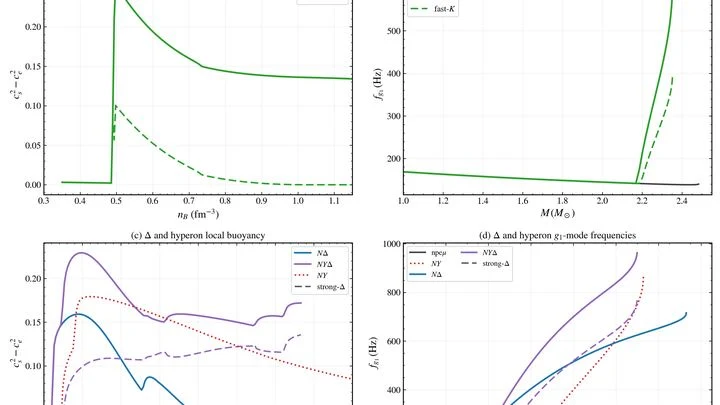
At the heart of a neutron star, matter is squeezed so tightly that protons and neutrons transform into heavier particles — hyperons. These particles resemble neutrons but contain a strange quark. For a long time, physicists couldn't understand how a star with hyperons inside could be as heavy as observations show.
A multitude of atoms can act like a synchronized orchestra: if each emits light in unison with the rest, the flash becomes many times brighter. This is superradiance — a phenomenon well studied in the lab, but almost never sought in space. Now astrophysicists suspect that such collective 'notes' also play out in interstellar space.
Inside a neutron star, matter is squeezed so tightly that a single teaspoon weighs as much as a mountain. Under such pressure, ordinary particles, protons and neutrons, can transform into exotic particles known as hyperons. These particles resemble neutrons but contain strange quarks.
Supermassive black holes at the centers of galaxies appeared so quickly after the Big Bang that astronomers are scratching their heads. The solution lies in the trembling of an invisible axion field.