A main sequencestar is a star that is currently fusing hydrogen into helium in its core. This is the longest and most stable phase in a star's life, lasting from millions to trillions of years depending on the star's mass. During this time, the star's internal pressure from fusion balances the inward pull of gravity, keeping it in a state of equilibrium. The vast majority of stars in the universe, including our Sun, are on the main sequence.
History
The concept was developed in the early 20th century, with key contributions from Ejnar Hertzsprung and Henry Norris Russell, who independently created the Hertzsprung–Russell diagram in the 1910s. The physical explanation of the main sequence as a hydrogen-burning phase was established later, notably by Arthur Eddington and others in the 1920s and 1930s.
How it works
The star's core reaches temperatures and pressures high enough for nuclear fusion to occur. Hydrogen nuclei (protons) combine through a series of reactions to form helium, releasing enormous amounts of energy in the process. This energy radiates outward, creating an outward pressure that counteracts the gravitational collapse. The star remains on the main sequence until it exhausts the hydrogen in its core, at which point it evolves into a red giant or another later-stage object.
The Sun has been on the main sequence for about 4.6 billion years and will remain there for roughly another 5 billion years before becoming a red giant.
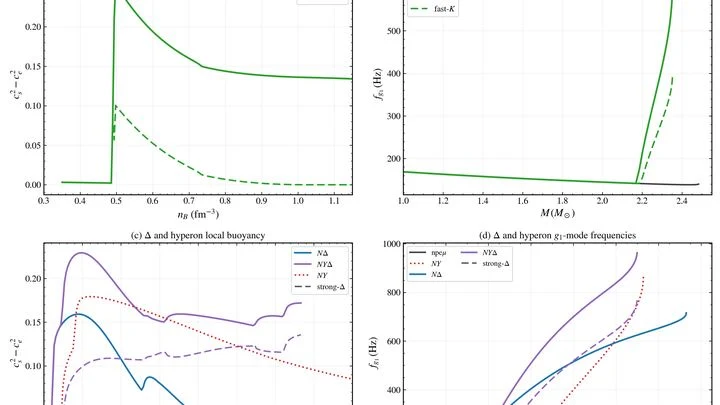
A neutron star is a boiling cauldron the size of a city but with the mass of one and a half Suns. Deep inside, matter is squeezed so hard that atomic nuclei lose their meaning. Strange forms of matter are born there: a kaon condensate (similar to a superfluid) and neutron stars with hyperons (heavy particles).
A neutron star is a city squeezed to the size of a metropolis, where matter is packed to the limit. At the very center of such a city, a redevelopment may begin: familiar neutrons and protons give way to quark plasma — free quarks, the building blocks of almost everything around us.
The stellar halo of the Milky Way is a galactic palimpsest: an ancient manuscript where earlier layers lie hidden beneath the visible text. For a long time, the Gaia-Sausage-Enceladus (GSE) structure was thought to be the final entry in this manuscript, the scar of a single catastrophic merger.
In an orchestra, each musician plays their own part, but at a certain moment all instruments pause on a single note. Cosmic rays behave somewhat like this — particles flying toward us from distant stars.
About 11 billion years ago, the Milky Way suffered a head-on collision. Not with an asteroid, but with an entire smaller galaxy. It slammed into ours and was torn apart like a puff of flour hit by a fist. Astronomers call this cosmic scar Gaia-Sausage-Enceladus (after the shape of the orbits of its remaining stars).
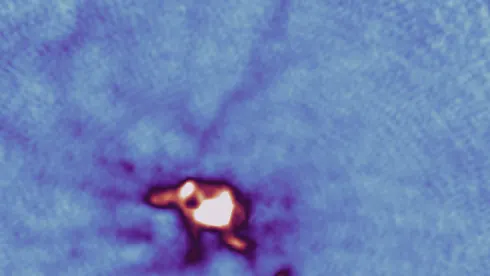
In the dark cloud G318.049+00.086, where no star has yet formed, dust and gas have arranged themselves into four long filaments. They converge into a dense central hub, like four rivers emptying into a lake. Gas flows along these filaments toward the center: the flow speed reaches 10–20 kilometers per second per parsec of length.