The sound horizon is the maximum distance that sound waves could travel in the primordial plasma before the universe cooled enough for matter and radiation to decouple. This scale, about 150 megaparsecs today, is imprinted in the distribution of galaxies as a preferred separation — the baryon acoustic oscillations (BAO). It serves as a standard ruler for measuring cosmic distances, allowing astronomers to map the expansion history of the universe and probe dark energy.
History
The concept of baryon acoustic oscillations was developed in the 1990s, with the sound horizon scale predicted from cosmic microwave background measurements. The first detections in galaxy surveys came in 2005 from the Sloan Digital Sky Survey and the Two-Degree Field Galaxy Redshift Survey.
How it works
In the early universe, photons and baryons were tightly coupled, forming a fluid that supported sound waves. Dark matter, however, did not interact with this fluid. The waves propagated outward from overdense regions until recombination, when photons decoupled and the waves froze. The resulting shell of baryons around the original density peak left a characteristic scale in the matter distribution, visible today as a slight excess of galaxies at a fixed separation.
In practice
BAO measurements are a key probe in dark energy surveys like DESI and Euclid, helping to constrain the equation of state of dark energy and the curvature of the universe.
Two transparent sheets with circles drawn on them. If you stack them exactly, the circles align. But give one sheet a slight twist, and a new pattern emerges: in some places the circles bunch together, in others they spread apart. That's roughly how moiré works — an unexpected pattern born from rotating two periodic structures.
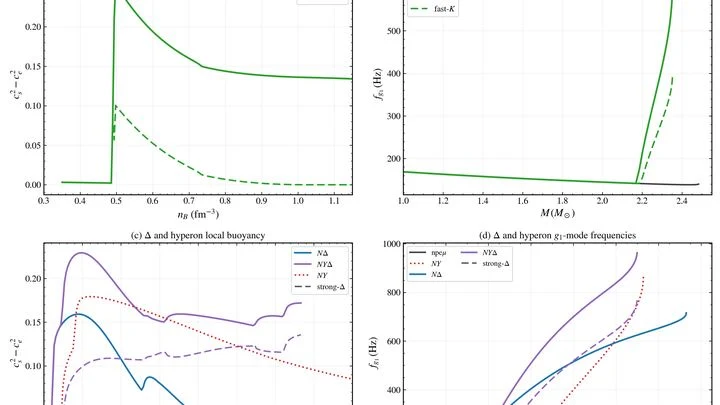
A neutron star is a boiling cauldron the size of a city but with the mass of one and a half Suns. Deep inside, matter is squeezed so hard that atomic nuclei lose their meaning. Strange forms of matter are born there: a kaon condensate (similar to a superfluid) and neutron stars with hyperons (heavy particles).
The universe is permeated by invisible mass, dark matter, whose existence was first proposed by Fritz Zwicky in the 1930s, based on his observations of galaxies moving in clusters.
Two rulers show slightly different lengths for the same table. That's roughly the situation in cosmology with the Hubble constant — the number that tells how fast the universe is expanding.
Strike a diamond and it rings, but sound lives inside it even without a strike. Waves of compression and rarefaction constantly ripple through it, like the ripples a stone makes on water. Except this ripple is the thermal jitter of the atoms themselves, and it can be detected with a laser.
The Universe is structured like a sponge: there are dense regions packed with galaxies and gas, and giant pores — cosmic voids. These voids occupy most of space, but their contents have remained a mystery because matter there barely reveals itself.
Now astronomers have 'felt' the voids using fast radio bursts — super-powerful pulses from distant galaxies.
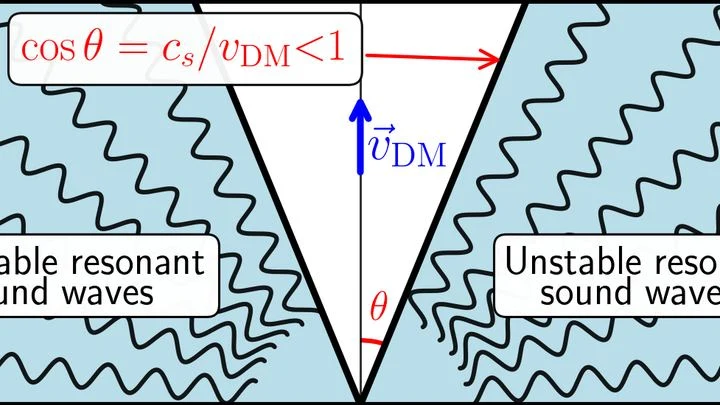
After the Big Bang, dark matter and ordinary matter (mostly hydrogen) went their separate ways in terms of speed. Their gravitational pull acts like a bow gliding across a string: when frequencies match, resonance occurs, and sound waves start to rapidly grow in ordinary matter.
The universe wasn't born in silence. Primordial gravitational waves — ripples in spacetime — still carry the echo of that event. Scientists try to hear it in two ways. Low 'notes' are captured in the Big Bang's afterglow — light emitted 380,000 years later.
A pebble dropped in a pond creates curved ripples, but from far away they appear as straight lines. Gamma-ray flashes from an evaporating black hole behave the same: a distant burst sends flat waves, while a nearby one arrives curved.
At the heart of the Milky Way spins a stellar bar — an elongated cluster, like a rotating paddle. Its gravity creates a rhythmic field around it, like waves from a speedboat.
The universe is expanding, and galaxies are flying apart like raisins in rising dough. The rate of this expansion, the Hubble constant, is a key number in cosmology.
The early universe was a hot soup of particles and light. In this soup, sound waves, fluctuations in density, spread outward from clumps of matter like ripples on a pond. When the universe cooled, these waves froze, leaving an imprint in the distribution of galaxies: they are slightly more abundant at a certain distance from each other.