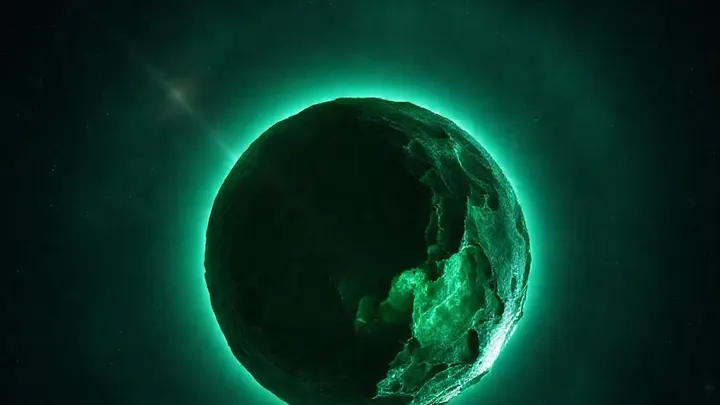
Neutron star composition is the study of what lies inside the densest observable objects in the universe. A neutron star packs more mass than the Sun into a sphere about 20 kilometers across, and its interior is a state of matter found nowhere else: a soup of neutrons, protons, and possibly exotic particles like hyperons or even dark matter. The 'skin' of a neutron star—its outer crust and envelope—plays a crucial role in how the star cools and emits light, and measuring this skin thickness can reveal the properties of the matter beneath.
History
Neutron stars were first proposed by Walter Baade and Fritz Zwicky in 1934, and the first confirmed discovery came in 1967 with the detection of pulsars by Jocelyn Bell Burnell. The idea of using neutron star skin thickness to probe dark matter gained traction in the 2010s with improved X-ray observations.
How it works
Neutron stars are born in supernova explosions, where gravity crushes electrons into protons to form neutrons. The balance between gravity and the quantum pressure of neutrons (degeneracy pressure) sets the star's size. The skin thickness is determined by the equation of state—the relationship between pressure and density—of nuclear matter. If dark matter accumulates in the star, it can alter this balance, changing the skin thickness and the star's cooling rate, which astronomers can observe through X-ray and radio telescopes.
In practice
This research helps astrophysicists interpret data from missions like NICER (Neutron star Interior Composition Explorer), which measures neutron star radii and masses to constrain the equation of state.
Fun fact
A teaspoon of neutron star material would weigh about a billion tons on Earth, yet the star's surface gravity is so strong that light is noticeably bent around it.
Beyond Neptune's orbit lies an ocean of icy islands that has remained nearly unchanged for four billion years. These islands, known as trans-Neptunian objects, hold the recipe for planet formation. Until recently, astronomers could only see the large ones, while the small, city-sized ones stayed invisible.
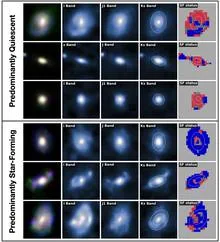
A ground-based image of a distant galaxy looks like a view through frosted glass: the atmosphere smears details, hiding the internal structure. Astronomers have long wanted to know where exactly star formation shuts off in galaxies, but ground-based telescopes could not resolve the subtle color gradients.
A light ray passing near a massive body bends around it, like a runner rounding the corner of a stadium. For a neutron star, this deflection angle is usually assumed to be the same as for a point mass. But if the star is wrapped in an invisible halo of dark matter, the picture changes: light passing through the halo is deflected less than the total mass would predict.
An interpreter gets distracted by every rustle in the hall, and a one-hour meeting stretches into two. A neutron star compresses a solar mass into a sphere the size of a city, and the matter in its core is denser than an atomic nucleus. Physicists cannot probe its structure in the lab: the required pressures are unattainable.
A neutron star is the ultra-dense remnant of a supernova: the mass of the Sun packed into a sphere the size of a city. For billions of years, it travels through space, gathering around itself invisible matter, dark matter, which emits no light but pulls with gravity.
High in the mountains, where the air is clear and still, physicists are preparing to catch elusive visitors from space — neutrinos. These particles, like ghosts, pass straight through the Earth, leaving almost no trace. But occasionally a neutrino does slam into an atom, producing a shower of particles that can be seen.
One hundred forty parsecs, a distance light traverses in four and a half centuries, separate us from the Taurus molecular cloud. Within its depths hide dark condensations: prestellar cores, where gas and dust slowly contract under their own weight.
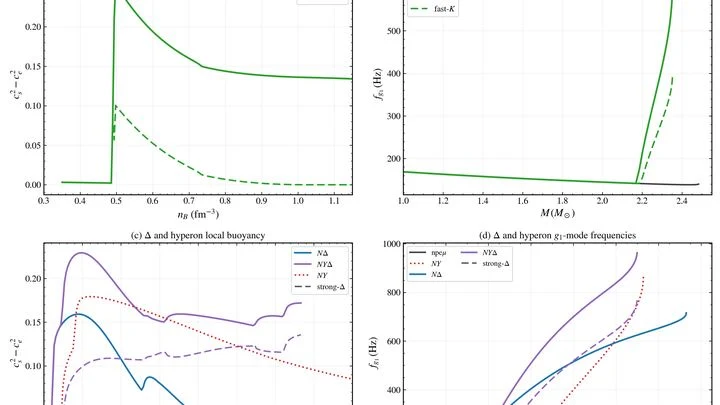
A neutron star is a boiling cauldron the size of a city but with the mass of one and a half Suns. Deep inside, matter is squeezed so hard that atomic nuclei lose their meaning. Strange forms of matter are born there: a kaon condensate (similar to a superfluid) and neutron stars with hyperons (heavy particles).
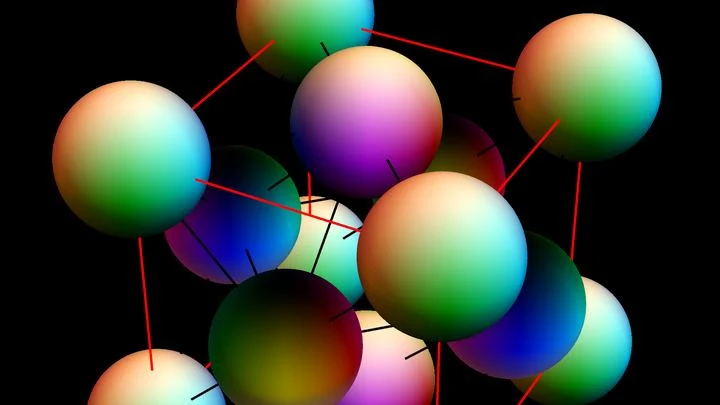
Water in a glass looks continuous, but it's made of molecules. Similarly, physicists have long described the matter inside a neutron star as a uniform soup of protons and neutrons. But real neutron stars are not soup. They are a dense crowd of particles where each neutron feels its neighbors.
The authors of the new work abandoned the uniform picture.
A heaping teaspoon, and the scale reads a billion tons. That's roughly what a teaspoon of neutron star matter would weigh if you could scoop it up and put it on a scale. Such objects are born after a supernova explosion: the star's core collapses into a sphere the size of a city, and the density exceeds that of an atomic nucleus.
A teaspoon of neutron star matter weighs as much as a mountain. But this mountain may have an invisible twin.
Deep inside a neutron star, ordinary matter is compressed to unimaginable densities. There, protons and neutrons can dissolve into a quark soup.
The atmosphere of Titan, discovered by Christiaan Huygens, is opaque to ordinary telescopes. But spectral analysis finds 'windows' of transparency — narrow regions where the haze parts.
Beyond Neptune, in the icy belt, astronomers watched as object (612533) 2002 XV93 momentarily occulted a distant star. Using метод прохождений (when a planet dims the star's light for a second, like a fly in front of a lamp), Уильям Боруки and Дэвид Шарбонно determined: the light not only dimmed but also shifted…
An atomic nucleus is like a droplet with a thin coating — a neutron 'skin.' Inside the droplet, protons and neutrons are mixed evenly, but on the outside, like the froth on milk, a layer forms where neutrons are noticeably more abundant.
The outer crust of a neutron star is like a layered cake, where each layer is a strictly defined filling. It's a crystalline lattice of atomic nuclei immersed in a sea of electrons. The deeper you go, the stronger the pressure, and the heavier the nuclei that can exist there without falling apart.
In the kitchen, there's a bucket of water and an identical bucket of sand. Pour the sand into the water, and you get a mixture where there's exactly five times more sand than water. That's roughly how our universe is arranged: one part ordinary matter — the stuff stars, planets, and we ourselves are made of — and five parts elusive dark matter.
A neutron star is the remnant of an exploded star, compressed to the size of a city. On its surface, a thermonuclear fire sometimes erupts: accumulated gas explodes like a giant hydrogen bomb. After the burst, ash remains — a mixture of heavy elements that rises to the surface and forms a hot atmosphere.
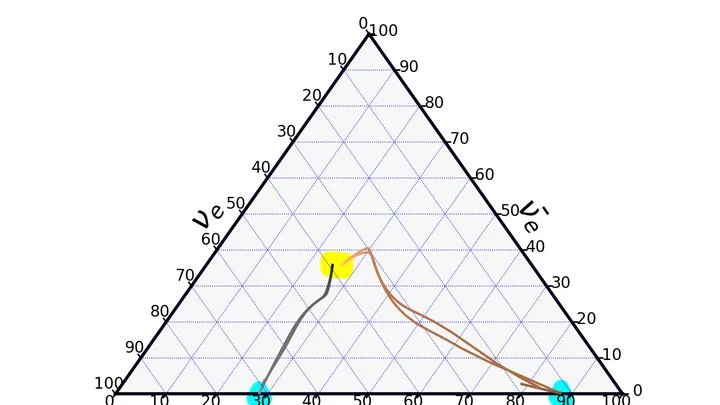
A pot of soup simmering with three ingredients. The chef adjusts the proportions on the fly, and the progress is tracked by the position of a point on a triangular scale. That's roughly how physicists tackle neutrinos from a supernova explosion.
Hot massive stars are the kitchens of the Universe, where heavy elements are cooked up. They end their lives in supernova explosions. To understand their recipe, astronomers use spectroscopy — the analysis of the rainbow band of light passed through a prism. Previously, deciphering such a 'menu' took hours.
The Universe is a colossal web of invisible dark matter and galaxies, stretched by the expansion of space. Neutrinos, nearly intangible ghost particles, barely cling to the threads, but their collective mass subtly shifts the tension of the entire network.
The proton is not a solid ball. Its charge, mass, and other properties are distributed differently in space, and each property has its own radius. Physicists have long been able to measure where the proton's charge is concentrated and where its mass lies.
If you build a giant blanket around a star, you get a Dyson sphere. It absorbs all the radiation and glows in invisible heat rays. No such sphere has been seen yet, but astronomers know: to find it, look for this thermal glow.
A thin crystal of hexagonal boron nitride is a relative of graphite, but transparent and insulating. Occasionally, single defects appear in its lattice: a boron or nitrogen atom is missing, leaving a trap for electrons. Such a trap can absorb light and re-emit it, like a tiny flashlight.
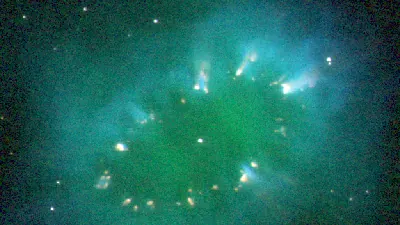
Deep in space, there's a cloud of gas that looks like a necklace with bright beads. This is the Necklace Nebula — the remains of a star that once swelled up and swallowed its neighbor. At the center, a pair remains: a small, hot star and its bloated companion, rich in carbon.
In the binary system Cyg X-2, a neutron star pulls matter from a normal companion star. The infalling gas spirals in, heats up to millions of degrees, and shines brightly in X-rays. Astronomers pointed two space telescopes, IXPE and NuSTAR, at this object and, for the first time, measured in detail how polarized that light is.
Light from a distant source passing near a neutron star bends like a flashlight beam in a funhouse mirror. Astrophysicists ran a numerical experiment: they traced rays backward from the observer to the star and looked at what picture a telescope would see.
At the center of our Galaxy lies a dense forest of dust and gas. Starlight barely penetrates this thicket, like a flashlight in fog. But it is precisely there, in this dense cloud, that new stars are born.
Scientists decided to look into this fog. They took light from 15 bright stars that shine through cold clouds.
A star 300 light-years away dances with an invisible partner. One side of the star heats up more than the other, as if the unseen dancer is breathing a hot wind onto it. This partner is a neutron star — a city-sized cinder so dense a teaspoon of its matter outweighs Mount Everest.
Supermassive bodies warp space, turning into a lens that bends light from distant objects. Such spacetime curvature allows astronomers to see the invisible. Recently, this method helped detect a hidden clump with the mass of a million Suns.
Using the most powerful space telescope, James Webb, astronomers peeked into the cosmic dressing room and saw how the rings of asteroid Chariklo are changing.
Astronomers couldn't understand why the 'hot Neptune desert' — a region right next to stars — has almost no Neptune-sized planets. It was thought that there they are doomed: the star's proximity boils off the atmosphere, leaving a bare rocky core. But the exoplanet LTT-9779 b, 29 times heavier than Earth and with a 19-hour orbit, survived.
At the center of the supernova remnant SN 1987A, 168,000 light-years from Earth, hides an object that astronomers have been seeking for 37 years. This is the closest supernova to have exploded in front of modern telescopes, and the only one where the compact remnant has yet to be seen directly.
High above Earth, a satellite flies, and inside it is an instrument the size of a small wardrobe. It catches particles that have been racing through the galaxy for billions of years and finally slam into the detector. Such particles are called cosmic rays, and they bring news of distant stellar explosions.