Quantum Transformer for 600 Dimensions express
In a noisy hall, an interpreter tries to catch every word, but rustles and echoes muddle the meaning. That's roughly how conventional computer methods handle complex quantum systems: the more particles and the stronger their correlations, the faster calculations drown in interference. A team of physicists has proposed a new approach — the 'Schrödinger Generator.' It doesn't just listen; it learns to untangle cross-talk and extract a clean signal.
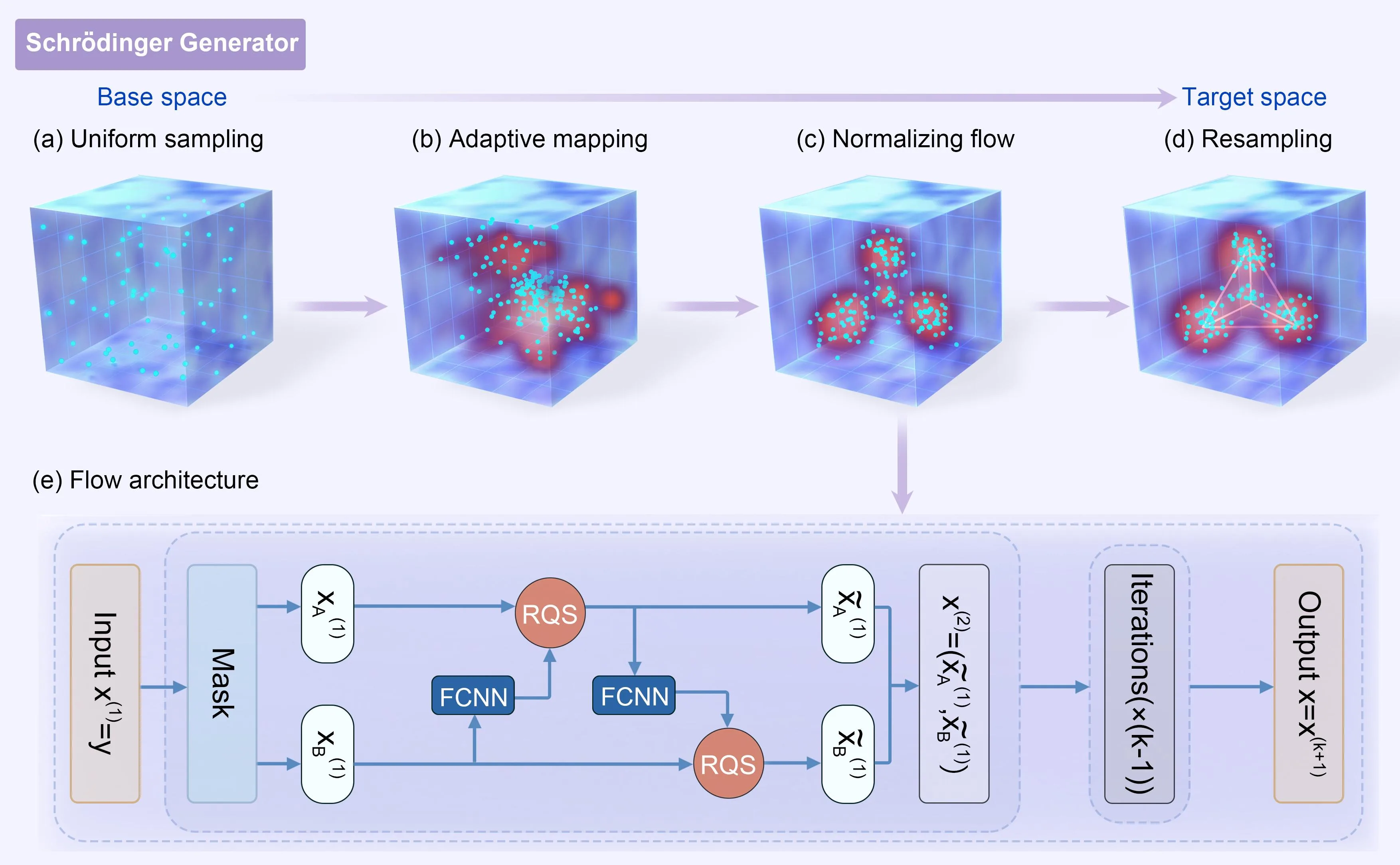
The secret lies in a smart division of labor. One part of the algorithm learns to spot simple patterns in each dimension individually. Another catches complex correlations that can't be neatly separated. Finally, a verification step ensures that even with imperfect tuning, the result remains honest. The scientists tested the method on atomic nuclei — systems of hundreds of protons and neutrons where particles are tightly bound. The generator accurately reproduced their behavior in spaces with more than 600 dimensions.
Such a tool promises breakthroughs not only in nuclear physics. It will be useful anywhere you need to quickly estimate probabilities in tangled systems — from forecasting financial risks to training neural networks.
Original abstract
as written by the authors arXiv:2608.00529v1
Integration and sampling in high dimensions are among central challenges in modern science and technology, underlying applications ranging from quantum many-body physics to Bayesian inference and artificial intelligence. Although conventional Monte Carlo methods are formally scalable, their efficiency deteriorates rapidly in the presence of strong correlations or sharp features in high-dimensional configuration space. Here we introduce a new framework, termed the Schr"odinger Generator, for integration and sampling based on the explicit optimization of coordinate transformations. The method decomposes the total Jacobian into two complementary components, including an adaptive map that minimizes estimator variance by learning the marginal structure in each dimension, and a normalizing-flow-based transformation that captures non-factorizable correlations in the target distribution. A final resampling step guarantees unbiased sampling even when the learned transformation is imperfect. We demonstrate stable and scalable performance for nuclear quantum many-body states in dimensions exceeding 600. Short-range correlations among nucleons in finite nucleus are faithfully reproduced. The framework offers a physically transparent approach to high-dimensional stochastic integration and sampling, opening new possibilities for simulations of complex quantum systems.
In quantum physics, particles in a nucleus constantly exchange virtual particles, creating forces that hold them together. These exchanges happen so fast that in one second, their number exceeds the number of stars in the observable universe.
The idea echoes the 'mental models' from Frank Herbert's Dune, where special training allows one to compute incredibly complex future scenarios by grasping hidden connections between events.