Quantum Transformer for 600 Dimensions express
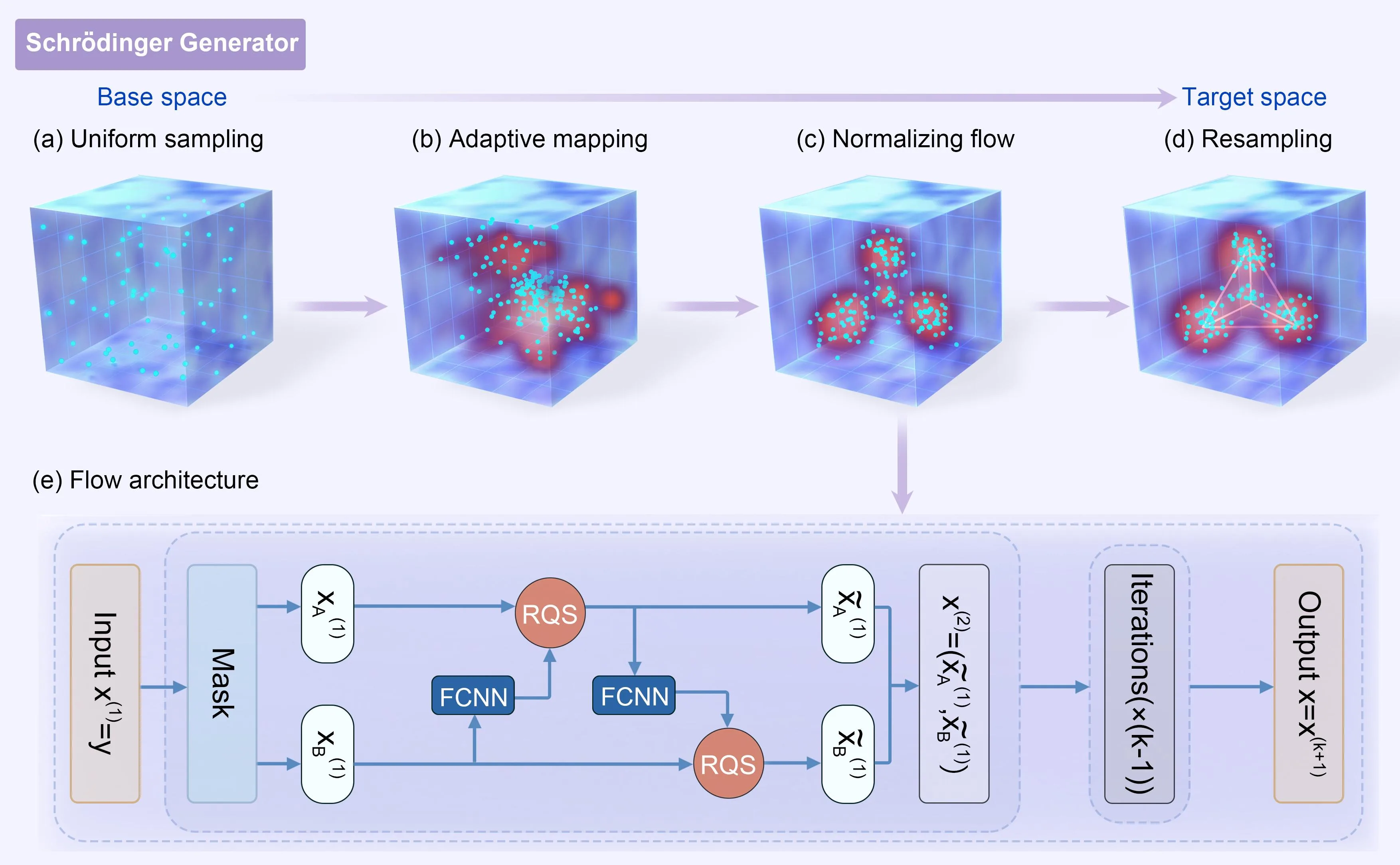
In a noisy hall, an interpreter tries to catch every word, but rustles and echoes muddle the meaning. That's roughly how conventional computer methods handle complex quantum systems: the more particles and the stronger their correlations, the faster calculations drown in interference. A team of physicists has proposed a new approach — the 'Schrödinger Generator.' It doesn't just listen; it learns to untangle cross-talk and extract a clean signal.
The secret lies in a smart division of labor. One part of the algorithm learns to spot simple patterns in each dimension individually. Another catches complex correlations that can't be neatly separated. Finally, a verification step ensures that even with imperfect tuning, the result remains honest. The scientists tested the method on atomic nuclei — systems of hundreds of protons and neutrons where particles are tightly bound. The generator accurately reproduced their behavior in spaces with more than 600 dimensions.
Such a tool promises breakthroughs not only in nuclear physics. It will be useful anywhere you need to quickly estimate probabilities in tangled systems — from forecasting financial risks to training neural networks.
In quantum physics, particles in a nucleus constantly exchange virtual particles, creating forces that hold them together. These exchanges happen so fast that in one second, their number exceeds the number of stars in the observable universe.
The idea echoes the 'mental models' from Frank Herbert's Dune, where special training allows one to compute incredibly complex future scenarios by grasping hidden connections between events.