Magnetic Light in a Crystal express
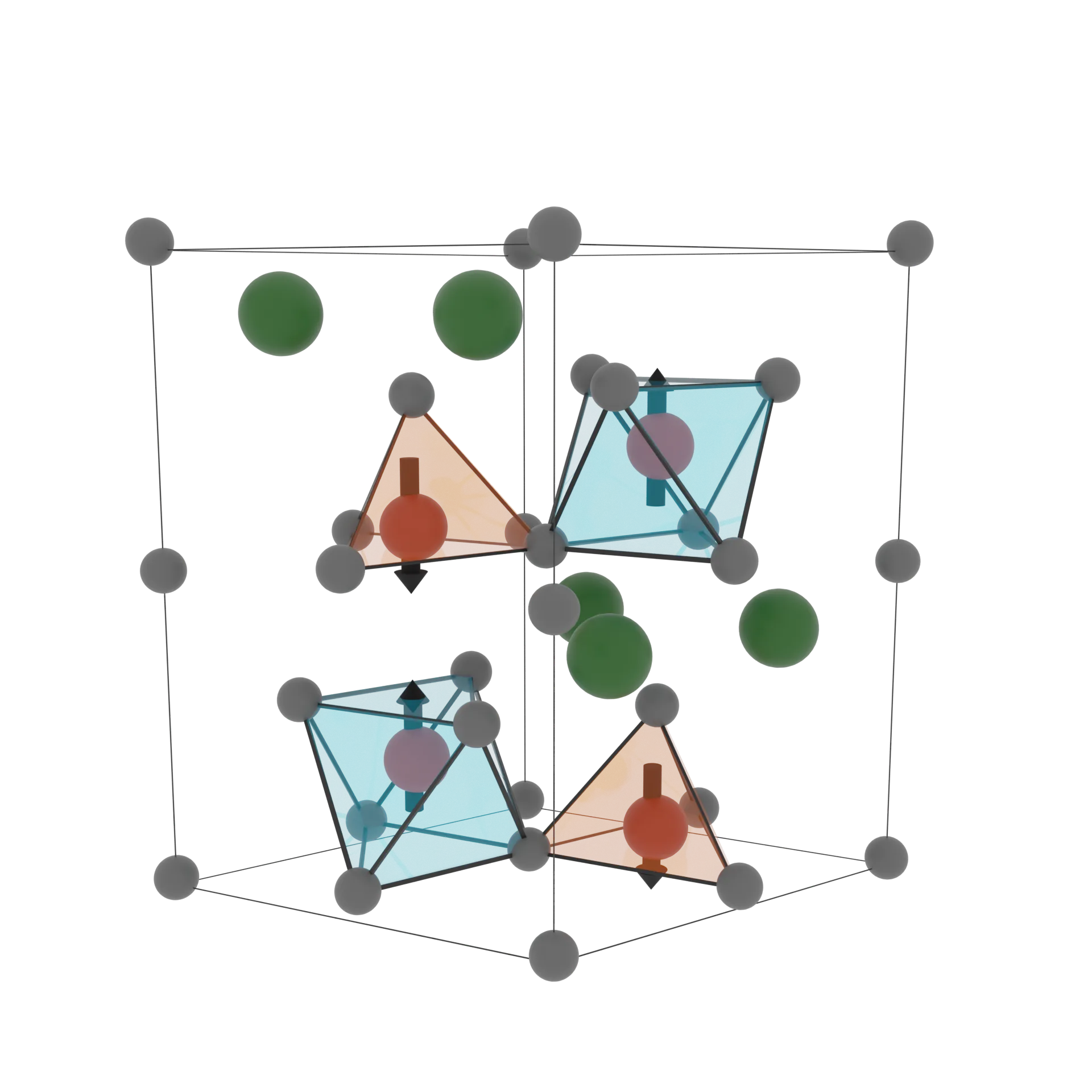
The crystal Mn₂Mo₃O₈ resembles a tiny city where manganese atoms are arranged in strict order: their magnetic moments (tiny internal arrows) point alternately up and down. This state is called collinear altermagnetism. When such a crystal is irradiated with light, the atoms begin to vibrate, and the frequencies of these vibrations reveal how the material is structured.
Physicists used two methods: Raman scattering (light changes color when it collides with atoms) and terahertz spectroscopy (radiation with frequencies between infrared and microwave). For the first time, they clearly captured all types of vibrations, including those that previously escaped observation. At room temperature, the crystal is not magnetic, but once cooled below a certain point, magnetic order emerges. Then, in the terahertz radiation, a broad band appears that absorbs left- and right-circularly polarized light (the direction of wave rotation) differently. This phenomenon, magnetic circular dichroism, indicates that light interacts with collective oscillations of magnetic moments.
The expected splitting of vibrations into two polarized branches did not occur. A likely reason is the weak coupling of spins (magnetic arrows) to the orbital motion of electrons in manganese ions. However, when an external magnetic field of 4 tesla (about 100,000 times stronger than Earth's magnetic field) is applied, the magnetic moments rearrange, and the new signal disappears. This confirmed that the signal is indeed linked to magnetic order.
This research adds an important detail to the understanding of altermagnets — materials where magnetic moments are compensated, but the symmetry of the structure creates unusual electronic properties. Such crystals could be useful in spintronics — electronics that uses not only charge but also the spin of electrons.
The terahertz radiation used in the experiment lies between infrared light and microwaves. It can 'see' through clothing and packaging, which is why it is used in airport security scanners.