Raman scattering is the inelastic scattering of photons by matter, where the scattered light gains or loses energy corresponding to vibrational or rotational transitions in the scattering molecules. Unlike Rayleigh scattering (elastic), Raman scattering shifts the photon's frequency, producing a spectrum that fingerprints the material's molecular structure. In optical fibers, it is a nuisance: it limits the power that can be transmitted by converting some light into unwanted wavelengths, but it also enables amplifiers and sensors.
History
The effect was predicted by Adolf Smekal in 1923 and experimentally confirmed by C.V. Raman and K.S. Krishnan in 1928, for which Raman received the Nobel Prize in Physics in 1930.
How it works
A photon interacts with a molecule, exciting it to a virtual energy state that is not a real quantum level. The molecule then relaxes to a different vibrational state, emitting a photon with energy equal to the incident photon minus (Stokes) or plus (anti-Stokes) the vibrational quantum. The intensity and frequency shifts of these scattered photons reveal the molecular bond energies and symmetries, making Raman spectroscopy a powerful analytical tool.
In practice
Raman scattering is used in fiber-optic communication as distributed temperature sensors (DTS) and in Raman amplifiers, while in laboratories it powers non-destructive chemical analysis, from pharmaceutical quality control to the detection of explosives.
Fun fact
Only about one in ten million photons undergoes Raman scattering, which is why the effect is weak and required intense laser sources to become practically useful.
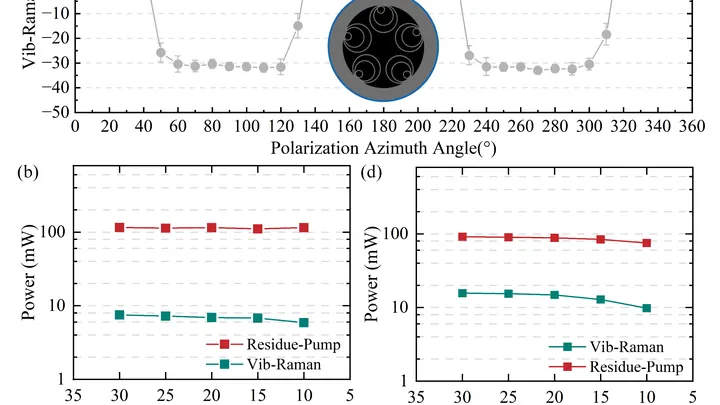
The mirror races along at nearly forty thousand kilometers per second. Light that strikes it bounces back, but changed, like a ball volleyed by a racket in mid-swing. That's exactly the kind of mirror scientists have built inside an ultra-thin glass thread filled with hydrogen.
First, a powerful laser pulse is sent down the fiber.
When light hits ordinary plastic, some of it reflects, like a glare on a window. To eliminate this glare, a special coating made of tiny structures is applied to the surface, which cancels out the reflection.
A sponge slowly watered from a watering can gets soaked all the way through. But if you dump the same bucket of water on it all at once, the middle gets wet while the edges stay almost dry. That's roughly how a material with nonlinear absorption behaves: the more intense the flux, the more it gets stuck at the point of impact.
A stack of playing cards lies still. You can slide the top card with your finger: that's crude intervention. Or you can blow so that the whole stack momentarily changes shape, but the cards don't scatter. That's roughly how light, in a new experiment, rearranges a crystal of tin selenide (SnSe).
Usually, to change the structure of a solid, you heat it or pass a current through it.
A weak laser beam falls onto a tiny structure — a hybrid cavity made of metal and glass. Inside is trapped a single light-emitting molecule. Normally, such light only slightly changes color as it scatters off thermal vibrations of atoms.
An electron is not just a point. It is a probability cloud, smeared out in space. When such a cloud collides with a powerful laser pulse, it can emit a high-energy photon — a gamma quantum. And this photon can be not just ordinary but twisted, like a corkscrew, carrying orbital angular momentum.
Even Jocelyn Bell Burnell, who first detected the strict periodicity of radio signals, noticed that some pulses would suddenly vanish. Today we know: variability is not a whim, but the voice of intricate electrodynamics.
In the quantum world, light and matter constantly exchange energy. Previously, they were described statically, like frozen poses. The new approach follows the dance itself: the transitions between states, like a continuous sequence of movements.
A distant lighthouse flashes for an instant brighter than an entire galaxy. This is a fast radio burst — a mysterious signal from deep space. Some repeat, and astronomers have noticed a peculiarity: these bursts show rapid changes in polarization — a property indicating how the radio wave is twisted in space.
A sheet of graphene one atom thick hangs in the air like a taut bedsheet. Heat waves, vibrations of atoms that physicists call phonons, ripple across it. Previously, it was thought that these waves quickly scatter due to strong interactions, and heat transfer is poor.
Light usually pushes an atom straight ahead, like wind pushing a sail. But if the beam is twisted into a corkscrew, the picture changes: the atom can fly off to the side, as if caught by a spinning wheel. In the new work, physicists calculated that such a vortex photon can transfer almost all of its rotation to the atom — up to 100 percent.
Ordinary light is like a crowd in a square: each photon moves on its own, bumping into others and scattering. But in some media, photons start running together like a pack of dogs: they bunch up. Scientists have built a random fiber laser where light particles gather into especially dense clusters.
In a silicon crystal, a phosphorus atom holds an extra electron on two very closely spaced orbits. These orbits are like two neighboring floors in a building where the staircase is almost invisible. A short laser pulse in the mid-infrared range pushes the electron from the lower floor to the upper one, and it starts swinging between them like a pendulum.
A light wave is like a crowd where everyone waves a flag in their own direction. To get such a crowd through a narrow corridor without losing order, you need guides. In optical fibers, polarization, the strict direction of the light wave's oscillation, plays that role.
In a particle accelerator, electrons race around a ring at nearly the speed of light. When such an electron collides with a photon, a particle of light, the photon bounces off like a ball hitting a moving truck and flies away with much greater energy.
A random fiber laser is a thin glass thread through which light travels, but instead of reflecting off mirrors, it reflects off the tiniest irregularities in the fiber itself. Such a laser doesn't produce a steady beam: its light flickers and flares like a candle flame in a draft.
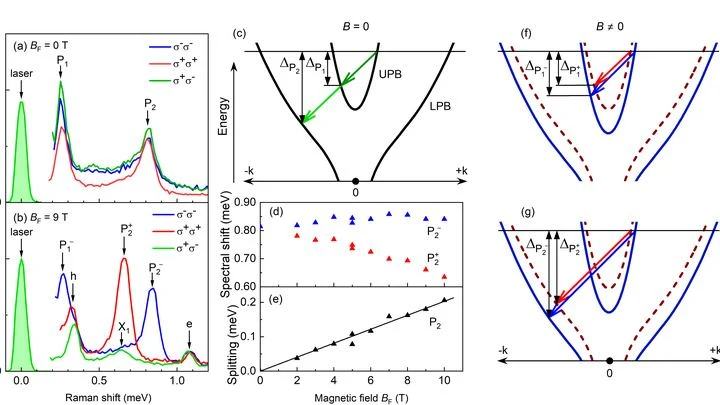
A laser beam hits a shiny crystal, and comes back different: slightly shifted in color, with a different polarization. In a magnetic field, this transformation of light becomes especially noticeable.
A quantum computer is like an orchestra that can only perform in complete silence. The slightest noise, and the delicate melody falls apart. For quantum devices, heat is that noise: even faint infrared radiation from nearby components heats up the qubits and erases their quantum states.