How Dust Disks Dance Around Newborn Stars express
Around a just-ignited star swirls a vortex of dust and gas. This vortex, the protoplanetary disk, grows by accreting material from the surrounding cloud. But how exactly does this material fall: does it flow evenly along the 'edges' or burst in as separate dense streams?
Astrophysicists studied nine stellar systems using three-dimensional supercomputer simulations. They resolved details as small as 0.8 astronomical units (slightly less than the Earth-Sun distance). It turned out that in the early stages (the first 50,000 years) dense gas streamers frequently slam into the disk. Each such 'stream' delivers as much mass in 10,000 years as the entire background inflow. Upon impact, the disk compresses: its size shrinks by half, and its mass drops by 40%. This is like a calmly spinning carousel that someone throws heavy sacks onto: it momentarily slows and flattens.
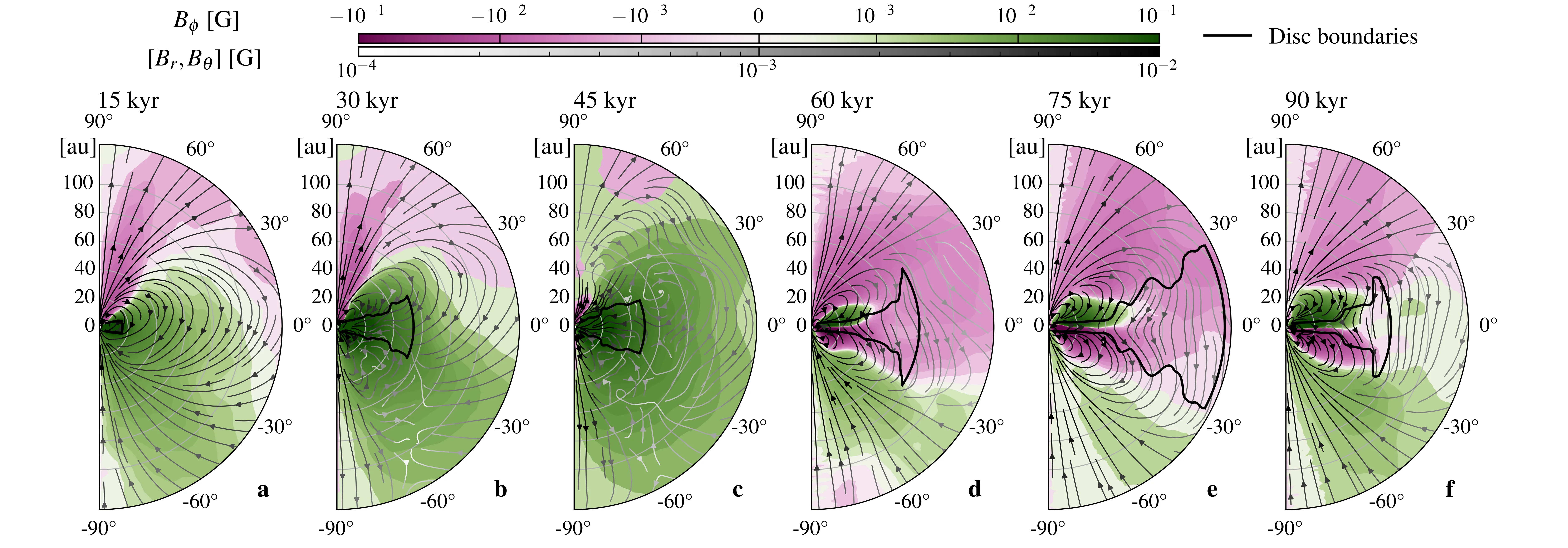
Later, when the main reserves of the cloud are depleted, the picture changes. The disk enters a calmer phase: material comes in mainly through the midplane and outer layers. At this time, a toroidal magnetic field forms in the disk: it twists into a ring, with the field direction reversing across the upper and lower surfaces of the disk. Such a structure helps feed the disk and mix material. The complete renewal of the disk's mass occurs in the same 10,000 years, as if a giant conveyor belt continuously replaces all its contents.
These results reveal something important: in their early life, protoplanetary disks are too turbulent a place for planet formation. Constant streamer impacts, strong turbulence, and rapid material renewal prevent dust grains from calmly sticking together into larger bodies. Planets have to wait until the star matures a bit and its surroundings calm down.
In 10,000 years, a blink of an eye by cosmic standards, the disk can completely refresh its material, as if it were shaken out and refilled.