Supercomputer simulation refers to the use of high-performance computing systems to model complex physical phenomena that are too large, fast, or dangerous to study experimentally. In astrophysics, supercomputer simulations are essential for understanding the birth and evolution of galaxies, which occur over billions of years and involve gravitational, hydrodynamic, and radiative processes. These simulations solve the equations of gravity and fluid dynamics on a grid or with particles, tracking the formation of stars, black holes, and dark matter structures. The provided titles show that modern simulations are increasingly combined with neural networks to accelerate or interpret results, such as generating synthetic galaxies or analyzing gravitational waves.
History
The first attempts to simulate galaxy formation date back to the 1970s, but it was not until the 1990s that simulations with sufficient resolution and physics became feasible, thanks to the growth of supercomputing power. Pioneering projects like the Millennium Simulation (2005) and Illustris (2014) have become benchmarks in the field.
How it works
A typical galaxy simulation starts with initial conditions representing the early universe—a nearly uniform distribution of dark matter and gas with tiny density fluctuations. The supercomputer then evolves this system forward in time, step by step, calculating gravitational forces between millions or billions of particles and modeling gas cooling, star formation, and feedback from supernovae. Because the dynamic range spans from kiloparsecs to sub-parsec scales, simulations use adaptive mesh refinement or particle-based methods to resolve structures. The output is a time series of snapshots that can be visualized as a movie of galaxy formation.
In practice
Supercomputer simulations are used to test theories of galaxy formation, interpret observational data from telescopes, and predict the properties of dark matter, as well as to design future space missions.
Fun fact
The largest galaxy simulations today track billions of particles, and a single run can take months on thousands of processors, generating terabytes of data—more than the entire text content of the Library of Congress.
A census by body shape: that's one way to describe what astronomers did with 6348 massive galaxies. Instead of height and weight, they measured how concentrated the light is toward the center, how flattened the galaxy is, and how asymmetric its shape is. Then they ran the same measurements on galaxies from three computer models of the universe and compared the results.
A cloud of waves collapses under its own gravity. While it's loose, everything goes by the book: the field oscillates gently in nearly flat space, and approximate formulas work perfectly. But add just a bit more energy, and the picture changes.
Physicists used a numerical model to catch the moment when simple calculations stop describing reality.
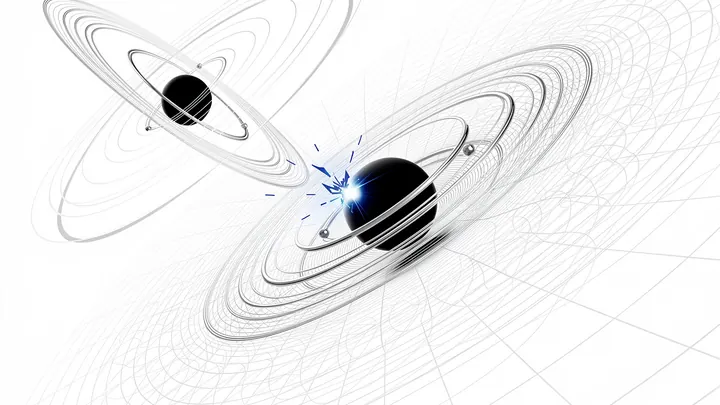
A galaxy collision is like a slow dance in which two partners gradually draw closer. Hidden at the center of each is a supermassive black hole — an invisible flywheel with a mass of millions or billions of suns.
In the first moments of its life, the universe resembled a boiling cauldron. Matter wasn't spread evenly — clumps and voids were brewing within it, and their violent motion gave rise to a trembling of space itself: gravitational waves.
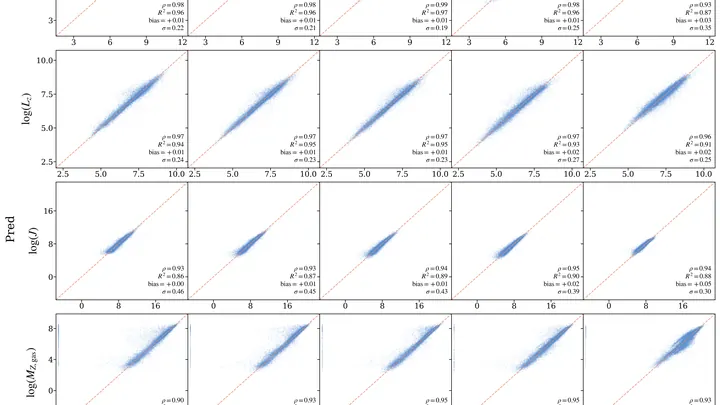
An artist makes a quick charcoal sketch, and the face in the portrait is already recognizable. Astrophysicists face a similar challenge: the spectrum of a star is its individual portrait, revealing temperature, composition, and gravity.
At the heart of almost every galaxy slumbers a supermassive black hole — the invisible conductor of a stellar orchestra. When galaxies collide, their central monsters draw closer, entwining in a gravitational dance. Sometimes a third partner joins the duo, and then a triple waltz begins, its outcome unpredictable.
Galaxy clusters are the greatest gravitational ensembles in the Universe. In X-ray glow from hot plasma, the story of cosmic expansion, hidden dark matter, and enigmatic dark energy is encoded.
An artist paints a portrait stroke by stroke, and then someone offers them a flash camera — one click, and it's done. That's roughly the shift from multi-step models to one-step models in generating images of galaxies.
Typical neural networks for image synthesis work like a watercolorist: they apply a layer, blur it, add details.
When black holes collide, the very fabric of spacetime trembles. That rumble, gravitational waves, gets picked up by detectors, but decoding the signal used to take hours of computer simulation.
Studying the birth of galaxies requires simulating billions of years of dark matter growth and star formation — even supercomputers handle this slowly.
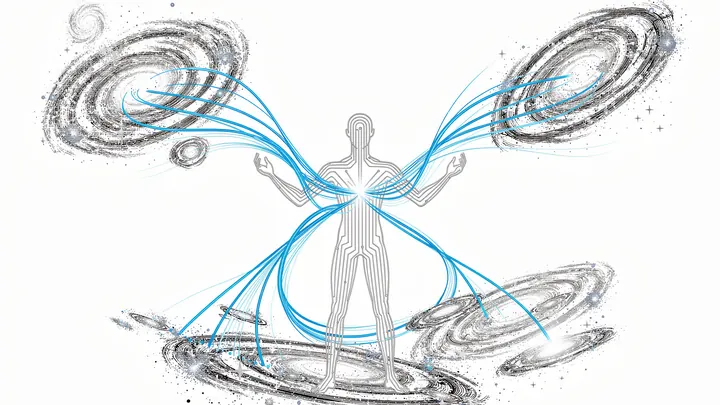
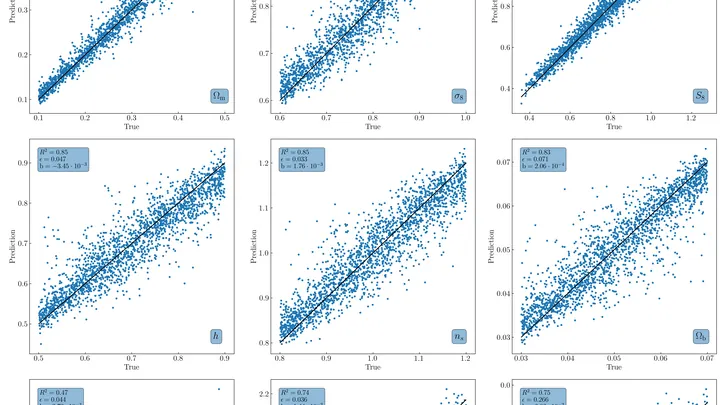
Thousands of universes were born in a computer, all to tell us about our own. Each one has its own galaxy clusters, arranged by the laws of gravity like peas in a jar shaken with varying force. From how the peas settle, you can tell what kind of hand shook the jar.