A stellar stream is a long, thin thread of stars that orbits a galaxy, formed when a smaller galaxy or star cluster is torn apart by the host galaxy's tidal gravity. The stream traces the path of the destroyed object, preserving a record of its orbit and the gravitational field it moved through. These structures are common around the Milky Way and other large galaxies, and they serve as fossil evidence of past accretion events.
History
The concept emerged in the late 20th century as astronomers began detecting tidal debris around the Milky Way. The first prominent stellar stream, the Sagittarius dwarf galaxy stream, was identified in the 1990s through surveys of stellar positions and velocities.
How it works
When a dwarf galaxy or globular cluster ventures too close to a larger galaxy, the difference in gravitational pull across the object — the tidal force — stretches it into a elongated shape. Over successive orbits, material is stripped off, forming a coherent stream of stars that follows the original orbit. The stars in the stream share similar ages and chemical compositions, marking their common origin. The stream's shape and motion are governed by the host galaxy's gravitational potential, including contributions from dark matter.
In practice
Stellar streams are used to map the distribution of dark matter in galaxies, since the stream's morphology and kinematics are sensitive to the gravitational potential. They also help reconstruct the merger history of galaxies and constrain the properties of dwarf galaxy companions.
Fun fact
The Milky Way's Sagittarius stream wraps around the entire galaxy, forming a ring of stars that nearly encircles the sky.
The night sky looks serene, but it is actually pierced by an invisible rain of charged particles: cosmic rays. Scientists have long tried to figure out where the most energetic ones are born. Until recently, it was thought that our Galaxy supplies particles up to about 4 EeV, the so-called "ankle" in the spectrum.
Around a just-ignited star swirls a vortex of dust and gas. This vortex, the protoplanetary disk, grows by accreting material from the surrounding cloud.
Right after the Big Bang, space cooled unevenly. In some places, folds could have formed — threads of energy as thin as a hair but incredibly dense. Physicists call them cosmic strings. They oscillate, collide, and emit gravitational waves — ripples in the fabric of space itself.
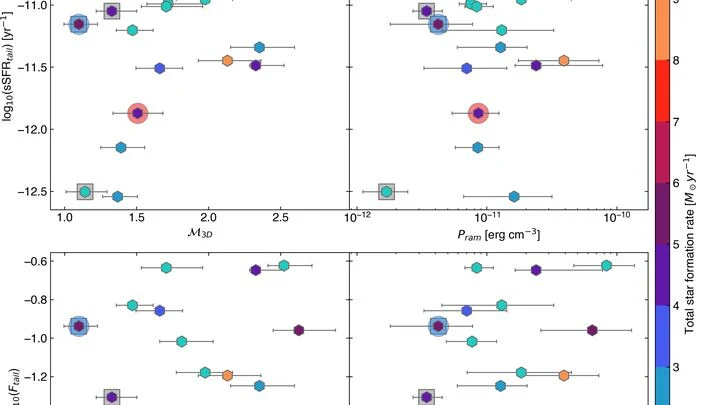
Galaxy NGC 4254 lies 1.5 million light-years from the center of the Virgo cluster. It drags a long stream of cooling hydrogen — a sign that it's plowing headlong into the hot gas. Losing cold fuel quenches the birth of new stars.
A gas disk with a mass of four hundred thousand suns encircles the black hole at the center of the Milky Way. Its gravity works like a gravitational rudder: slowly but inexorably turning the orbits of binary stars, driving them into the region where tidal forces tear the pair apart.
A stone falls into still water, and smooth rings spread across the surface. If the stone doesn't just fall but also spins, tiny whirlpools, vortices, appear on the surface. Light can do the same, only instead of water, it's space and time themselves.
A branch falls into a whirlpool. It gets spun and broken, but sometimes a powerful fountain of water bursts from the center. Similarly, a black hole tears apart a passing star, and occasionally a blinding plasma jet, a jet, shoots into space.
Dwarf galaxies orbiting the Milky Way look as if they’ve survived a gravitational storm. Their stellar bodies are stretched, scattered by tidal tails, and heated from within.
Dark matter — the invisible foundation of cosmic architecture — makes up 85% of all mass, yet eludes direct observation. In the 1920s, Edwin Hubble discovered the expansion of the universe and the realm of galaxies; by the 1930s, Fritz Zwicky suspected hidden mass in their clusters.
At the center of a tiny galaxy lies a dense clump of stars and dark matter. This clump, called a soliton, is not frozen in place: it quivers and oscillates like jelly on a plate.
The giant cloud of icy chunks on the outskirts of the Solar System, the Oort cloud, resembles a transparent bubble stretched to a light-year across. Usually, these chunks hang quietly in their distant corners, but sometimes something disturbs them.
Most often, it's the tidal influence of our Galaxy.
A planet the size of Neptune wandered too close to its star. The star begins to pull the planet's outer layers onto itself — gas streams off the planet like water from an overflowing bucket. This process is called Roche-lobe overflow (astronomers use this term for the boundary beyond which a star can tear material away from a planet).
Immediately after the Big Bang, in the seething cauldron of the cooling Universe, much like in unevenly hardening glass, stresses appeared — hairline cracks in reality, cosmic strings. Picture a tightrope walker balancing on an invisible cable stretched across the abyss of warped spacetime.
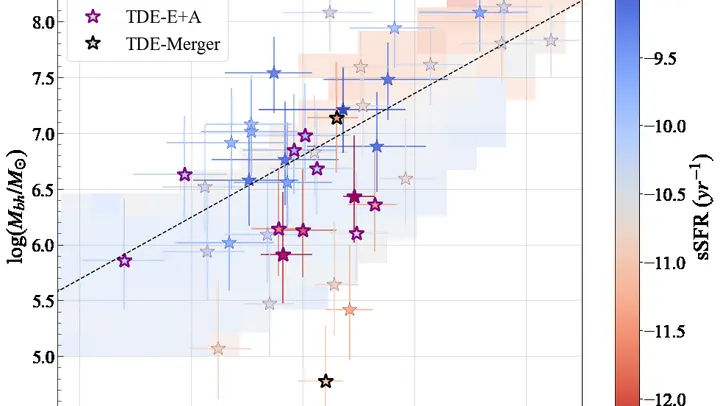
In the centers of galaxies, where supermassive black holes lie dormant surrounded by stellar swarms, lights of monstrous power sometimes flare up — tidal disruption events. But some of these events behave oddly: they repeat again and again, and each new ignition is dimmer than the last.
A stellar river winds around the center of a distant galaxy like a glowing ribbon on an invisible frame. That frame is the dark halo: a vast cloud of invisible dark matter whose gravity holds stars and gas in place. If the halo is squashed like a pumpkin or stretched like a melon, the stellar stream will bend differently.
Imagine a dark room with dust floating in the air. A bright flashlight goes off, and the dust particles light up, revealing their positions. Astronomers have applied a similar trick to our Galaxy. The flashlights were gamma-ray bursts, the most powerful explosions in distant galaxies, and the dust particles were interstellar clouds.
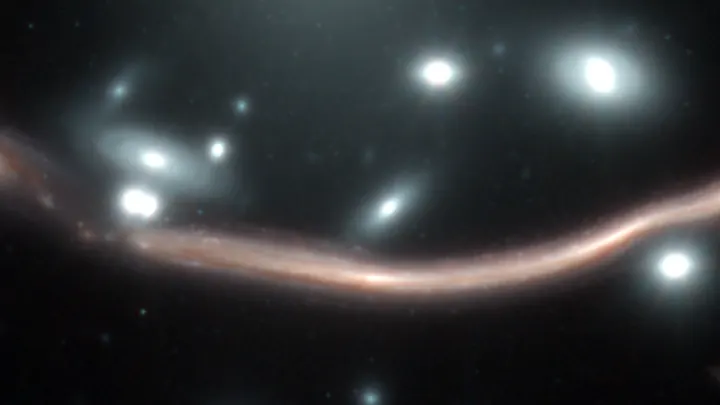
Light from the distant Dragon Galaxy has been traveling toward us for more than seven billion years. On its way, it passes by a huge galaxy cluster whose gravity bends the path of light like a lens. As a result, the galaxy appears brighter and larger than it really is, just as a magnifying glass enlarges fine print.
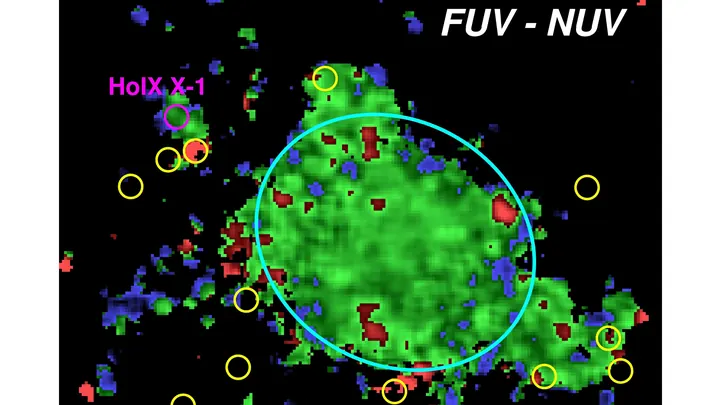
The galaxy Holmberg IX is like a city where construction of new houses suddenly stopped, even though building materials are everywhere. Astronomers peered into it with various telescopes and saw a strange picture: plenty of gas and heavy elements, but almost no dust. Usually, where there's gas, new stars are born, but here it's different.
A black hole can torment a star for years, rather than rip it apart immediately. Tidal forces are when the hole's gravity stretches the star: the near side is pulled harder than the far side. Usually, getting too close rips the star apart instantly — that's a tidal disruption event.
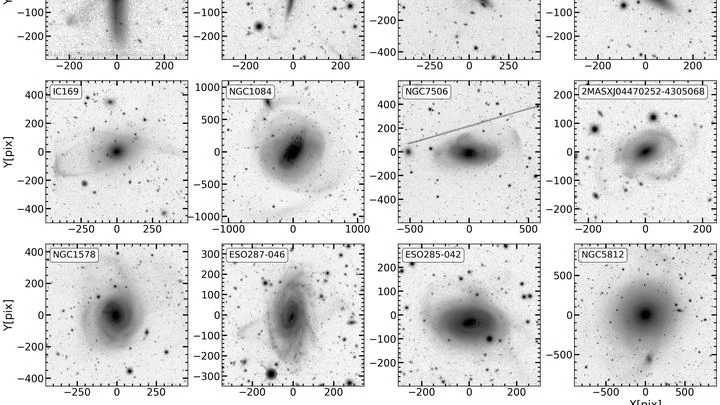
On the outskirts of galaxy M83, also known as the Southern Pinwheel, a river of ancient stars drifts through the void. It stretches 81 kiloparsecs — roughly 264,000 light-years, two and a half times the diameter of our Milky Way.
Above the Sun's surface hang long ribbons of glowing gas — streamers. They look like giant harps stretched across the corona. When a wave runs along such a ribbon, it trembles and bends like a string after being plucked.
For a long time, it was thought that only a very fast ejection of material, one traveling at more than 500 kilometers per second, could launch such a wave.
A gas cloud the size of a small galaxy is falling into the Milky Way at hundreds of kilometers per second. Such clouds are called high-velocity clouds, and until now no stars had been found in them — only gas. Now, in one of them, named Complex H, astronomers have spotted a pair of young star clusters.
A distant galaxy, similar to our Milky Way, is blowing gas into space like a hair dryer blowing dust off a table. Seven beams of light from an even more distant object pierced this gas cloud, and astronomers saw that the gas flow is narrow, like a jet from a hose, not wide like a fan.
A galaxy plunges into a dense cluster like a runner into a crowd. The oncoming gas, known as the intracluster medium, strips away its own gas, stretching it into a long, glowing tail. Astronomers call these galaxies jellyfish: they have a body and flowing tentacles of stripped material. But only in a few do new stars ignite within those tentacles.
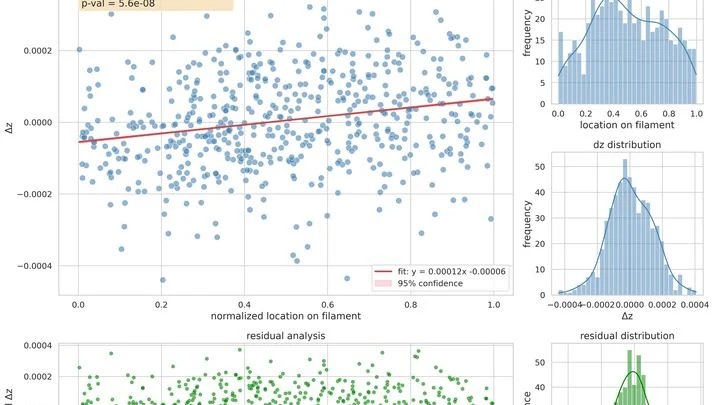
The Universe looks like a giant spiderweb: galaxies aren't scattered randomly but are gathered into knots and along filaments. Inside the filaments, there's plenty of gas, and that's where new stars most often flare up. But how has this changed over time? Scientists compared data from a computer model with real observations of thousands of galaxies.
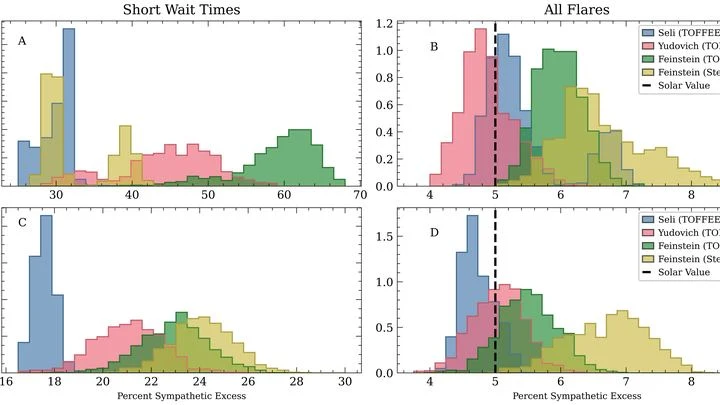
The Sun occasionally produces flares — powerful bursts of energy that last from minutes to hours. Most are random, like raindrops hitting a roof. But sometimes one flare seems to ignite another: the second begins almost immediately after the first, even though they occur in different locations. Astronomers call these sympathetic flares.
When a massive star dies and explodes, it releases not only light but also invisible lightweight particles. They fly out in all directions at nearly the speed of light. Only a small fraction reaches Earth, but each explosion sends its own clump. These clumps stretch along the way: fast particles overtake slow ones, and by the time they arrive, a clump can be spread over tens of thousands of years.
A planet hugging its star is like an ice cube forgotten on a scorching skillet. The ice melts and evaporates, except instead of water, it's hydrogen and helium from the planet's upper layers.
The center of a galaxy is a bustling metropolis where a giant black hole often snatches inattentive stars. But telescopes caught a flare in a quiet suburb, tens of thousands of light-years from the core. This gave away a wandering black hole — an invisible predator, flung out of the center after an ancient galaxy collision.
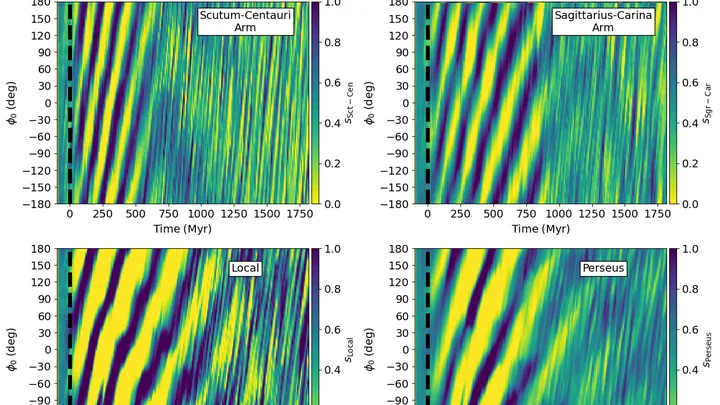
The Sagittarius galaxy plunged into the disk of the Milky Way and passed through again and again, like a stone thrown into a still pond. Each strike left ripples: waves and warps in the star field.
A giant planet circles too close to its star. With each orbit, it tugs on the star with its gravity, and waves are born deep inside the star, like ripples from a stone dropped into water. These waves damp the planet's orbit, and it spirals into the star. The star swallows the planet and starts spinning faster.
Stellar rotation is the key clue.
You can't see a black hole until a star wanders too close. Then tidal forces stretch the star like a cook rolling out dough, and some of the material falls into the hole, flaring up as a final goodbye. Such events, called tidal disruptions, are a rare chance to weigh a black hole that would otherwise remain invisible.
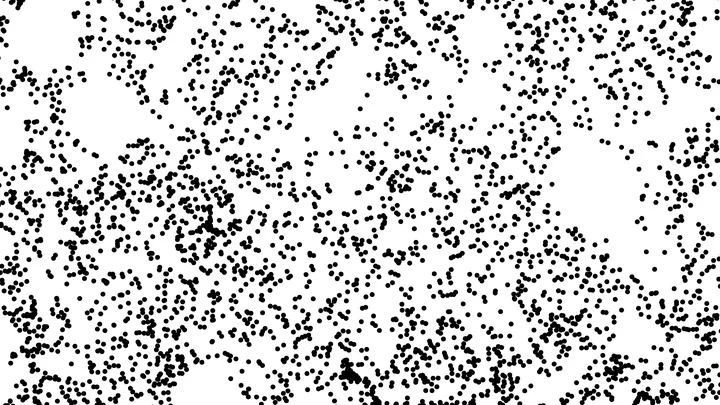
On large scales, the universe resembles a giant spiderweb: bright galaxy clusters are connected by long filaments of galaxies, gas, and dark matter. Previously, it was thought that matter flows along these filaments like water through pipes, heading toward the clusters.
The pulsar in the Crab Nebula blinks like a lighthouse: every 33 milliseconds it sends out a radio pulse, and it does so with the precision of atomic clocks. But sometimes its rotation stumbles: the star suddenly speeds up slightly, as if something inside it is shifting.
Space works like a billiard table. Massive outer planets, like heavy balls, transfer their energy to light inner worlds. Such a gravitational kick can fling a small planet out of the stellar system. It turns into a free-floating wanderer — a rogue exoplanet without a star.
Detecting these invisible bodies is hard: they neither emit nor reflect light.
The young binary star IRS 44 in the constellation Ophiuchus resembles a bustling kitchen: streams of gas, like jets of dough, fall onto a rotating disk, and where they strike, heat is born.
A river of stars (not a cluster, but a distinctly elongated, glowing ribbon) crosses the outskirts of a distant galaxy. Such a stream was spotted in data from the first survey by the Vera Rubin Observatory. It stretches along the minor axis of the galaxy LEDA 751050, like a scarf streaming from the galactic disk.
The stream is enormous: 130 by 15 kiloparsecs.
As early as Vera Rubin found that stars on the outskirts of galaxies move too fast — as if held by an invisible web. And Fritz Zwicky was the first to suspect that clusters of galaxies hide enormous invisible mass. Today we call it dark matter and try to understand what it's made of.
In the early Universe, just one and a half billion years after the Big Bang, three massive galaxies collided in a small volume of space. Their gravitational dance flung out giant streams of cold gas that stretched for 60 kiloparsecs, a distance twenty times the diameter of our Galaxy.