Dust grains are tiny solid particles in space, ranging in size from a few molecules to about a micrometer across, similar to smoke particles or fine sand. They are composed of silicates, carbon compounds, and ices, and they play a surprisingly important role in astrophysics. Despite their small size, dust grains absorb and scatter light, making distant objects appear dimmer and redder — a process called extinction. They also emit their own thermal radiation, which can dominate the infrared spectrum of galaxies.
History
The existence of interstellar dust was inferred in the early 20th century from the reddening of starlight, but its detailed properties were only revealed with the advent of infrared astronomy in the 1970s and 1980s.
How it works
Dust grains form in the outflows of evolved stars, where heavy elements condense into solid particles, and in supernova remnants. In interstellar space, they grow by accreting atoms and molecules onto their surfaces. When ultraviolet light from stars strikes a dust grain, it heats up and re-emits the energy as infrared radiation. Dust grains also act as catalysts for chemical reactions, providing a surface where atoms can meet and form molecules, including complex organic ones.
In practice
Understanding dust grains is essential for interpreting observations of star-forming regions, planetary systems, and the cosmic microwave background, as dust emission contaminates these signals.
Fun fact
Dust grains are so efficient at absorbing light that a single grain can block a star's light from reaching us, and they are responsible for the dark patches visible in the Milky Way's band across the night sky.
Light from a distant galaxy reaches us through its own dust. This dust is not a smooth haze but ragged clouds, like wisps of cotton. Old models treated it as a uniform mist, and then the galaxy didn't add up energetically: too much light disappeared in the ultraviolet and too little came back in the infrared.
Astronomers did what a cook does when they dice a potato instead of tossing it in whole.
In 2008, the Spitzer telescope aimed at the star HD 15407A and detected a strong infrared excess. Fifteen years later, in 2023, JWST repeated the measurements. The light from the dust had dimmed by 14%. But the mineral composition of the dust remained the same, like a fingerprint taken in different years.
The JWST spectrograph caught a barely perceptible dip in the spectrum of a distant galaxy — two lines, like shadows cast by cold gas. These are the sodium lines, the very yellow light of streetlamps. Here, at the edge of the visible Universe, they betray the slow exhalation of a galaxy returning matter to space.
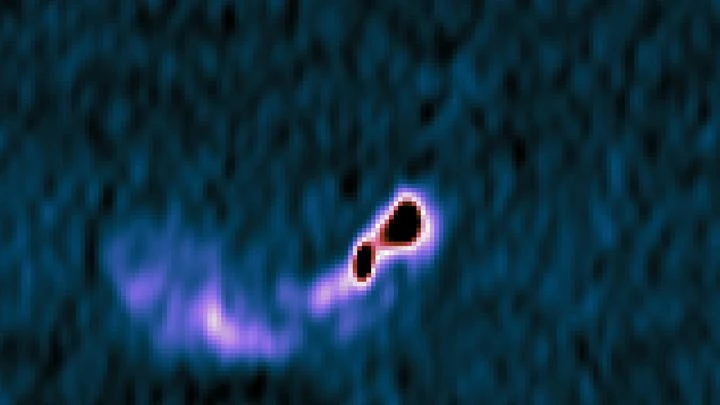
Eight bright spots on the radio sky. They are all the same quasar HS 0810+2554, whose light passed through a gravitational lens — a massive foreground galaxy.
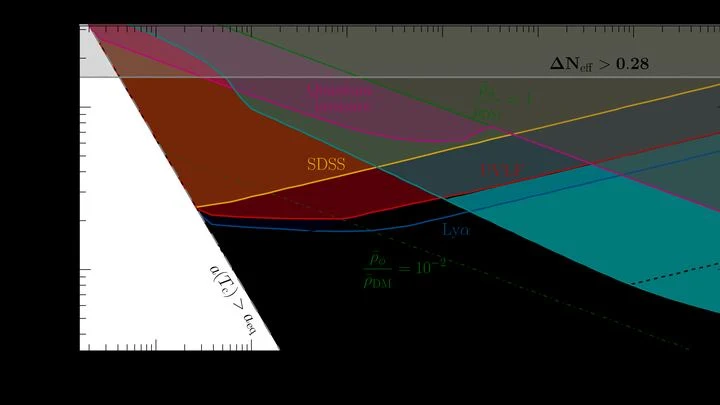
Dark matter is invisible to telescopes, but its gravity was revealed half a century ago by Vera Rubin. Since then, physicists have explored dozens of hypotheses, and one of the most elegant is primordial black holes, formed in the first moments after the Big Bang.
When two neutron stars, the ultra-dense cores of dead stars, collide, a kilonova is born: an explosion a thousand times brighter than a typical nova. This is the universe's true smelting works. In the scorching cloud racing outward at near-light speeds, a furious flux of neutrons transmutes atomic nuclei into gold, platinum, osmium.
The Moon is a natural archive that has been collecting cosmic dust for billions of years. Among the microscopic grains that arrived from distant stars, there could be techno-specks — particles created by alien civilizations.
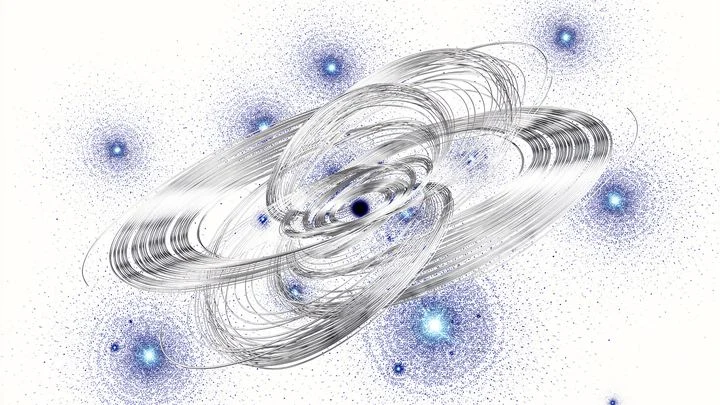
At the center of the Milky Way, like a matryoshka doll within a matryoshka doll, lies a supermassive black hole, surrounded by a swarm of stars and an invisible shell of dark matter. This shell, or "spike," is expected to be extremely dense right at the horizon.
Using the James Webb telescope, astronomers peered into an ancient quasar — the dazzling heart of a galaxy where a giant black hole sucks in matter. It turns out it doesn't just destroy, but also creates: its powerful outflows and shock waves act like a true cosmic mill.
The first two billion years after the Big Bang were an era when the universe resembled a boiling construction pit. Dark matter clumped the gas together, igniting the first stars. It seemed there simply wasn't enough time to assemble massive elliptical galaxies—'dormant' stellar metropolises — from this raw material.
Imagine a dark room with dust floating in the air. A bright flashlight goes off, and the dust particles light up, revealing their positions. Astronomers have applied a similar trick to our Galaxy. The flashlights were gamma-ray bursts, the most powerful explosions in distant galaxies, and the dust particles were interstellar clouds.
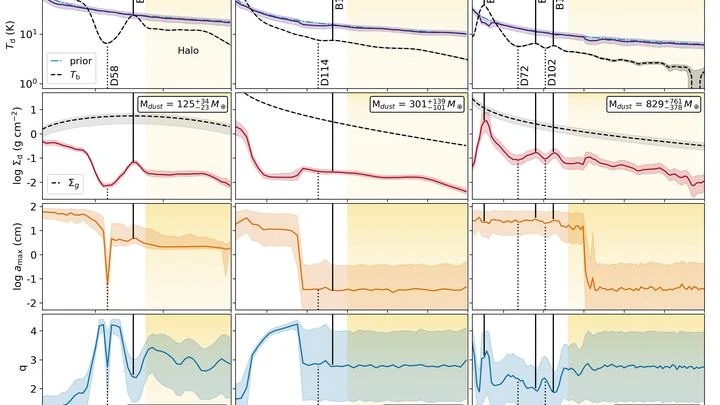
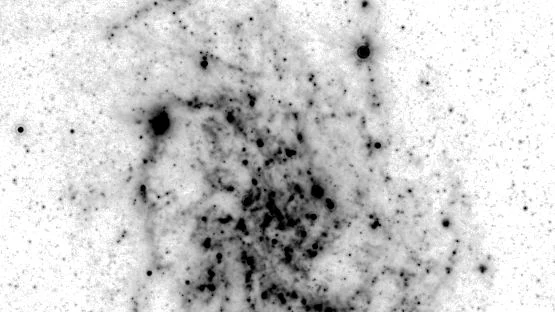
A young star is surrounded by a flat, rotating disk of gas and dust, like pizza dough that's been spun out. Planets are born inside such a disk. But around three stars (Elias 2-24, IM Lup, and DM Tau) astronomers noticed something odd: far beyond the edge of the bright disk stretches a barely visible but enormous dust halo.
In the first moments after the Big Bang, the cosmos resembled a giant cooling pond. Just as water, when freezing, becomes covered with a network of cracks, so the cooling universe could have cracked — not into ice, but into the thinnest filaments of pure energy. These filaments are called cosmic strings.
A newborn star is like a kitchen mixer: it whips up the surrounding cloud, and splatters fly in all directions. Only instead of batter, it's gas and dust. Previously, astronomers had only seen gas jets, and dust was considered too fragile: the shock wave should shatter dust grains into atoms.
Light from distant stars, as it travels through cosmic dust, loses some of its energy. Dust grains absorb and scatter light, and the way they do so at different wavelengths reveals their composition and size. Astronomers call this the dust extinction curve.
In the constellation Cetus, 65 million light-years from Earth, three dwarf galaxies nestle: DF2, DF4, and DF9. All have been declared “galaxies without dark matter” — the mysterious invisible substance that usually holds stars together.
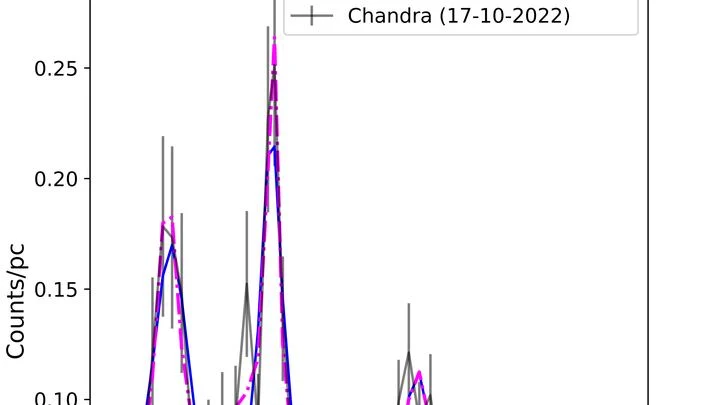
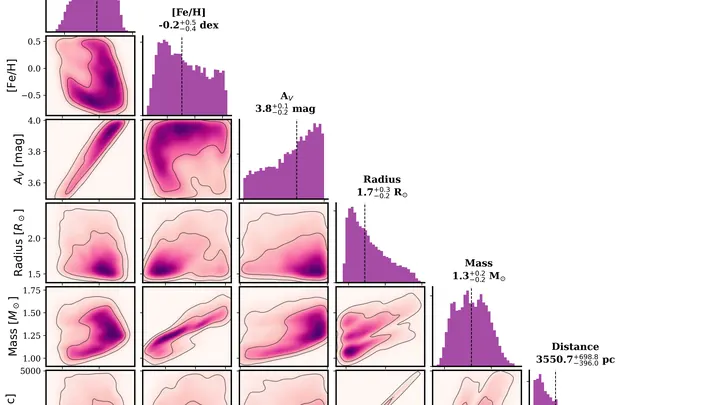
In a constellation where new stars are born, one of them behaves like a faulty lightbulb: sometimes shining steadily, sometimes dimming by a factor of several. Astronomers have been monitoring the star Gaia-GIC-1 for several years and now understand that its blinking is the shadow of a huge dust cloud that periodically passes in front of it.
A distant galaxy, similar to our Milky Way, is blowing gas into space like a hair dryer blowing dust off a table. Seven beams of light from an even more distant object pierced this gas cloud, and astronomers saw that the gas flow is narrow, like a jet from a hose, not wide like a fan.
A distant galaxy birthing hundreds of stars should glow in oxygen. That's what astronomers thought: hot young stars heat the gas, which then emits a characteristic infrared glow at a wavelength of 63 microns. It's like steam rising from a boiling pot — a sure sign of vigorous activity.
A dust grain in interstellar space is like a tiny compass. Inside it sit inclusions of magnetic minerals that make the grain rotate along invisible magnetic field lines. How obediently the grains align determines how they polarize the light of distant stars and what radiation they emit.
Inside cold clouds of gas and dust where new stars ignite, astronomers have spotted unexpectedly delicate structures. The ALMA telescope, working in the millimeter range, has revealed more than 323 ultra-thin dust filaments within 121 massive clumps.
Astronomers using James Webb and spectroscopy (splitting light into colors) peered through dust into the center of galaxy IRAS 07251-0248. There they discovered benzene, acetylene, methane — the same hydrocarbons found in gasoline and plastics.
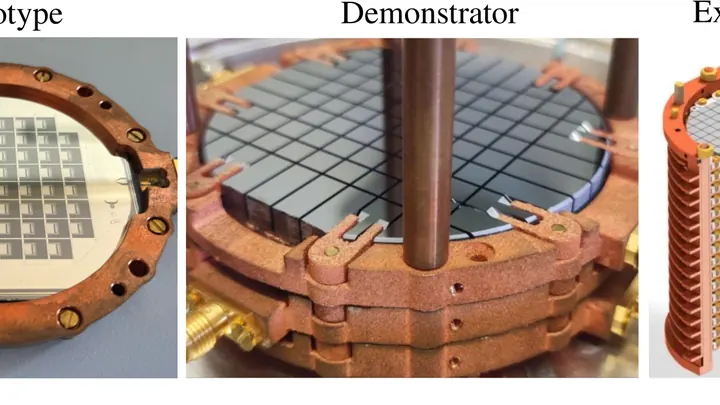
Dark matter is the invisible substance that holds galaxies together, yet it has so far escaped direct detection. The BULLKID-DM detector is designed to catch candidate particles with a mass around 1 GeV (roughly that of a proton) and an extremely weak interaction with ordinary matter — a…
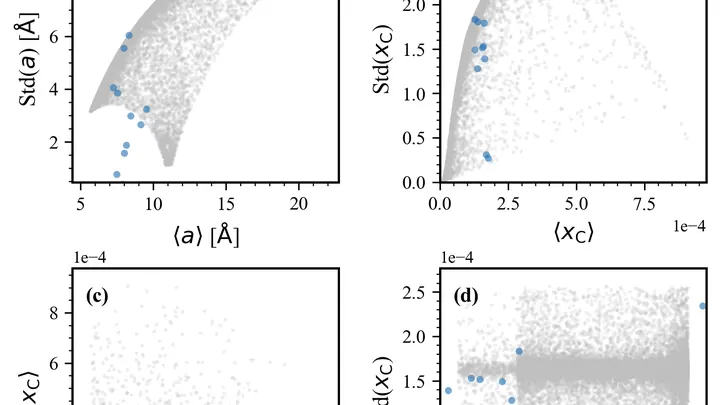
Cosmic dust isn't dirt: it's tiny grains, like soot from a campfire, scattered between the stars. Some of them spin at breakneck speeds, millions of times per second, emitting faint radio waves. Astronomers call this anomalous microwave emission: it interferes with studies of the early universe, but it's also a mystery in its own right.
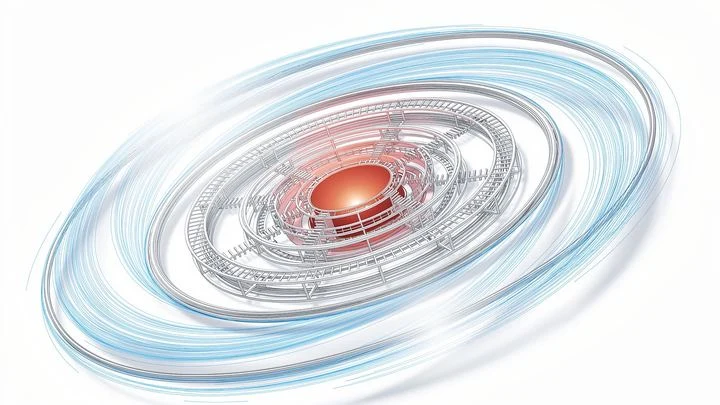
At the center of nearly every large galaxy sits a supermassive black hole. It pulls in gas and dust, and a bright disk swirls around it. But the James Webb Telescope looked further out — into a region where the black hole's light is weaker, yet the dust still glows.
Astronomers examined eight galaxies.
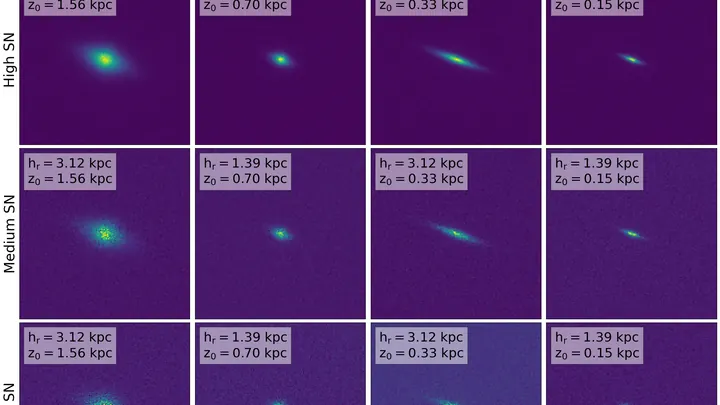
The James Webb Space Telescope peered 11 billion years back in time and spotted galaxies turned edge-on toward us. To measure their thickness, scientists devised a clever method: they calculated it the same way you'd measure the thickness of a slightly tilted pancake, not a perfectly flat one. Previous estimates were imprecise because they assumed an ideal angle.
Two houses with identical facades but different interior layouts: from the outside the V-shaped spectrum looks the same, but inside there are different light sources and different amounts of dust. That is exactly how the two populations of distant galaxies that astronomers have long confused appear.
At the center of the supernova remnant SN 1987A, 168,000 light-years from Earth, hides an object that astronomers have been seeking for 37 years. This is the closest supernova to have exploded in front of modern telescopes, and the only one where the compact remnant has yet to be seen directly.