Galactic evolution is the process by which galaxies form, change, and grow over cosmic time. It encompasses a wide range of phenomena, from the slow accumulation of gas and dust to dramatic mergers and the activity of supermassive black holes at galactic centers. The modern view treats galaxies not as static islands but as dynamic systems shaped by both internal processes and their environment, with stochastic events like supernovae and gas accretion playing a crucial role alongside more predictable dynamical evolution.
History
The concept of galactic evolution developed throughout the 20th century, with early work by Edwin Hubble on galaxy classification and later theoretical frameworks by astronomers like Beatrice Tinsley in the 1970s, who linked galaxy properties to their star formation histories.
How it works
Galaxies evolve through a combination of processes. Gas clouds collapse and fragment to form stars, while stellar feedback—winds, radiation, and supernova explosions—injects energy and heavy elements back into the interstellar medium, regulating further star formation. Supermassive black holes at galactic centers can also release enormous energy when they accrete matter, heating or expelling gas and quenching star formation. Dynamical interactions, such as galaxy mergers and tidal encounters, reshape galactic structure and trigger new bursts of activity.
In practice
Understanding galactic evolution is essential for interpreting observations from telescopes like Hubble and James Webb, and for building cosmological simulations that trace the growth of structure in the universe.
Fun fact
Some 'impossible' early galaxies observed by JWST appear too massive for the young universe, but recent measurements of their peculiar velocities suggest they may be brighter than they are massive, resolving the paradox.
An old city gains new suburbs. In the center, narrow streets where life has nearly stopped, while on the outskirts construction is booming. That is what a spiral galaxy looks like when its core stars have long aged and new stars are still being born in the outer disk.
Around a just-ignited star swirls a vortex of dust and gas. This vortex, the protoplanetary disk, grows by accreting material from the surrounding cloud.
The early universe was less like a calm pond and more like a boiling cauldron. Matter flowed, collided, and swirled against the backdrop of rapid spatial expansion. To understand how stars and galaxies emerged from this hot soup, physicists build digital simulations.
This new work is the third part in a series on lattice-based cosmological modeling. The first two focused on fields; this one deals with fluids.
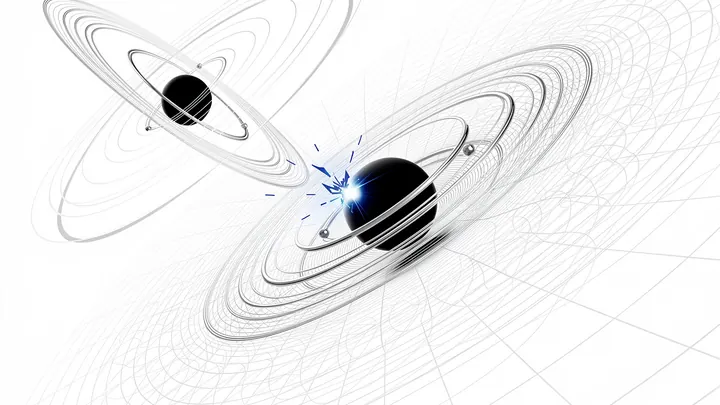
A galaxy collision is like a slow dance in which two partners gradually draw closer. Hidden at the center of each is a supermassive black hole — an invisible flywheel with a mass of millions or billions of suns.
Imagine a pot of boiling water. Toss in a handful of pasta, and it quickly overcooks and clumps into a sticky mess. But in a huge restaurant kettle where the pasta floats freely, each piece stays separate.
When the cooling cosmos, in the aftermath of the Big Bang, lost its primordial symmetry, tensions arose in the fields, like microcracks forming in solidifying glass. Global monopoles, predicted by Gerard 't Hooft and Polyakov, became such “scars” on the fabric of the universe. Each monopole is a tiny but incredibly massive knot of field.
At the heart of almost every galaxy slumbers a supermassive black hole — the invisible conductor of a stellar orchestra. When galaxies collide, their central monsters draw closer, entwining in a gravitational dance. Sometimes a third partner joins the duo, and then a triple waltz begins, its outcome unpredictable.
The universe hasn't always been expanding. In some models, it first contracted, nearly empty and flat, and then, upon reaching a limit, bounced back and started growing, like the world we know. This scenario is called bouncing cosmology.
Lenticular galaxies are the cosmic quiet types: they have a disk but no bright spiral arms. For a long time, their origin remained a mystery. A team of scientists ran the Hydrangea computer simulation and traced the fate of each galaxy from its youth to the present day.
On the mass–size diagram, these galaxies line up in a V shape.
Stars are born in cold clouds of cosmic dust and hydrogen. Inside these cocoons, protostars — the cores of future suns — were long thought to be just hot clumps. But it turns out many of them are powerful accelerators: they shoot out narrow jets of gas that, slamming into surrounding matter, produce invisible gamma-ray light.
At the center of a distant galaxy, a supermassive black hole is surrounded by a flat, rotating disk of gas and dust — a giant cosmic funnel of matter. A small compact object, such as another stellar-mass black hole, may find itself in this disk.
An artist paints a portrait stroke by stroke, and then someone offers them a flash camera — one click, and it's done. That's roughly the shift from multi-step models to one-step models in generating images of galaxies.
Typical neural networks for image synthesis work like a watercolorist: they apply a layer, blur it, add details.
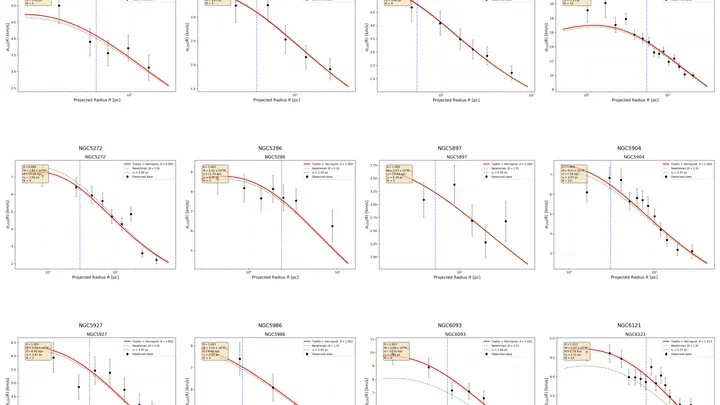
Globular clusters are dense 'balls' of hundreds of thousands of stars that orbit the center of the Milky Way. Some were born in our Galaxy, others were captured when the Milky Way swallowed dwarf satellite galaxies. They can be distinguished by chemical composition, but astronomers now have a new tool — dynamical age.
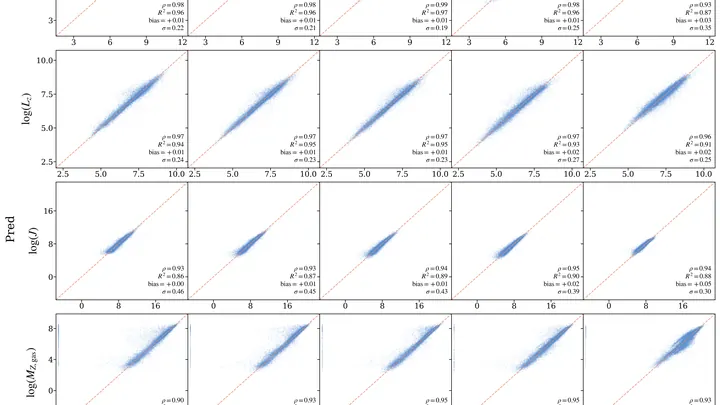
Studying the birth of galaxies requires simulating billions of years of dark matter growth and star formation — even supercomputers handle this slowly.
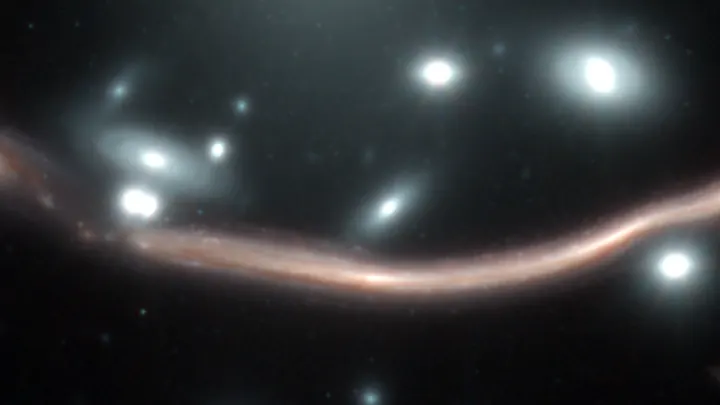
Light from the distant Dragon Galaxy has been traveling toward us for more than seven billion years. On its way, it passes by a huge galaxy cluster whose gravity bends the path of light like a lens. As a result, the galaxy appears brighter and larger than it really is, just as a magnifying glass enlarges fine print.
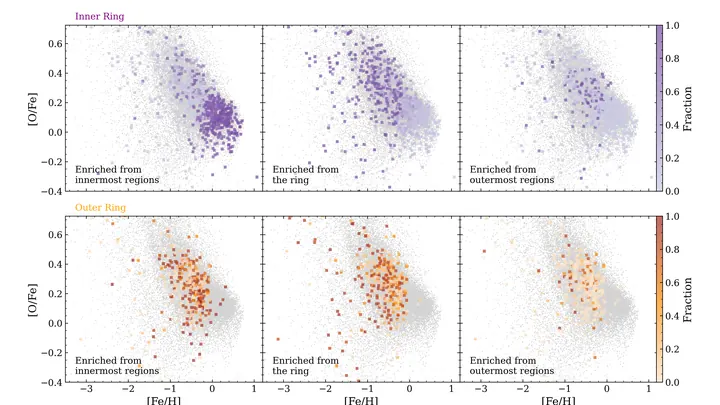
A star inherits the chemical makeup of its parent gas cloud, just like a child inherits genes from its parents. Astronomers turned this into a method: by measuring the fraction of carbon and other elements with spectroscopy (splitting light into colors), they construct family trees for the stars in a galaxy.
Drop two identical pebbles from a mountain peak: one lands a centimeter to the left, and a minute later they end up in different valleys. A galaxy is the same mountain, only with billions of pebbles and a slope that stretches over millions of years. The authors of a new study simulated a disk of 40 million point-like stars and tested how quickly it forgets where it started.
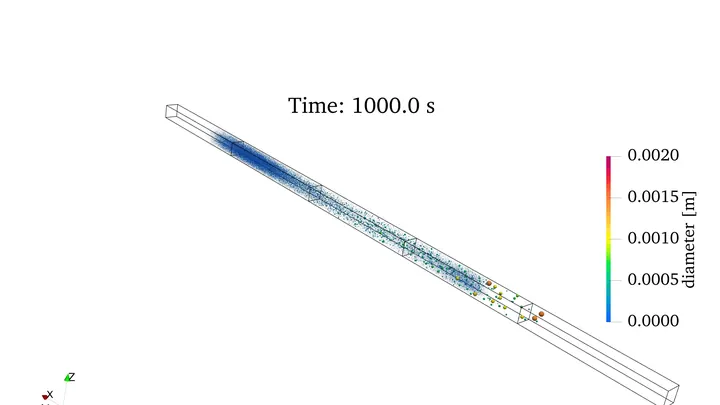
In a cloud, thousands of tiny water droplets hang in the air. For rain to fall, they need to grow: stick together into larger drops and become heavy enough to fall to the ground. But how exactly do droplets find each other in a huge cloud?
Scientists created a computer model that tracks each droplet individually, as if each one had its own little sensor.
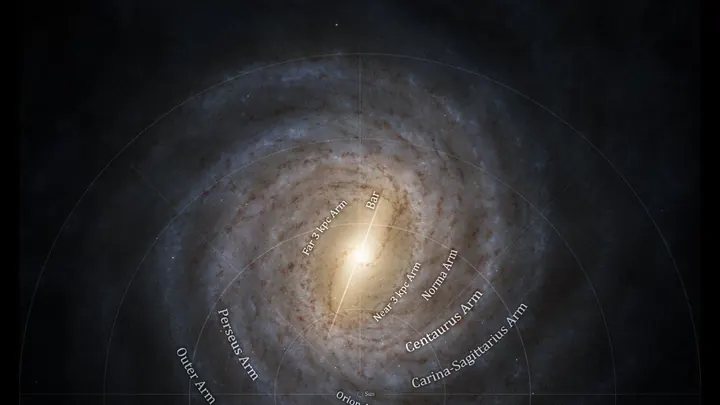
Other galaxies are just ancient snapshots, but we watch the Milky Way live. Comparing data over 30 years, scientists found that the Galaxy’s center is, like, speeding up: the supermassive black hole got heavier, swallowing the mass of a large asteroid each year; the stellar bar (a huge beam of billions of suns, like the…
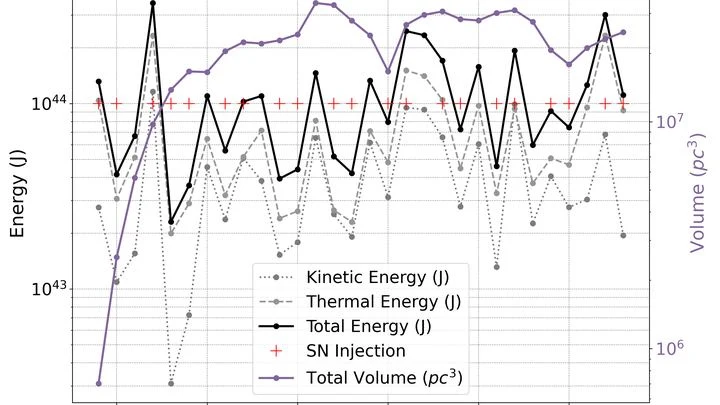
Superbubbles are cosmic giants, akin to soap bubbles, but instead of soap film, they contain rarefied interstellar gas, and they're inflated not by a breath but by a series of supernova explosions. In computer simulations, they behave like living things: they grow, cool, and move. But until now, we couldn't precisely trace their boundaries.
Ring-shaped reefs, atolls, are usually explained like this: corals grow along the edge of a volcanic island while the island slowly sinks. What's left is a hollow ring that can stretch for kilometers. But satellite images show similar rings around very small reefs where there are no volcanoes and no subsidence.
The Universe looks like a giant spiderweb: galaxies aren't scattered randomly but are gathered into knots and along filaments. Inside the filaments, there's plenty of gas, and that's where new stars most often flare up. But how has this changed over time? Scientists compared data from a computer model with real observations of thousands of galaxies.
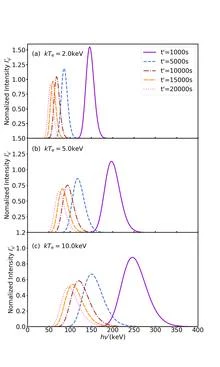
When a massive star dies and explodes, it releases not only light but also invisible lightweight particles. They fly out in all directions at nearly the speed of light. Only a small fraction reaches Earth, but each explosion sends its own clump. These clumps stretch along the way: fast particles overtake slow ones, and by the time they arrive, a clump can be spread over tens of thousands of years.
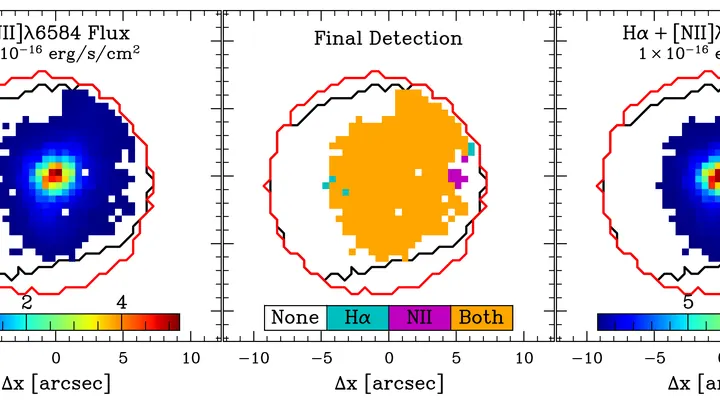
A galaxy cluster is like a busy intersection where galaxy-cars race through a headwind of hot gas. This wind, called ram pressure, strips galaxies of their cold gas — the fuel for star formation. Astronomers from the SAMI survey traced how this happens in hundreds of galaxies across eight nearby clusters.
On a high-speed highway, a steady flow of cars sometimes clumps into a traffic jam because of random slowdowns. In the young Universe, the overall expansion of galaxies after the Big Bang resembled this orderly movement. But each galaxy also performed its own maneuvers — braking or accelerating under the pull of neighboring galaxies.
On October 9, 2022, detectors on Earth recorded a gamma-ray burst of unprecedented power. GRB 221009A was so bright that its radiation ionized the upper layers of the ionosphere, and satellite instruments were temporarily blinded.
The Galaxy is a forest where birds don't start singing right away. First, trees must grow — stars, around which planets eventually appear. The Drake equation counts how many birds might be singing in this forest right now, but it implicitly assumes that their number doesn't change: as many as there are, that's how many there have always been.