Black Holes That Didn't Evaporate express
A campfire that doesn't go out all at once but smolders for hours because the wood inside still holds the heat of the past flame. That's roughly how the memory effect works for black holes. Normally, a tiny black hole with the mass of a mountain should evaporate in fractions of a second, scattering particles like sparks. But if it 'remembers' everything it has swallowed, the process slows down, and the hole lives for billions of years, surviving to this day.
Such survivors are excellent sources of neutrinos, ghostly particles that barely interact with matter. As a hole evaporates, it produces neutrinos of staggering energies — millions of times higher than anything the most powerful Earth-based accelerator can achieve.
Detectors like IceCube, a cubic kilometer of Antarctic ice studded with sensors, are trying to catch them.
The authors calculated what signal memory-holes would leave in IceCube and future facilities like IceCube-Gen2 and GRAND200k. It turns out that what matters is not just the average mass of the holes, but also the spread around it. If masses are broadly distributed, like the heights of people in a crowd, then light holes at the edge of the distribution produce an especially powerful neutrino flux.
This means such populations can be constrained more tightly than if all holes had the same mass.
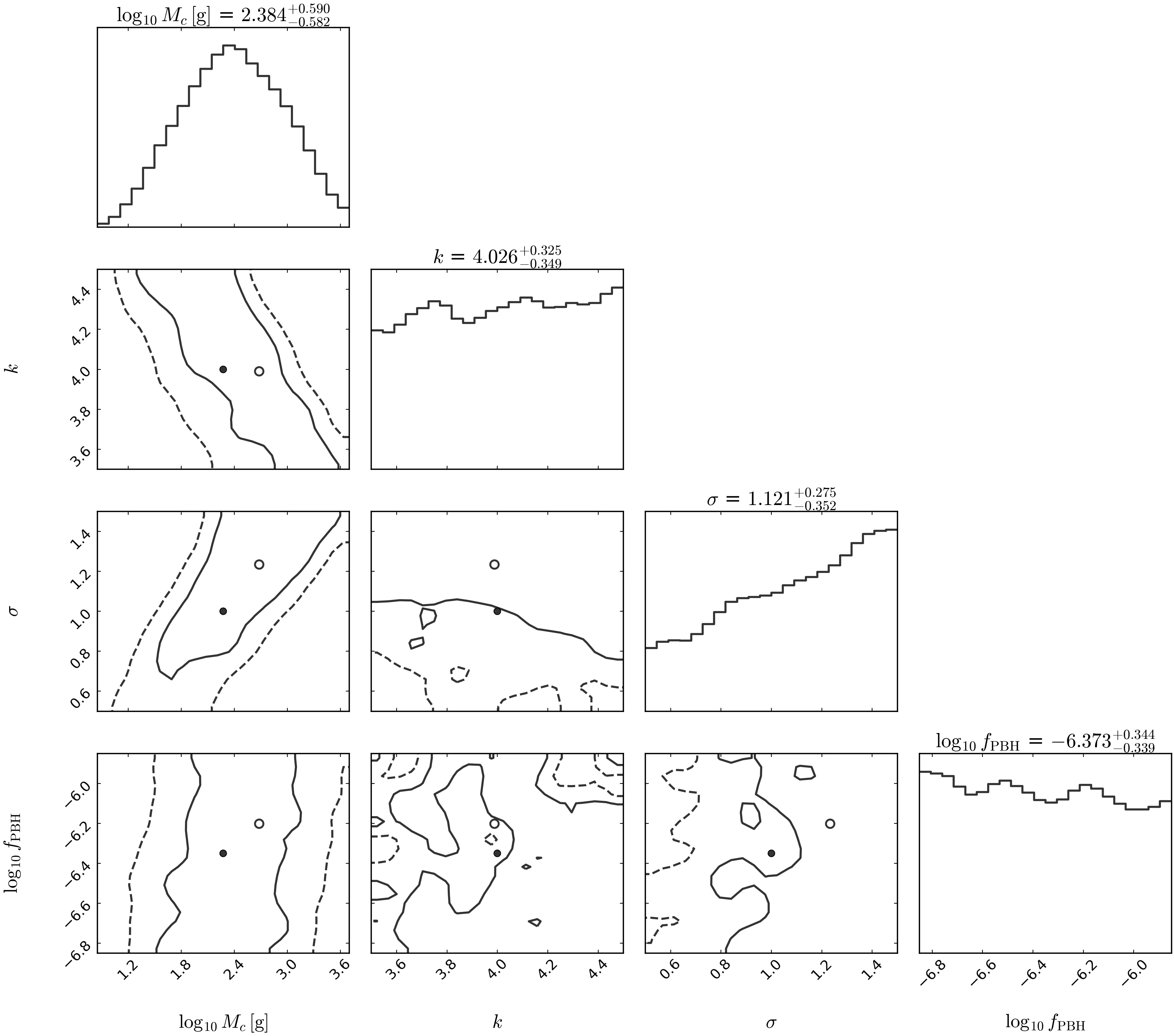
Moreover, if future detectors see about 30 neutrino events, one could try to distinguish whether the hole population is uniform or spread out in mass. It turns out that proving a spread is easier than proving its absence. This all feels like detective work: we peer into ice and radio waves to understand the invisible 'embers' of a long-extinguished cosmic fire.
Original abstract
as written by the authors arXiv:2608.08144v1
The memory-burden effect can suppress the late-time evaporation of primordial black holes (PBHs), allowing those below the standard Hawking evaporation threshold to survive until the present epoch. These lighter PBHs emit high and ultra-high-energy neutrinos, opening the tentalizing possibility of discovery via neutrino telescopes. We study the constraints on memory-burdened PBHs from current IceCube HESE, MESE, and EHE data; and forecast the sensitivity reach of IceCube-Gen2 radio and GRAND200k. In particular, we study how this signal depends on whether the surviving population is described by a log-normal mass function or by a monochromatic one. We find that log-normal distributed populations can be more strongly constrained than monochromatic populations with the same median mass primarily because their low-mass tails enhance the high-energy neutrino flux. We show that current IceCube data provide the leading limits for a lower memory burden parameter $$k$$, whereas the projected radio detectors become substantially more sensitive for higher values of $$k$$. We also study a scenario where future experiments would see a positive signal coming from PBHs. We consider a representative 30-event signal in IceCube-Gen2 and GRAND200k and study how well one could distinguish the two mass-function hypotheses. We find that it is easier to disfavor the monochromatic distribution when the log-normal distribution is assumed to be true. Finally, we study how well the parameters of the memory-burdened PBHs can be estimated in these future experiments.
Neutrinos interact so weakly with matter that they can pass through the Earth like light through glass. To catch even one, detectors the size of a cubic kilometer are built.
In Peter Watts's novel Blindsight, alien probes use black holes as weapons, but here, conversely, long-lived holes become beacons revealing the secrets of the early universe.