The black hole memory effect refers to the permanent imprint that violent events, such as mergers or matter infall, leave on a black hole's geometry and oscillations. When a black hole is perturbed, it rings like a bell, emitting gravitational waves in a characteristic set of frequencies called quasinormal modes. The memory effect is a lasting change in the spacetime curvature — a kind of 'gravitational memory' — that persists after the oscillations have died away, encoding information about the event that caused the disturbance.
History
The concept of gravitational memory was first discussed in the 1970s by Ya. B. Zel'dovich and A. G. Polnarev, and later formalized in the context of asymptotic symmetries by Bondi, van der Burg, Metzner, and Sachs. The specific application to black hole oscillations and evaporation is a topic of active research in the 2020s.
How it works
When matter or gravitational waves pass near a black hole, they permanently displace the spacetime fabric, shifting the relative positions of test particles. This is analogous to a spring that, after being stretched and released, returns to a slightly different rest length. In the context of black holes, the memory effect modifies the black hole's mass, spin, and the asymptotic structure of spacetime. Recent studies suggest that this memory can also affect the black hole's evaporation rate, as the altered geometry changes the quantum radiation process.
In practice
The black hole memory effect is a target for gravitational wave observatories like LIGO and LISA, as detecting it would confirm a fundamental prediction of general relativity and provide a new probe of strong-field gravity.
Fun fact
The memory effect is so subtle that a single gravitational wave event from a distant merger would permanently shift the distance between Earth and the Moon by less than the width of an atom.
A campfire that doesn't go out all at once but smolders for hours because the wood inside still holds the heat of the past flame. That's roughly how the memory effect works for black holes. Normally, a tiny black hole with the mass of a mountain should evaporate in fractions of a second, scattering particles like sparks.
The first moments after the big bang: space expands rapidly — physicists call this period inflation. Inside this swelling fabric, like soap bubbles in a stream of air, regions of new vacuum begin to form — a first-order phase transition. Most bubbles pop or merge as soon as they appear.
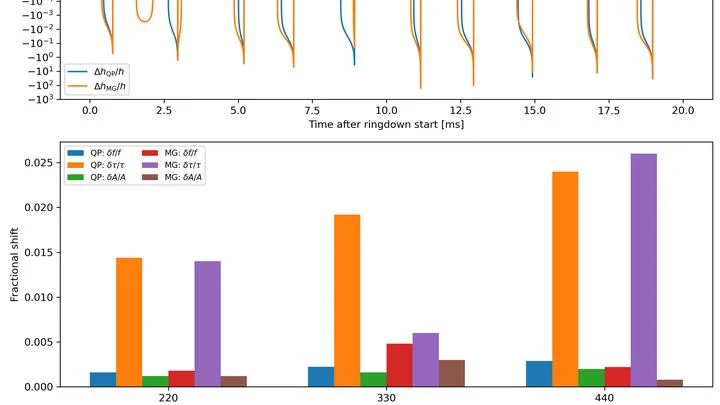
After a hit, a black hole rings like a bell. But instead of sound, it emits gravitational waves whose frequency rapidly decays: these are called quasinormal modes. From such a 'ring,' you can infer the hole's mass, spin, and other properties.
A black hole rings like a bell when something massive falls into it. This ring is gravitational waves, and its overtones tell us about the shape of the horizon.
Wormholes — tunnels through curved spacetime, allowed by general relativity. To be stable, they need repulsive energy — the kind that pushes apart rather than attracts.
Gravitational waves are the very trembling of space, born when black holes or other massive bodies collide. Their main oddity isn't that they pass through us, but that they permanently alter the curvature of spacetime and the distances between everything they touch.
A giant black hole tore apart a star, leaving behind a lopsided disk of scorching gas — like a vinyl record warped by the heat. Now a tiny black hole (or a star) zips around and repeatedly pierces that disk. Each puncture is a bright X-ray flare.
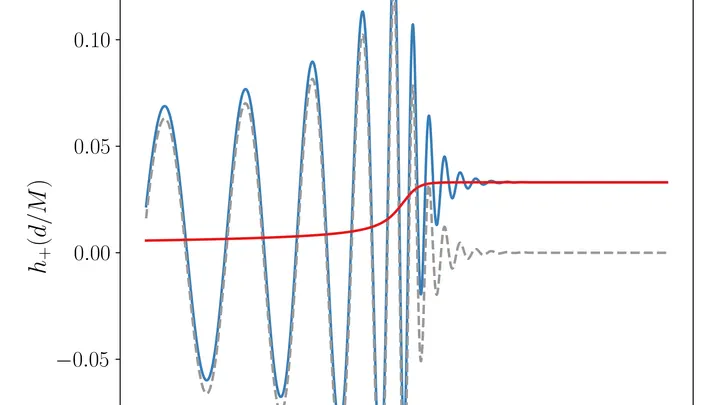
A black hole collision isn't just a burst of gravitational waves; it also leaves a lasting trace: an eternal curvature of spacetime — gravitational memory. Like a boat on water leaves a lingering wake, the cosmos 'remembers' the catastrophe.
A black hole doesn't just swallow everything around it: it also slowly evaporates, like a chunk of ice in the sun. As the hole shrinks, the quantum fields around it start behaving unusually. In a new study, physicists traced how entanglement, a special kinship between particles that persists even when they are far apart, changes.
A black hole, perturbed by a merger, vibrates at characteristic resonant frequencies — much like a bell ringing after being struck. Each hole has its own spectrum of these oscillations, allowing astronomers to reconstruct its parameters.
Gravitational wave detectors work like sensitive microphones, picking up the trembling of space from distant cosmic catastrophes. When two black holes merge into one, the newborn object rings like a bell, and that ringing is a unique 'voice' of gravity.
A swarm of mirrors and antennas envelops a black hole like bees around a hive. But instead of honey, this structure collects energy enough to power a consciousness the size of a galaxy. These very 'Dyson minds' were the topic of a recent meeting at MIT. The idea traces back to [scientist:F. J.
A bell struck by a hammer hums softer and softer. Its ring fades smoothly, like ripples on water after a stone is tossed in. A black hole behaves much the same way after colliding with another hole: it shudders, and those shudders, gravitational waves, fly off into space, gradually weakening.
Drop a stone into a pond — the ripples spread and fade away. A black hole, after colliding with another hole or a star, also 'rings', but its oscillations are not simple. Near the hole, 'overtones' sound — secondary waves born from the nonlinearity of spacetime itself.
The early universe was an extremely hot and dense medium. In this medium, like bubbles of steam in boiling water, bubbles of a new state of space spontaneously emerged — regions where physical properties changed abruptly.
A guitar string after being plucked produces not only the fundamental note, but also quiet overtones. A similar phenomenon appeared in the gravitational waves from the merger of two black holes (event GW250114).
Every evening, in the city archive, the attendant places new folders on the shelves. If too many arrive during the day, the shelves sag, and the next morning the archive responds to requests more slowly. A black hole's memory works in much the same way: it doesn't just store information, it physically feels its weight.