A Drop on Glass: Why Solution Elasticity Doesn't Change the Stain express
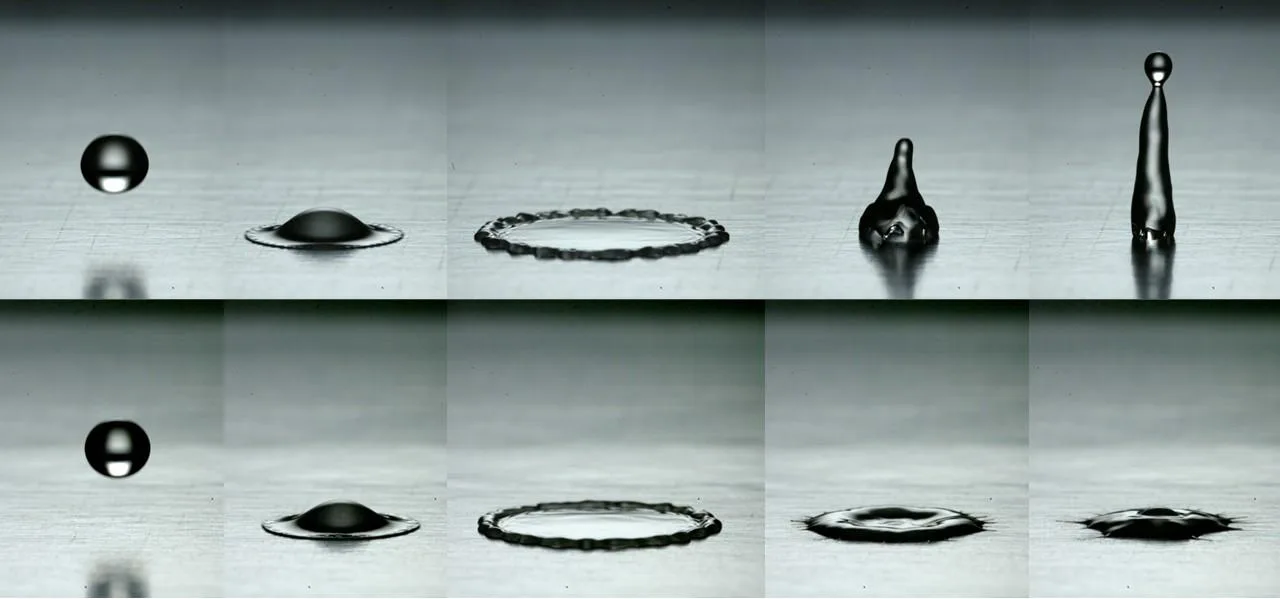
A raindrop falls on glass and flattens into a pancake. Add a bit of polymer to the water, and it becomes elastic, like jelly. You'd think such a jelly would spread differently. But experiments with solutions of polyethylene oxide and polyacrylamide showed that the maximum stain radius doesn't change even at a concentration of 1000 ppm (one part per thousand).
The reason is that elastic forces in the drop during impact are negligible compared to inertia and viscosity. The researchers derived a dimensionless criterion Γ (gamma) that estimates the contribution of elasticity. For all experiments, Γ turned out to be much less than one — meaning elasticity truly doesn't matter. This contradicts predictions based on the Weissenberg and Deborah numbers, which are often used to assess elastic effects.
This result simplifies modeling: to calculate the maximum spreading of an elastic drop, you only need its density, velocity, viscosity, and surface tension. Polymer additives, often used in paints and inks, won't change the stain size upon impact: they only prevent splashing and rebound.
Elastic liquids, like jelly, can 'remember' their shape: if you pull quickly, they snap, but if you pull slowly, they stretch like chewing gum.