Light Flows Without Friction: Three Ways to Measure the Limit
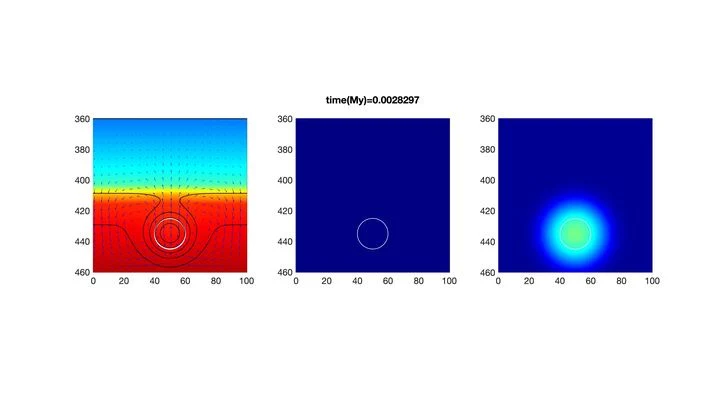
In a Paris laboratory, light was made to flow around an obstacle the way water flows around a rock in a stream. But this water is special: it feels no friction.
Water in its liquid state, considered essential for life as we know it.Liquid water is the state of water where molecules are in constant motion but remain loosely bound by hydrogen bonds, giving it a definite volume but no fixed shape. It is essential for life as we know it, serving as the solvent for biochemical reactions, a temperature regulator, and a transport medium in organisms. Its unique properties, such as high specific heat capacity, high surface tension, and anomalous density behavior (maximum density at 4°C), arise from the dynamic network of hydrogen bonds.
The understanding of water's structure has evolved over centuries, with the hydrogen bond concept introduced by Linus Pauling in the 1930s, but the full complexity of liquid water's dynamics remains an active research area.
In liquid water, each molecule forms about 3.4 hydrogen bonds on average, constantly breaking and reforming on a picosecond timescale. This network is responsible for water's high boiling point, its ability to dissolve many substances, and its unusual thermal properties. The hydrogen bonds are electrostatic attractions between the slightly positive hydrogen atoms of one molecule and the slightly negative oxygen atoms of another.
Liquid water is used as a coolant in nuclear reactors, a solvent in chemical manufacturing, and a working fluid in power generation. Its properties are also critical in climate modeling and biological research.
Liquid water can exist in two distinct liquid phases at very low temperatures, a phenomenon known as liquid-liquid phase transition, which is still not fully understood.