Levitating Without Magic: Magnetic Trap Holds a Sphere express
A magnetic top that doesn't fall. A tiny sphere of yttrium iron garnet hovers in midair, held by invisible forces. This isn't a magic trick but a Paul trap — an alternating magnetic field that rapidly changes direction and keeps the sphere from falling, like a juggler tossing balls.
Inside the sphere live magnons — quanta of magnetic waves, like ripples on a pond. These waves are strongly coupled to the sphere's motion. The scientists calculated that the coupling can become stronger than the energy losses, even at room temperature. This means the sphere's motion and the magnetic waves can exchange information without loss.
Such a levitating sphere is a candidate for quantum memory: a device that stores quantum information. Magnons could serve as intermediaries between motion and light, connecting different quantum systems. The first step is to trap the sphere and measure its trembling. The next is to learn to control its motion using magnons.
Original abstract
as written by the authors arXiv:2608.12752v1
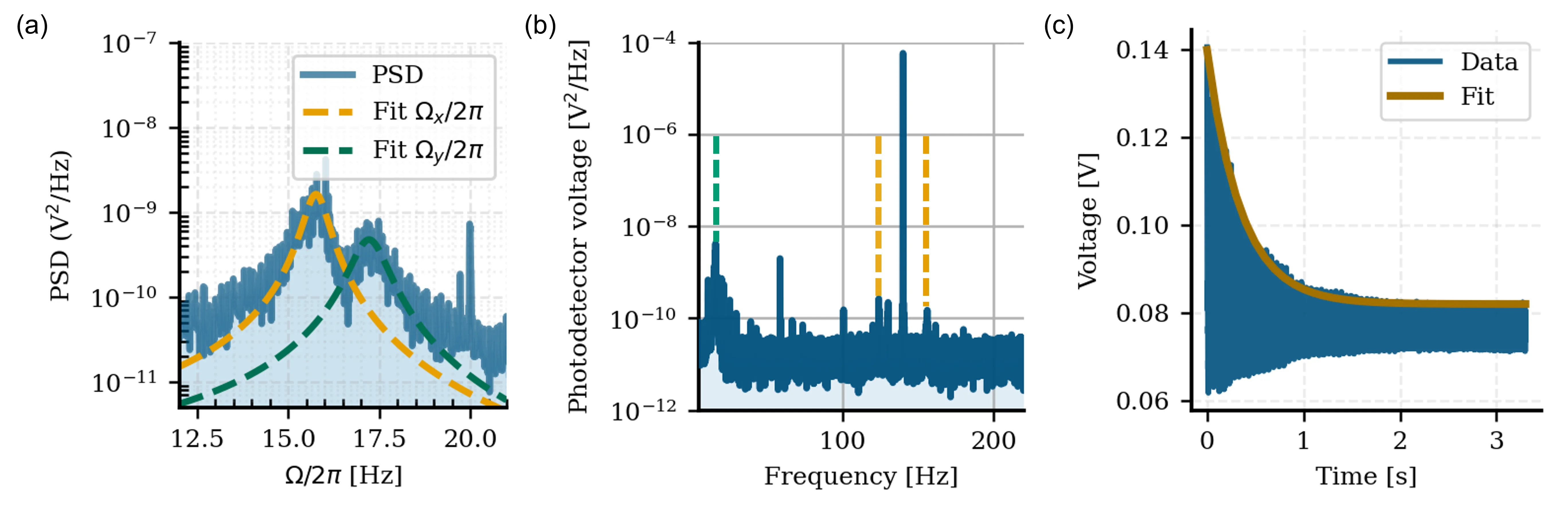
Magnetic levitation offer passive levitation of massive objects for use in advanced inertia sensors, for the generation of non-classical macroscopic motional states, and towards the table-top testing of low energy gravity with quantum mechanics. Magnons, a quanta of spin wave, couple to many physical quantities and strongly to electromagnetic fields, even at room temperature. In this work we demonstrate the stable trapping of a small YIG sphere using a magnetic Paul trap. We present a classical stability analysis of a magnetic Paul trap and show the stability diagram for all mechanical degrees of freedom. We show that coupling between librational and translational modes changes the stability region. We experimentally levitate the soft magnet yttrium iron garnet at room temperature obtaining Q-factors of $$\sim25$$ and secular frequencies $$15.8$$ Hz and $$17.2$$ Hz. We provide numerical estimates of the achievable enhanced coupling between the center-of-mass motion and excited magnon modes, with a cooperativity above unity despite strong mechanical damping, indicating potential applications in quantum information processing, quantum interconnects and quantum memories.
Yttrium iron garnet is a transparent crystal used in microwave filters and lasers. Its magnons live longer than in other materials, which is why it's so interesting for quantum experiments.