Magnetic layers that glow and remember express
In an ordinary semiconductor, it is hard to get two things at once: strong magnetism and a tightly bound electron-hole pair that is born when light is absorbed. Magnetic impurities, which make a material magnetic, also prevent the electron and hole from staying together: they are like noisy neighbors that do not let the pair exist in peace.
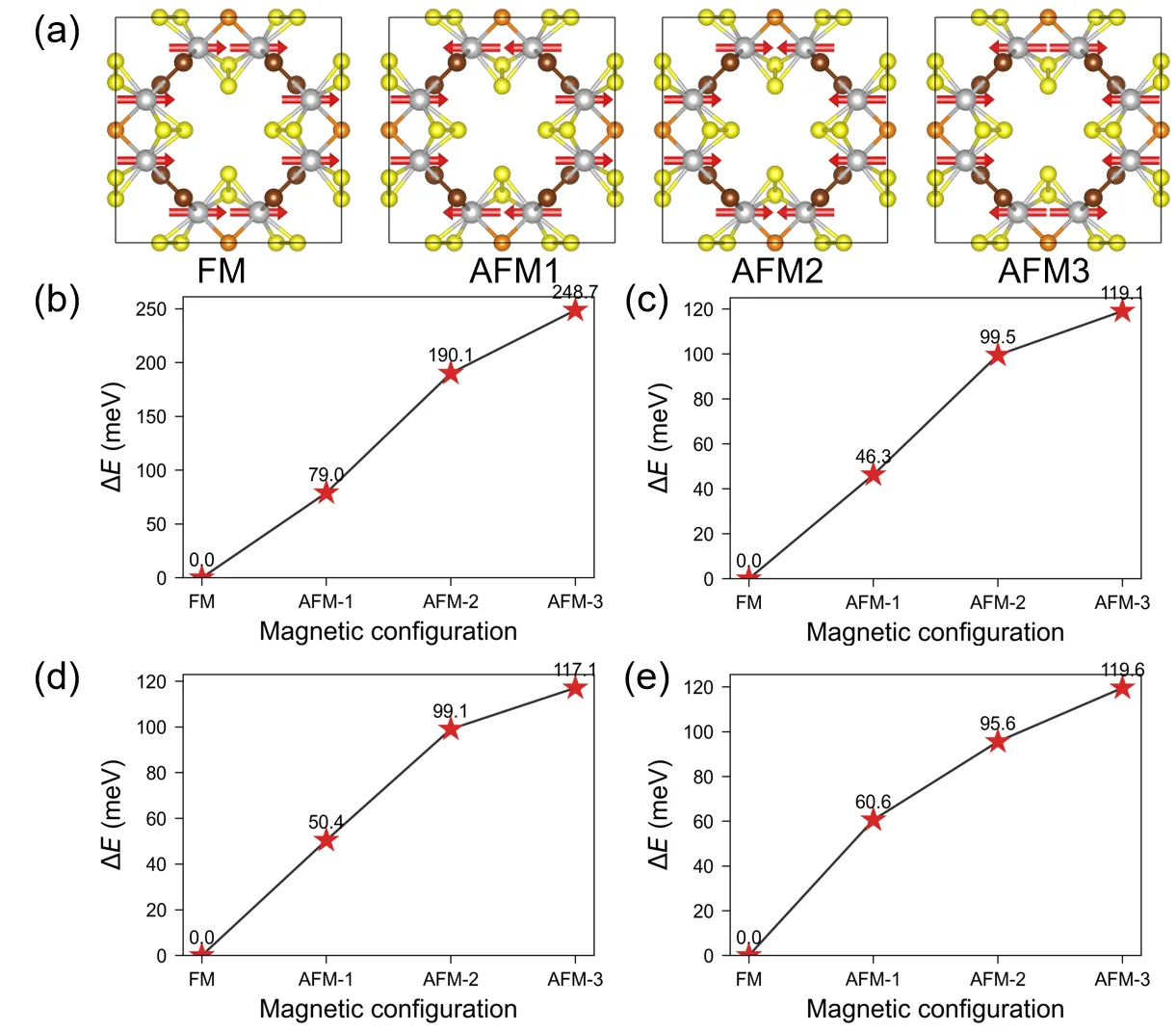
A new approach assembles the material from pre-made V4S9X4 clusters (where X is fluorine, chlorine, bromine, or iodine). Inside each cluster there are localized states that are responsible both for the magnetic moment and for the strong attraction between the electron and hole. Between clusters, a coupling arises that aligns their magnetic moments in one direction: this produces ferromagnetism. As a result, a two-dimensional layer remains magnetic up to 507.6 kelvin, that is, above room temperature.
This layer has two types of excitons. The dark exciton lives long—1.20 nanoseconds, and stores spin information. The bright exciton emits light very quickly, in 86.87 picoseconds. This difference allows the material to respond quickly to light while remembering the spin state for a long time. And if you switch the magnetic order from ferromagnetic to antiferromagnetic, the exciton lifetime changes over a wide range, while the binding energy barely suffers.
This trick, assembly from clusters, gives engineers a new way to design materials where light, spin, and magnetism work together at room temperature. Such layers could become the basis for quantum information devices and fast optical electronics.
Original abstract
as written by the authors arXiv:2608.13093v1
Room-temperature spin-optoelectronic devices require a combination of robust ferromagnetism and giant exciton binding, a pairing mutually exclusive in conventional semiconductors due to magnetic localization that screens excitons. Cluster-assembled V4S9X4 (X = F, Cl, Br and I) monolayers overcome this bottleneck via a hierarchical design, that is, intra-cluster localized states host both local magnetic moments and strong electron-hole interactions, while inter-cluster coupling mediates long-range ferromagnetism. Remarkably, these two-dimensional semiconductors exhibit intrinsic ferromagnetism with Curie temperature up to 507.6 K. As a prototype, V4S9Br4 monolayer possesses a giant exciton binding energy of 1.85 eV. Its lowest exciton is a dark state (DI) with a radiative lifetime of 1.20 ns, whereas the first bright exciton (BI) exhibits an ultrafast radiative decay of 86.87 ps. This stark lifetime contrast enables simultaneous ultrafast optical response and long-lived spin information storage. Most notably, switching between ferromagnetic and antiferromagnetic order allows for wide-range tuning of exciton lifetime, with the giant binding energy remaining nearly intact. Our findings establish cluster assembly as a powerful paradigm for designing next-generation spin-photonic and quantum information devices operating at room temperature.
The dark exciton in V4S9Br4 lives 14 times longer than the bright one, even though it is the same electron-hole pair, just with the spins oriented differently.