Heat Without Wires: Metal and Ferroelectric express
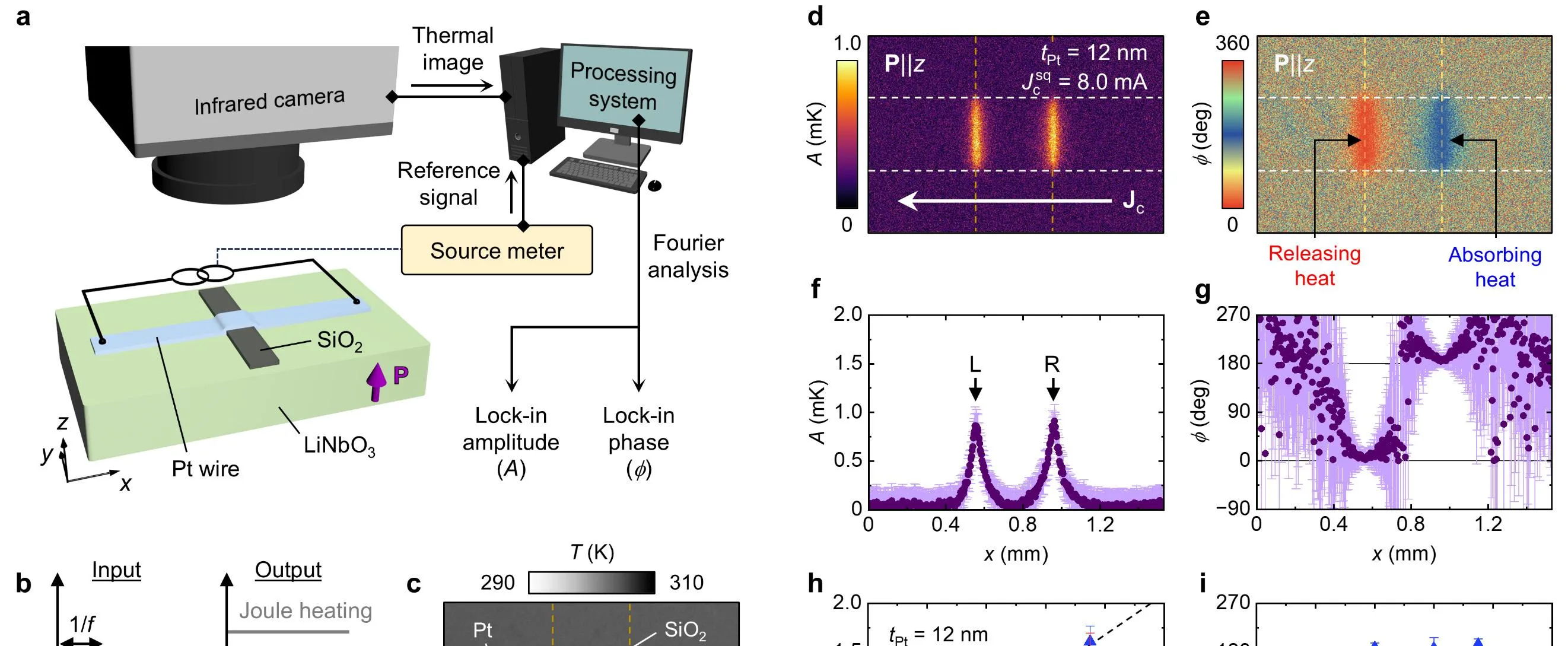
If you run a current through two soldered conductors, the junction heats up or cools down: that's the Peltier effect, which powers car refrigerators. But in the new experiment, there was no junction and no current across the boundary: a piece of homogeneous metal simply lay next to a ferroelectric crystal (a material where electric charges are displaced like compass needles). The metal changed temperature.
Inside the ferroelectric, collective waves, ferrons, ripple like the wake of a stone thrown into a pond. Electrons in the metal, like boats on water, start to bob in time with the ripples. The waves transfer energy across a tiny gap, and the metal heats up or cools down depending on the crystal's polarization direction.
This means that lattice vibrations, phonons, also come into play. They act like bridges, carrying heat further. The discovery could be both a nuisance and a boon for microelectronics: on one hand, unwanted heating in chips; on the other, a new way to cool or heat precisely without wires or contacts.
Original abstract
as written by the authors arXiv:2608.15596v1
The Peltier effect induces a heat current when a charge current passes through a conductor. Since a charge current is conserved at the junction between two different conductors, the difference between the heat flowing in both conductors for the same charge current leads to heating or cooling of the interface, providing an operating mechanism of solid-state heat pumps. Here, we report observation of heat absorption and release signals even in a junction-free, homogeneous metal when placed in proximity to a ferroelectric insulator. Our experiments using active thermographic imaging techniques confirm the prediction of the ferron-drag effect, i.e., the nonlocal excitation of ferrons, the collective excitation of the ferroelectric order, by conduction electrons in the adjacent metal. We reveal the electric-polarization-direction dependence of the temperature change signals and their unexpected increase with the metal thickness beyond the charge screening length, uncovering additional electron-phonon-ferron interactions in the metal/ferroelectric hybrid structure. The discovery of crosstalk between metals and ferroelectrics via remote ferrons could become both a nuisance and an opportunity for highly integrated circuits with ferroelectric barrier materials and revolutionize the design architecture of thermoelectric devices.
Ferroelectrics are used in motion sensors: when you walk past, the heat of your body slightly changes their polarization, triggering a signal.