Charge transfer is the movement of electric charge from one material or layer to another, fundamentally altering the electronic properties of the system. This process is central to many phenomena in condensed matter physics, from the generation of electricity at material interfaces to the behavior of complex materials like high-temperature superconductors and organic semiconductors. It explains how contact between different materials can create electric fields, how light can induce charge separation in photovoltaic cells, and how charge accumulation affects the performance of electronic devices.
History
The concept of charge transfer has been studied since the early 20th century, with foundational work on contact electrification and semiconductor junctions. However, the modern understanding of charge transfer in complex materials and at interfaces developed in the latter half of the 20th century, particularly with the advent of surface science techniques.
How it works
Charge transfer occurs when electrons (or holes) move from a region of higher electrochemical potential to one of lower potential, often across an interface. This can be driven by differences in work functions, applied voltages, or photon absorption. The transferred charge creates an electric field that modifies the band structure near the interface, leading to effects like band bending, the formation of depletion layers, or the creation of bound states such as trions.
In practice
Charge transfer is exploited in virtually all electronic devices, including transistors, solar cells, and batteries. It is also key to emerging technologies like organic electronics and perovskite solar cells, where efficient charge separation at interfaces is critical.
Fun fact
When you rub a balloon on your hair, the charge transfer that makes it stick is the same fundamental process that governs the operation of the most advanced semiconductor devices.
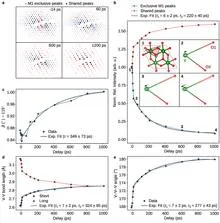
The camera captures not a race but a dance of atoms. In vanadium dioxide, the transition from an insulating to a metallic state occurs within trillionths of a second, yet until now no one had seen exactly how the vanadium and oxygen atoms move. Now, ultrafast electron diffraction has captured this route frame by frame.
A hunter sets snares in the woods. They know the animal's habits but not whether it will ever show up. In much the same way, physicists set up detectors in hopes of catching particles of dark matter — the invisible substance thought to make up most of the Universe's mass.
A new study offers hunters an unusual tool: not a trap, but a measuring tape.
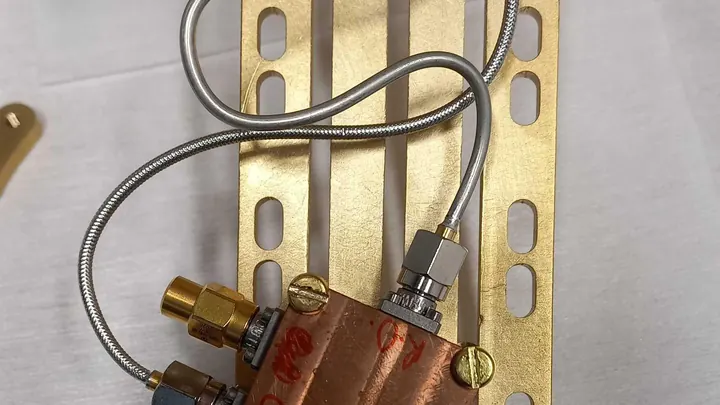
Crystals glued to the outside and inside of a metal wall act as an invisible channel. One, receiving current, starts to tremble, and these vibrations, like ripples on water, spread out in all directions through the metal. The inner crystal catches this tremor and generates electricity again.
Imagine a skyscraper assembled not from individual bricks but from entire studio apartments. That's exactly how the Au₆Te₁₂Se₈ crystal is built: its nodes are not atoms but superatomic clusters of gold and chalcogens that behave as single quantum objects.
An ordinary crystal is like an apartment building: electrons move through shared hallways and staircases, influencing each other through the walls. Now, imagine removing all the walls, leaving just a single line of apartments. How would the residents behave?
Hydrogen has nothing to do with it, but the collective behavior of electrons takes center stage.
An electron flying through a gas is like a swimmer trying to cross a crowded pool. Each collision with an atom changes its course and speed. In dense argon gas, there are so many collisions that a simple description no longer works.
Physicists measured electron mobility — how easily electrons drift under an electric field.
A rug lies flat, but if you push it from the edge, wrinkles run across it. In a thin film of tantalum sulfide (1T-TaS2), wrinkles made of electrons, charge waves, freeze as if the rug were stuck to the floor. To move them, you need to apply force. Scientists have found a way to control this force using an electric field and a magnet.
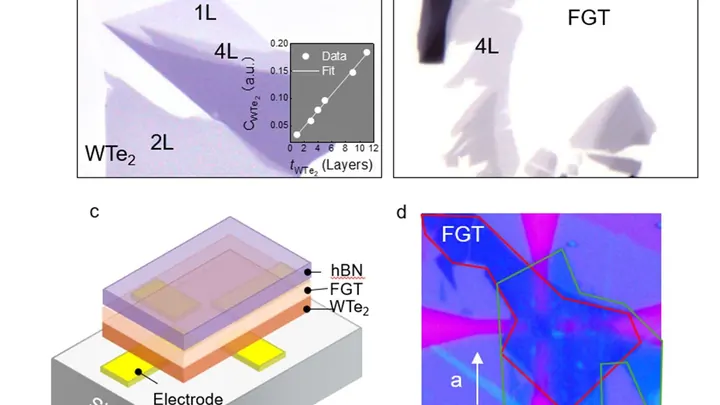
Usually, current in a metal acts like boiling water on ice: it heats the material and destroys magnetic order. But in a layered structure of tungsten ditelluride and the ferromagnet Fe3GeTe2, current behaves differently.
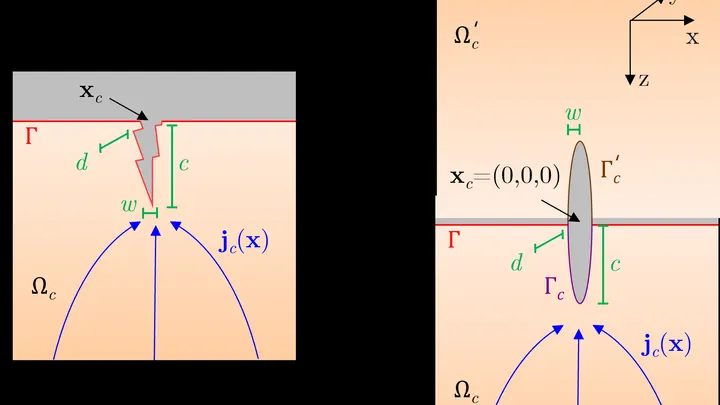
A metal filament as thin as a hair grows through the ceramic like a root through asphalt. In solid-state batteries, such filaments are called dendrites, and they appear when the charging current exceeds a critical threshold. The ceramic electrolyte is solid but brittle, like glass.
Normally, current flows equally well in both directions if there's no magnet. A magnetic field or magnetic material breaks that symmetry: electrons start to prefer one direction. But in a new study, physicists found a way to do without magnets.
In a crystal, atoms may not sit perfectly ordered but with some disorder.
A quantum computer is like an orchestra where every musician must hit their note without going flat. But superconducting qubits share a common ailment: random charges accumulate on their electrodes, and the 'note' drifts. Engineers call this charge offset drift, and usually battle it for years.
In a superconductor crystal, electrons sometimes arrange themselves into charge waves, like ripples on water, but made of the particles themselves. Some waves stretch far, while others live only over short stretches. Scientists took the material YBa$$_2$$Cu$$_3$$O$$_{6.67}$$ and hit it with short X-ray pulses to observe both types of waves.
When two different materials are pressed together and then pulled apart, a spark jumps between them. Anyone who has pulled off a wool sweater in the dark or gotten a shock from a doorknob knows the feeling. For a long time, it was thought that charges simply hop from one surface to another due to differences in material properties.
Light in semiconductors is born from pairs of charges, an electron and a hole, that attract each other like a magnet to a fridge. Such a pair is called an exciton. If you add one more charge to the pair, you get a trion — a trio of three particles.
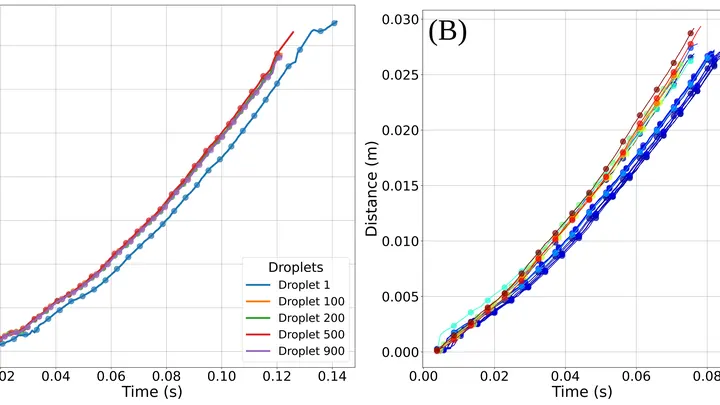
A water droplet races across a taro leaf like a bead on a freshly waxed floor. But it doesn't just glide: it picks up electricity. Thirty years ago, scientists explained why lotus leaves stay dry: their surface is covered with microscopic bumps that trap air. Now it turns out that water on leaves has another, hidden power.
Diamond is not just a gemstone. This crystal can conduct electricity when free charge carriers, electrons and holes, appear in it. But how fast do they move? In scientific papers, numbers vary by tens of times. One lab reports a mobility of 1000 cm²/(V·s), another 4000.
After an injection under the skin, a drug doesn't just spread out like ink in water. Antibody molecules carry an electric charge, and that charge makes them interact with surrounding tissues — much like a magnet attracts or repels iron filings.