Heat Without Wires: Metal and Ferroelectric express
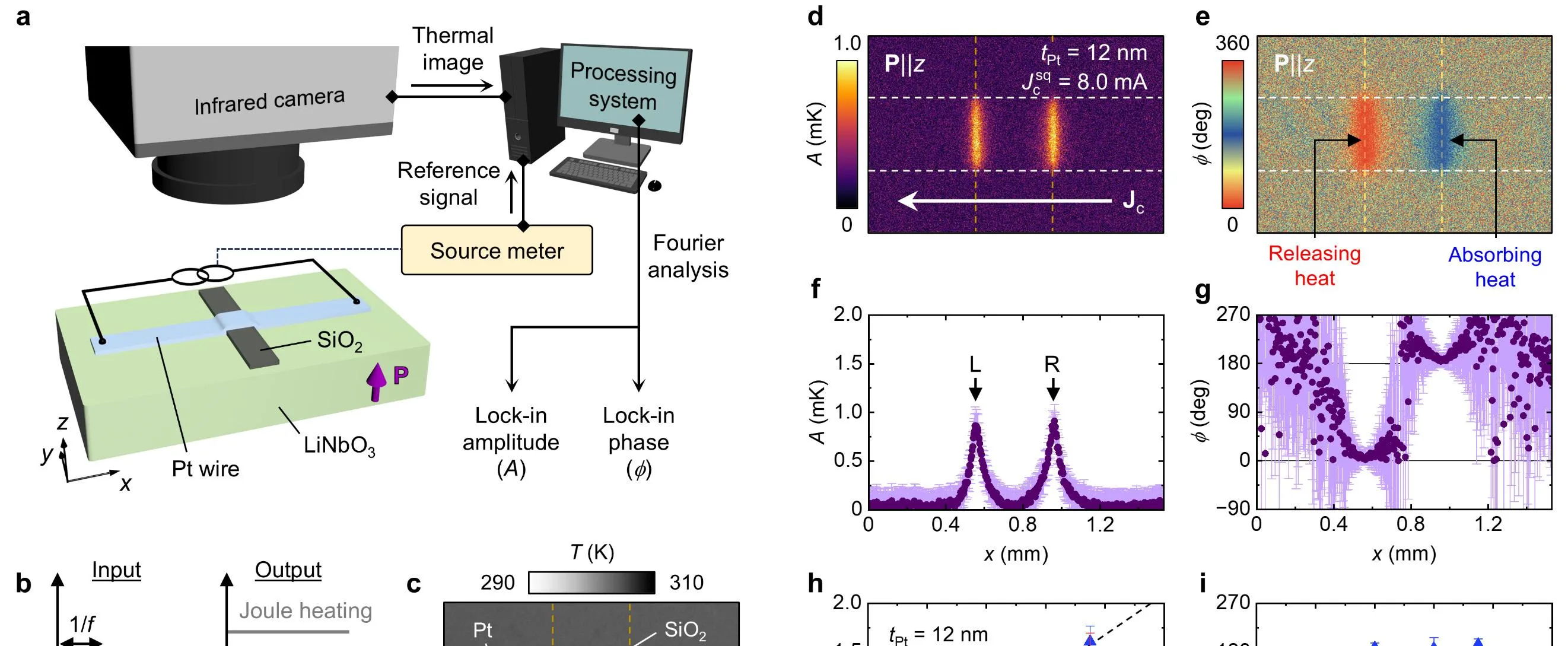
If you run a current through two soldered conductors, the junction heats up or cools down: that's the Peltier effect, which powers car refrigerators. But in the new experiment, there was no junction and no current across the boundary: a piece of homogeneous metal simply lay next to a ferroelectric crystal (a material where electric charges are displaced like compass needles). The metal changed temperature.
Inside the ferroelectric, collective waves, ferrons, ripple like the wake of a stone thrown into a pond. Electrons in the metal, like boats on water, start to bob in time with the ripples. The waves transfer energy across a tiny gap, and the metal heats up or cools down depending on the crystal's polarization direction.
This means that lattice vibrations, phonons, also come into play. They act like bridges, carrying heat further. The discovery could be both a nuisance and a boon for microelectronics: on one hand, unwanted heating in chips; on the other, a new way to cool or heat precisely without wires or contacts.
Ferroelectrics are used in motion sensors: when you walk past, the heat of your body slightly changes their polarization, triggering a signal.