Quantum Relief of a Monolayer express
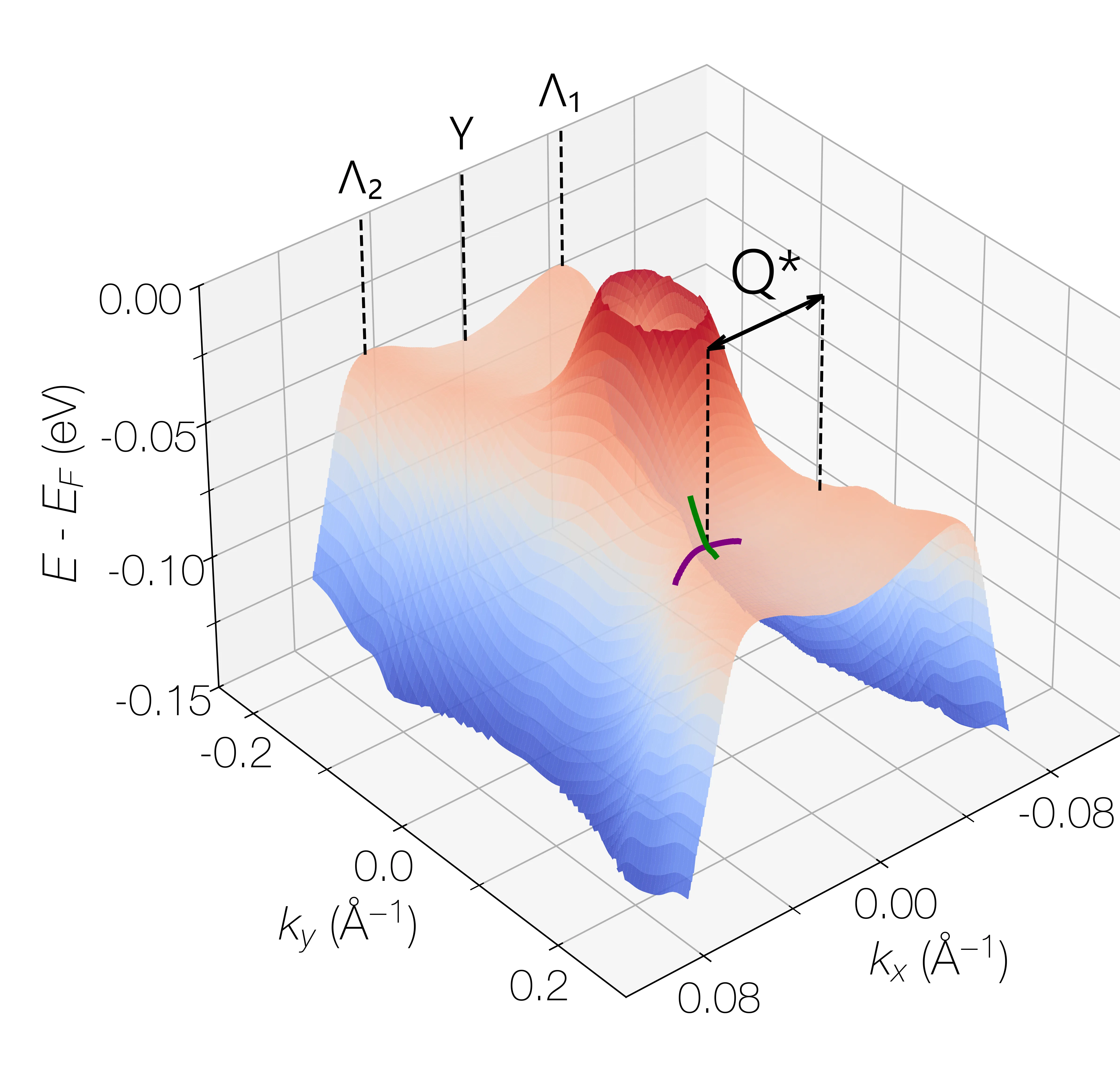
An ultrathin film of tellurium, tantalum, and iridium atoms behaves as an insulator in its interior but conducts current along its edges. This property, the quantum spin Hall effect, promises lossless electronics. However, calculations of the electronic structure did not predict such a phase for the 1T-TaIrTe₄ monolayer. The researchers suspected a special point in the electron energy distribution — a van Hove singularity, where the density of states spikes sharply, like a crowd at a narrow intersection.
To test this, the authors of the new work measured the electronic spectrum of the monolayer using micro-focused angle-resolved photoemission spectroscopy. A laser beam knocked electrons out of the sample, and a detector measured their energy and direction. This revealed how the energy bands are arranged. It turned out that the saddle point, an analogue of a mountain pass on the energy landscape, does exist, but it sits at a charge density where transport experiments showed nothing unusual.
Moreover, the linewidths in the spectrum indicate weak electron-electron interactions. So strong correlations, which were thought to be the cause of the strange behavior, are not the main factor in this material. The van Hove singularity and correlations play only a secondary role. What exactly triggers the quantum spin Hall effect in 1T-TaIrTe₄ remains a mystery, but now it is clear where not to look.
The thin film reminds us again: its behavior cannot be predicted by simply shrinking a bulk crystal. Each layer is a separate world with its own rules.
Angle-resolved photoemission spectroscopy works like a high-speed camera for electrons: by knocking them out with light, one can reconstruct the energies and directions they had inside the material.