How to Hear the Sun's Magnetic Pulse ✛
The Sun has a magnetic field, and it is constantly changing. This field is like an invisible ribbon wrapped around the star. As the Sun rotates, the ribbon tugs, and those tugs are transmitted to Earth — our planet's magnetic field starts to tremble. Such tremors are called geomagnetic activity. Previously, to understand how strongly the Sun 'tugs' at Earth, you had to build complex models. Now scientists have found a simple way: take a map of the Sun's magnetic field and separate out two main parts — one along the rotation axis, the other across it.
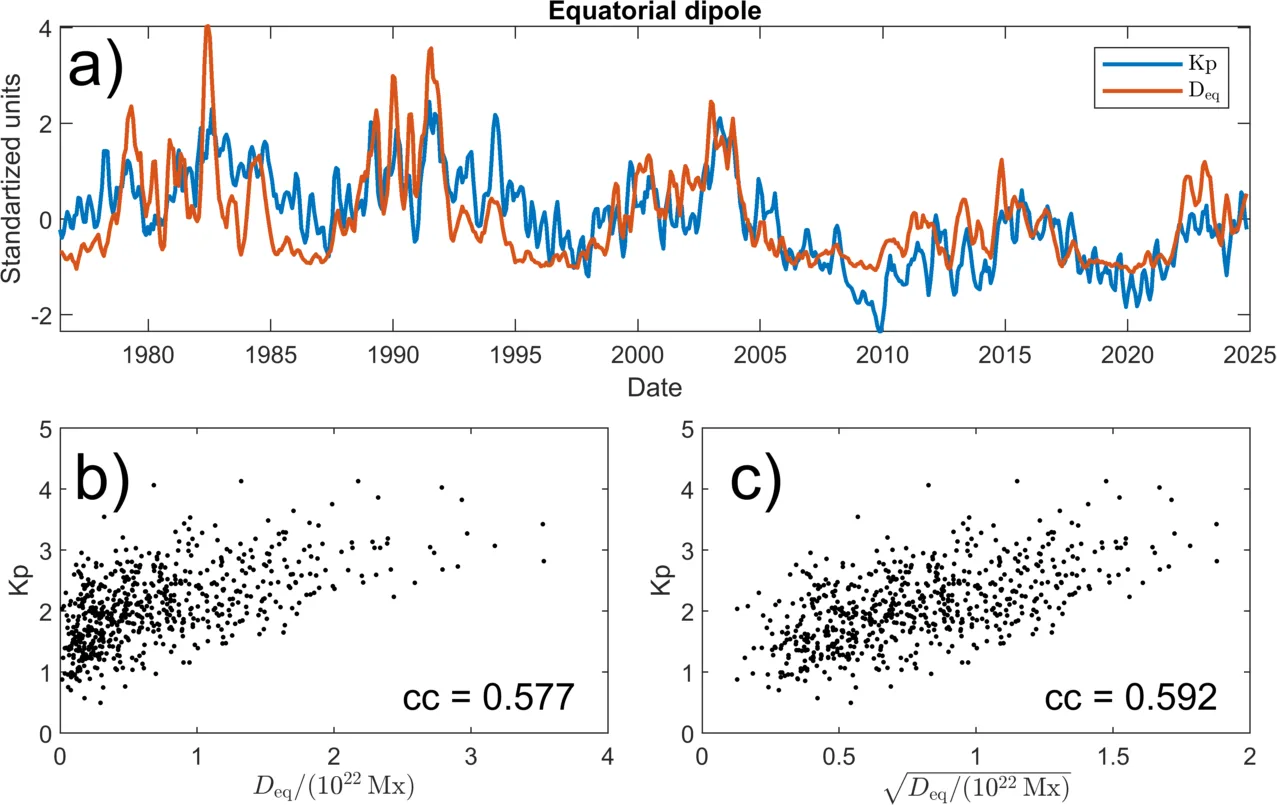
The researchers took 50 years of solar magnetic field maps — one for each rotation of the star, 652 maps in total. For each map, they computed two numbers: the field strength along the axis and the field strength across it. Then they compared these numbers with the Kp index, which shows how disturbed Earth's magnetic field is. It turned out that from these two numbers, Kp can be predicted with 71% accuracy. Moreover, the transverse part of the field affects Earth about twice as strongly as the axial part. It's as if an orchestra had two drums: one sets sharp beats, the other a slow rhythm.
The new index is called PIGA. It predicts geomagnetic activity well during quiet periods, but at solar activity peaks it can be off — then the Sun's magnetic field becomes too complex for just two numbers. But PIGA allows us to estimate how the Sun affected Earth in the past, when there were no satellites, and will help improve space weather forecasts. Now, looking at a map of the Sun, you can immediately tell how strongly it will 'tug' at Earth.
The equatorial dipole component of the Sun's magnetic field oscillates with a period of about a year and nearly vanishes at cycle minima, while the axial component changes smoothly and reflects the strength of the polar fields.