The Sun's Magnetic Pulse, Heard by Earth ✛
The Sun breathes, and that breath has a magnetic rhythm. Every 27 days, the visible surface of the star makes a full rotation, and with it, its magnetic field, like an invisible ribbon wrapped around the star. Earth, like a keen listener, responds to this rhythm with fluctuations in its own magnetic field — geomagnetic storms, auroras, satellite glitches. But until now, no one could directly link the "pulse" of the solar field to what Earth feels.
Previously, to know how strongly the Sun disturbs Earth, one had to build complex models of the solar corona and wind. That's like trying to predict the volume of an orchestra by studying the sheet music of each violin individually. Researchers from the Wilcox Solar Observatory took a different approach: they took 50 years of solar magnetic field maps (one for each rotation, 652 maps in total) and extracted the two main components of the field. One aligned with the rotation axis, and the other lying in the equatorial plane. These two components are like two drums in an orchestra: one sets a low rhythm, the other a high one.
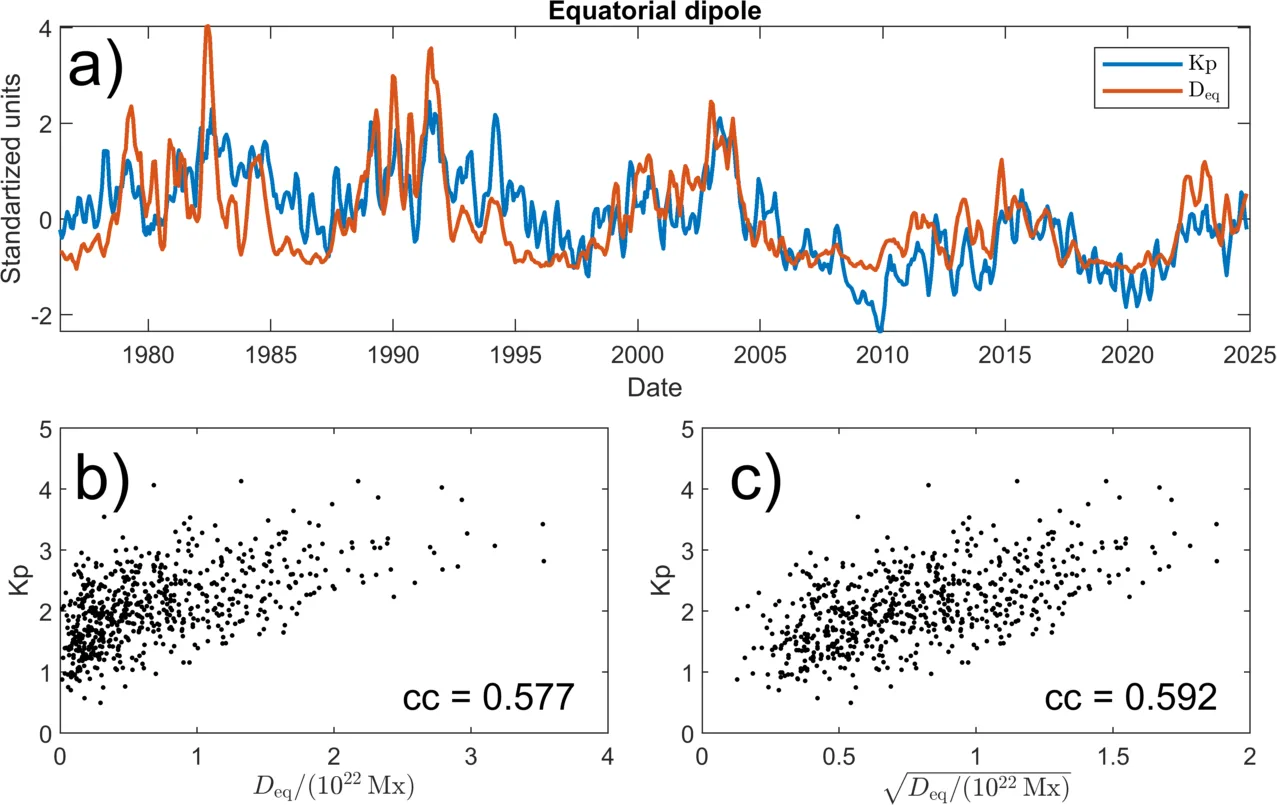
It turned out that Earth's geomagnetic activity is best predicted by a simple formula where the equatorial component enters with a square root, and the axial component linearly. The correlation with the Kp index reached 0.71—meaning that from two numbers on a solar map, you can explain more than half of the variability in Earth's storms. The equatorial component contributes roughly twice as much as the axial one: it is this component, oscillating with a period of about a year, that drives sharp bursts of activity. The axial component, meanwhile, changes smoothly, reflecting the strength of the Sun's polar fields.
The new index, named PIGA (photospheric index of geomagnetic activity), reproduces well the long-term trend and behavior during the declining phases of solar cycles 22 and 24. But near maxima, it can overestimate or underestimate activity, like a conductor who hears the overall rhythm but sometimes confuses individual cymbal crashes. This limitation arises because at cycle maximum the Sun's magnetic field becomes very complex, and two dipole components are no longer sufficient.
Now that the Sun's "pulse" can be read directly from surface maps, new possibilities open up. One can estimate the Sun's geoeffectiveness in the past, when there were no satellite observations — using historical reconstructions of the magnetic field from sunspot observations. PIGA can be used to calibrate magnetic field evolution models, resolving the known ambiguity in their parameters. And perhaps this simple index will help better forecast space weather, which affects power grids and even winter weather on Earth.
The Sun continues to breathe, and Earth continues to listen. And now we have a tuning fork to align their rhythms.
The equatorial dipole component of the Sun's magnetic field oscillates with a period of about a year and nearly vanishes at cycle minima, while the axial component changes smoothly and reflects the strength of the polar fields.