A Photospheric Index of Geomagnetic Activity ✛
Context
Geomagnetic activity is the response of Earth's magnetosphere to the solar wind and the heliospheric magnetic field. It is measured by indices such as Kp and aa, which have been maintained since 1932 and 1868, respectively. Although it is known that activity originates from photospheric magnetic fields, no direct quantitative relationship between them existed. This work stands apart: nearby studies address the solar corona, solar wind, and fast radio bursts, but none directly linked the photospheric dipole to a geomagnetic index.
Methods
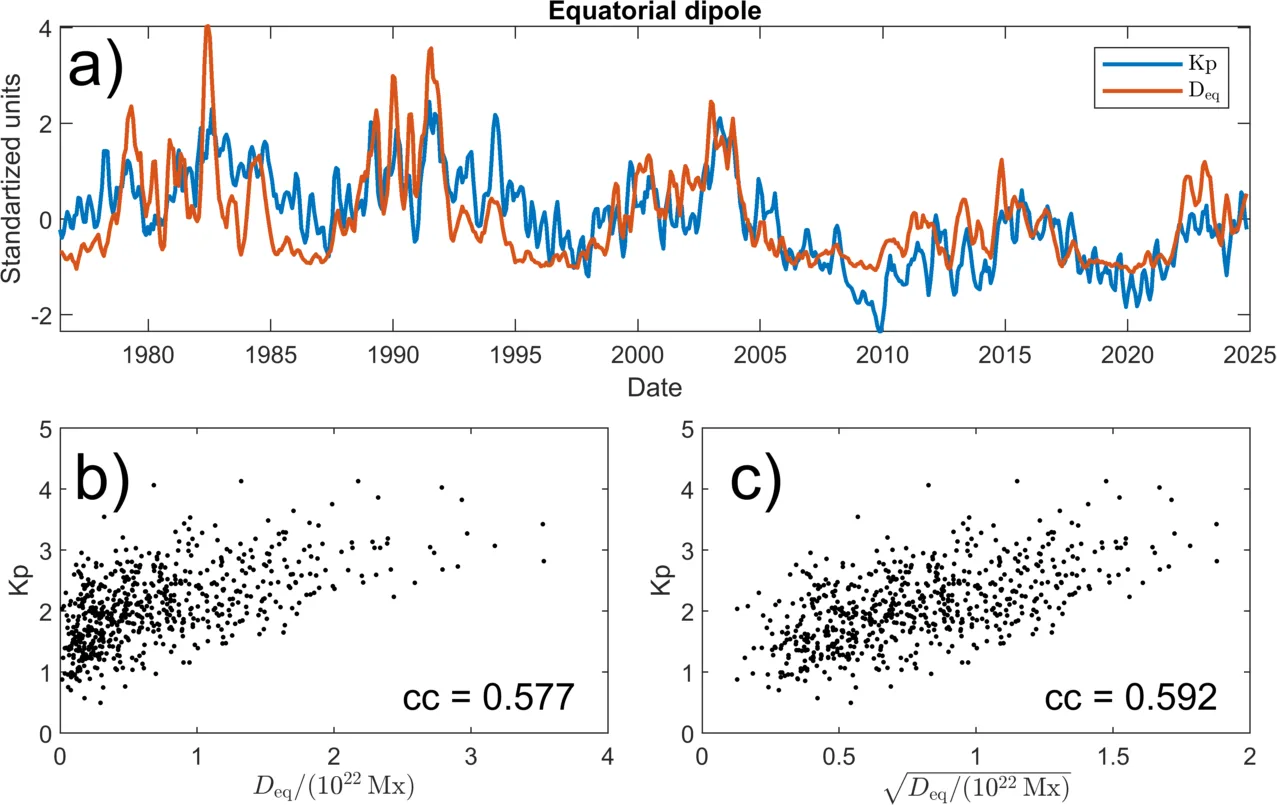
The authors used synoptic magnetograms from the Wilcox Solar Observatory (WSO) for 1976–2025, covering 652 Carrington rotations. From these, they computed the equatorial and axial components of the photospheric dipole moment using vector summation. The equatorial component was taken with a square root to linearize its relationship with the Kp index. Then, using total least squares (TLS) regression, they fitted a linear combination of these components that best predicts the rotation-averaged Kp index.
Results
The resulting index is PIGA = 0.05 + 1.8√($D_{eq}$) + 0.33D_ax, where $D_{eq}$ and $D_{ax}$ are the equatorial and axial dipole components in units of 10²² Mx. The correlation with the Kp index was 0.71, and the mean absolute deviation was 0.38. The equatorial component contributes roughly twice as much as the axial component. PIGA reproduces the long-term trend and behavior during the declining phases of cycles 22 and 24 well, but overestimates or underestimates activity near solar maxima.
Implications
Unlike neighboring studies that examine individual phenomena—coronal holes, magnetic flux ropes, solar wind forecasts—this work provides, for the first time, a simple quantitative formula directly linking the global photospheric field to geomagnetic activity. This removes the need for expensive modeling of the corona and heliosphere to assess geoeffectiveness. The work aligns with general research on solar–terrestrial connections but stands out for its simplicity and reliance solely on dipole components.
Future development
PIGA can be applied to historical reconstructions of the Sun's magnetic field from sunspot and facular observations, as well as to forecasts based on surface flux transport models. Because the index depends on the equatorial dipole, it can serve as an additional constraint on the parameters of these models, alleviating a known degeneracy. A version of PIGA based on the aa index could extend the analysis back to the mid-19th century.
Impact
The index may be useful for seasonal forecasting of winter weather, as geomagnetic activity influences atmospheric chemistry and temperature. It is also applicable for assessing impacts on power systems and electrical grids.
Next steps
Test PIGA on longer aa-index records and on historical magnetic field reconstructions. Use PIGA to calibrate parameters of surface flux transport models.
Key open problems
A long-standing problem in solar physics is reliably reconstructing the past magnetic field due to degeneracy in transport model parameters. PIGA offers a new independent observational constraint based on geomagnetic data, which could improve understanding of the global field's evolution and its geoeffectiveness.
The knowledge machine's view
This section is addressed to the author of the paper and their colleagues. Neighbouring works were found by meaning-based search across our archive, not by word overlap. We do not review: we show the field around the work.
What the work does
The authors constructed a photospheric index of geomagnetic activity (PIGA) from the equatorial and axial dipole components of the photospheric magnetic field using WSO synoptic maps for 1976–2025. Using TLS regression, they fitted a linear combination of the components that best predicts the rotation-averaged Kp index. They obtained a correlation of 0.71 and a mean absolute deviation of 0.38, with the equatorial component contributing twice as much.
Where its strength is
A simple and physically transparent formula links the global photospheric field to geomagnetic activity without modeling the corona or solar wind. This opens the door to rapid estimates of geoeffectiveness and historical reconstructions.
Where it could go next
- It might be interesting to compare PIGA with direct observations of the Sun's magnetic poles to refine the contribution of the axial dipole component to long-term trends.based on: Solar Magnetic Poles: First Shots from Beyond the Equator arXiv:2512.03611
- Related work on magnetic ropes in the chromosphere suggests that accounting for small-scale magnetic structures not reflected in the dipole components could improve the description of geomagnetic activity near solar maxima.based on: Magnetic Ropes on the Sun: A New View from the Chromosphere arXiv:2606.10411
- To test PIGA's applicability over longer intervals, one could use the magnetic field reconstruction methods for the far side of the Sun described in a companion paper.based on: Peeking Around the Sun's Edge arXiv:2603.02614
Worth trying
- Try adding quadrupole components of the photospheric field to the regression and see if the correlation with Kp improves.
- Use PIGA to forecast geomagnetic activity several rotations ahead, based on extrapolation of the dipole components.
- Compare PIGA predictions with the aa geomagnetic index over a longer period, using historical reconstructions of the photospheric field.
Why this may matter
If the simple linear relationship between the photospheric dipole and geomagnetic activity holds up, it provides a cheap tool for long-term space weather forecasting and for assessing the Sun's geoeffectiveness in the past, including periods before regular solar wind measurements began.
Nearby works in our archive
- Nuclear Explosions and Magnetic Storms: Decoding Celestial Flashessimilarity 0.53
- Solar Magnetic Poles: First Shots from Beyond the Equatorsimilarity 0.53
- Peeking Around the Sun's Edgesimilarity 0.52
- Magnetic Ropes on the Sun: A New View from the Chromospheresimilarity 0.49
- The Solar Chromosphere: How Twisted Magnetic Fields Ignite Bright Flaressimilarity 0.49
- A Distant Planet's Magnetic Pulsesimilarity 0.49
The archive is sparse around this work: the closest review is only 0.53, against a usual 0.64. It looks like few have drilled nearby.
The equatorial dipole component of the Sun's magnetic field oscillates with a period of about a year and nearly vanishes at cycle minima, while the axial component changes smoothly and reflects the strength of the polar fields.
Key numbers
- correlation with Kp: 0.71
- mean absolute deviation: 0.38
- ratio of contributions of equatorial and axial components: 2.1
- WSO data period: 1976–2025
- number of Carrington rotations: 652