A magnetic dynamo is the process by which a rotating, convecting, and electrically conducting fluid generates a magnetic field. This mechanism is responsible for the magnetic fields of planets, stars, and even galaxies. The Earth's magnetic field, which protects us from solar wind and cosmic radiation, is generated by the dynamo action of molten iron in the outer core. The Sun's magnetic field, which drives solar activity and space weather, arises from the dynamo action of ionized plasma in its convection zone. Understanding dynamos is crucial for explaining the variability of magnetic fields, including the Sun's 11-year cycle and the occasional reversal of Earth's magnetic poles.
History
The idea that the Earth's magnetic field is generated by a self-exciting dynamo was first proposed by Joseph Larmor in 1919. The first successful numerical dynamo simulation was achieved in 1995 by Gary Glatzmaier and Paul Roberts, which reproduced many features of the Earth's magnetic field, including its reversals.
How it works
The dynamo process relies on the induction equation of magnetohydrodynamics. A conducting fluid in motion, such as convecting molten iron or plasma, cuts through magnetic field lines, generating electric currents. These currents, in turn, produce new magnetic fields. If the fluid motion is sufficiently complex and energetic, the induced fields can reinforce the original field, leading to a self-sustaining amplification. The rotation of the body provides the necessary helicity (twist) to organize the motion into a coherent dynamo. The process is chaotic and nonlinear, leading to complex time variations in the field.
In practice
Dynamo theory is used to model and predict solar activity, which affects satellite operations, power grids, and communication systems on Earth. It also informs the study of planetary magnetic fields, helping to assess habitability of exoplanets.
Fun fact
The Earth's magnetic field has reversed hundreds of times in its history, and the last reversal occurred about 780,000 years ago; the process takes thousands of years, during which the field's strength drops significantly.
An orchestra without a conductor: each musician tunes to a neighbor, and out of that comes a well-coordinated melody. In the world of microscopic magnets, the role of that orchestra is played by a tiny neodymium sphere levitating above a superconducting film.
An interpreter gets distracted by every rustle in the hall, and a one-hour meeting stretches into two. The same happens with a capacitive gyroscope: to hear the nanometer-scale displacement of its proof mass, it needs perfectly tuned gaps between the plates. The smaller the sensor, the harder it is to maintain that precision.
The Sun breathes, and that breath has a magnetic rhythm. Every 27 days, the visible surface of the star makes a full rotation, and with it, its magnetic field, like an invisible ribbon wrapped around the star.
The solar wind is a stream of charged particles constantly blown off the Sun's surface, filling the entire solar system. It's not like a steady breeze: it has eddies, gusts, and calm patches. Scientists call this turbulence.
In the solar corona, it rains from time to time — only not water, but plasma. The hot gas cools, clumps into blobs, and rushes downward along magnetic loops, like drops running down invisible gutters.
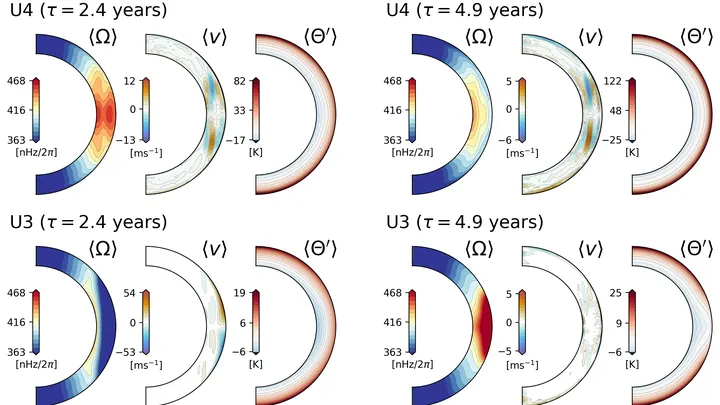
27 days at the equator, 32 at the poles. Five days' difference, and over a year, the equator gains almost a week. A gas ball 1,4 million kilometers in diameter spins like a layered top: each layer moves at its own speed.
A branch falls into a whirlpool. It gets spun and broken, but sometimes a powerful fountain of water bursts from the center. Similarly, a black hole tears apart a passing star, and occasionally a blinding plasma jet, a jet, shoots into space.
The mystery of the radius valley — a sharp drop in the number of exoplanets with radii ~1.8 Earth — haunts astronomers. JWST, transit surveys like Kepler and TESS draw a clear gap: rocky super-Earths and gaseous sub-Neptunes are separated by almost a chasm.
Inside planets and stars, in rotating oceans of plasma, turbulent flows, Coriolis forces, and magnetic tension collide. The central question is how the energy of this chaos crystallizes into a stable magnetic framework that can last billions of years.
In the vast clouds of rarefied gas that fill the space between stars, something is always churning. Supernova explosions, colliding streams — all of it shakes the plasma. And in this rippling, as it turns out, hides the mechanism that gives birth to magnetic fields.
Plasma is a gas in which electrons are stripped from atoms.
For almost a century, seismology has been the planet’s chief X-ray, probing the interior through elastic waves. But neutrinos, ghost particles predicted by Wolfgang Pauli, offer a different perspective.
When physicists drive electrons through an ultrapure gallium arsenide channel at helium temperatures, they expect to see a well-behaved, almost ideal fluid.
Space is threaded with magnetic fields. They exist around galaxies, stars, and even in nearly empty voids — the vast empty spaces between galaxy clusters. It's usually thought that fields are amplified from weak 'seed' fields by turbulence, much like a dynamo. But the origin of the seed fields themselves has remained a puzzle.
Cosmic rays do not travel in straight lines. Charged particles accelerated to enormous speeds loop through the Galaxy's magnetic field like dust motes in a gust of wind. It's usually assumed that they simply scatter along and across field lines.
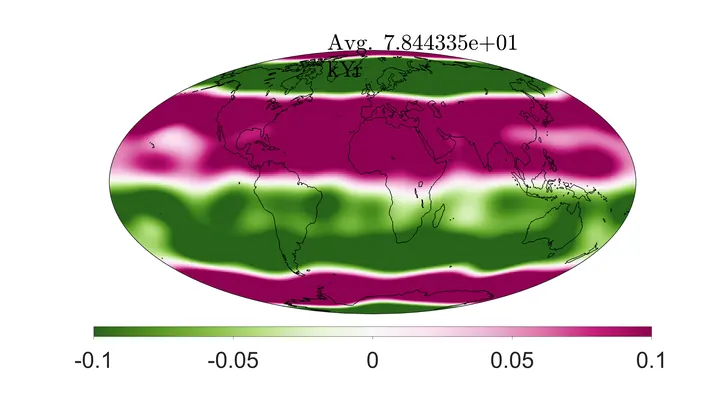
Earth's magnetic field is like an invisible shield that protects us from cosmic radiation. But if you look closely at its long-term averaged pattern, you'll notice that this shield isn't perfectly smooth: it has its own "seams" and "patches." New research using computer simulations of the geodynamo shows that…
Right after the Big Bang, space was a hot plasma — a mix of charged particles and light. In such a medium, electric currents couldn't flow on their own: a 'potential difference' was needed to push electrons relative to photons.
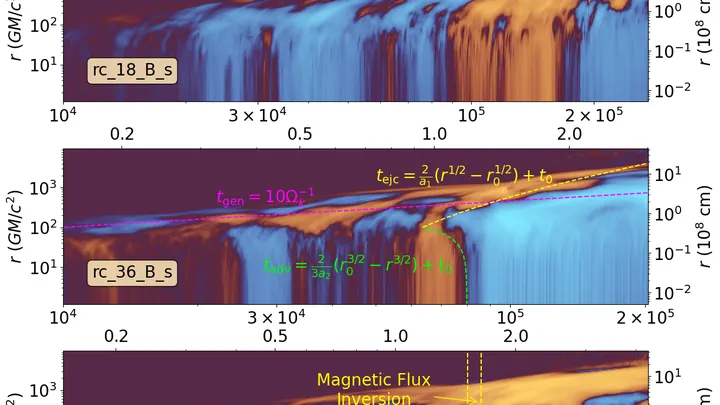
A massive star collapses, and a black hole is born, surrounded by a disk of incandescent plasma. For narrow jets to burst out of this disk, an ordered magnetic field is needed. But inside the star, it's tangled.
A magnetic field in plasma resembles a stretched soap film: pressure from inside pushes it out, while surface tension pulls it in, giving it shape. Here too, magnetic pressure and tension forces balance each other.
The crown of a huge tree sways in the wind, but the roots and trunk are hidden underground. On the Sun, magnetic fields play the role of such invisible roots. They emerge from the depths, thread through the entire atmosphere, and govern the motion of the hot gas — plasma.
In the scorching solar corona, where temperatures soar past a million degrees, float cold, dense clouds — solar prominences. They hang for weeks, neither falling nor dissolving, like icebergs in a boiling ocean. How they got there is a question that has puzzled astronomers for decades.
A cell about to divide first marks its waist. Beneath its membrane, in a thin gel of protein filaments, movement begins. The filaments flow like a slow river, and a belt forms in the middle of the cell. This belt tightens more and more until the cell is pinched in half.
Scientists built a computer model of this process.
When a massive star explodes as a supernova, its outer layers are blasted into space at thousands of kilometers per second. A shock wave forms — a giant invisible bulldozer that sweeps up interstellar gas and dust. In this maelstrom, particles can be accelerated to energies comparable to that of a flying tennis ball compressed into a single proton.
A stream of scorching gas races away from a star, and suddenly stalls, as if it hit an invisible wall. That's exactly what researchers saw when they tried to reproduce a stellar eruption on a laboratory scale. They used a laser to create a plasma jet and shot it through a magnetic field — first weak, then strong, like that of many stars.
Magnetic fields on the surface of the Sun appear as dark spots and bright faculae. But they are born deep inside, where flows of hot gas act like a giant dynamo. The question is whether sunspots on the surface can predict what will happen inside the star years from now.
The authors applied a mathematical theorem similar to the rule linking the area of a shape to its boundary.
Deep inside Earth lies a solid iron core about the size of the Moon. It floats in liquid metal and sways slightly, like a pit in a peach when you shake the fruit. Such oscillations are called Slichter modes: the core shifts both along the planet's axis and perpendicular to it.
Three forces act together to damp this motion.
The James Webb Space Telescope is gazing more and more at exoplanets — worlds orbiting alien stars. Some of them are scorching rocky spheres, tidally locked with one side forever facing their star. There, rock melts into oceans of liquid lava. How does this lava move?
When a baker kneads dough, the grains of flour can tell you which mill they came from. It's the same with Earth: the composition of iron in its depths preserves a memory of where the pieces that assembled the planet were born.
In most magnetic materials, a domain wall, the boundary between regions with different magnetization, moves in one direction under current, set by the current's direction. But in ferrimagnets near a special point where the angular momenta of two sublattices cancel each other, the behavior changes.
The Sun's corona looks like a shaggy dandelion: bright petal-like loops hold hot gas near the surface, while long, tenuous jets escape into space between them. These jets, the heliospheric current sheet, stretch across the entire solar system.
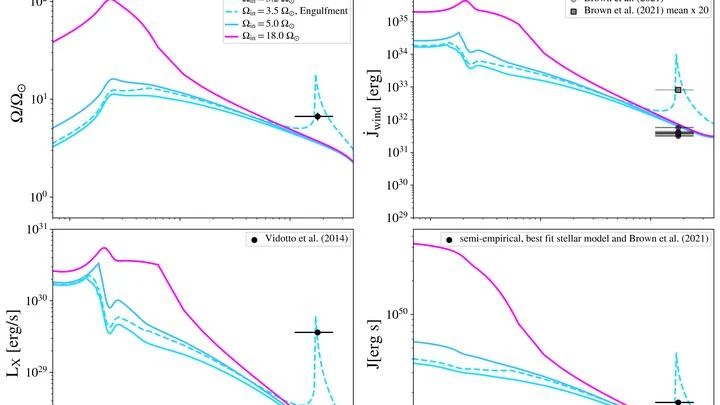
GJ 504, a star almost the same age as our Sun, is spinning with remarkable vigor: it completes a full rotation in just 3.4 Earth days, while actively emitting X-rays. For comparison, typical stars of the Sun's age rotate much more slowly, as if they've lost their youthful energy. GJ 504, however, behaves like a figure skater who has received a powerful push and launched into a rapid spin.
If you toss a stone into a pond, ripples spread across the water. Tiny magnetic crystals also host waves — except it's not water that oscillates but the direction of magnetization. These are called spin waves. They travel through the crystal like ripples on a surface and can carry information.
The Sun regularly produces explosions that hurl huge clouds of charged particles into space. Such a cloud travels toward Earth and can knock out satellites, disrupt radio communications, and even leave cities without electricity.
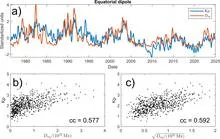
The Sun is not a calm sphere but a boiling cauldron that follows its own rhythms. Roughly every 11 years, its activity peaks: more dark spots appear on its surface, and streams of charged particles fly into space. But hidden within this grand cycle is a shorter one — about 1.7 years.
A solar flare is like a tightly coiled spring suddenly uncoiling. In the Sun's corona, energy accumulates in the twisted magnetic field, and then it is abruptly released, accelerating particles and heating plasma.
A young star is surrounded by a flat, rotating disk of gas and dust — the construction site for future planets. The disk lives its own life: gas flows toward the star, dust clumps together, and from outside, harsh ultraviolet light from neighboring hot stars presses down on it all, like wind blowing leaves off a path.
Around young stars, flat clouds of gas and dust swirl: these are the birthplaces of planets. For matter in such a disk to clump together, it must be constantly stirred. But what makes the gas move chaotically when it would otherwise be calm? Part of the answer lies in the fact that the gas in the disk barely conducts electricity: it is weakly ionized.
Inside giant planets like Jupiter and Saturn, heat doesn't always rise freely. Heavy elements, which are more abundant in some layers than others, prevent hot fluid from floating up. This creates semiconvection — a type of mixing where heat and composition spread at different rates.
The Sun doesn't rotate as a solid body: its equator spins faster than its poles. This difference in rotation speed creates layers that move at different speeds, like ocean currents at different depths.