A Cosmic Compass: Where the Fastest Particles Come From ✛
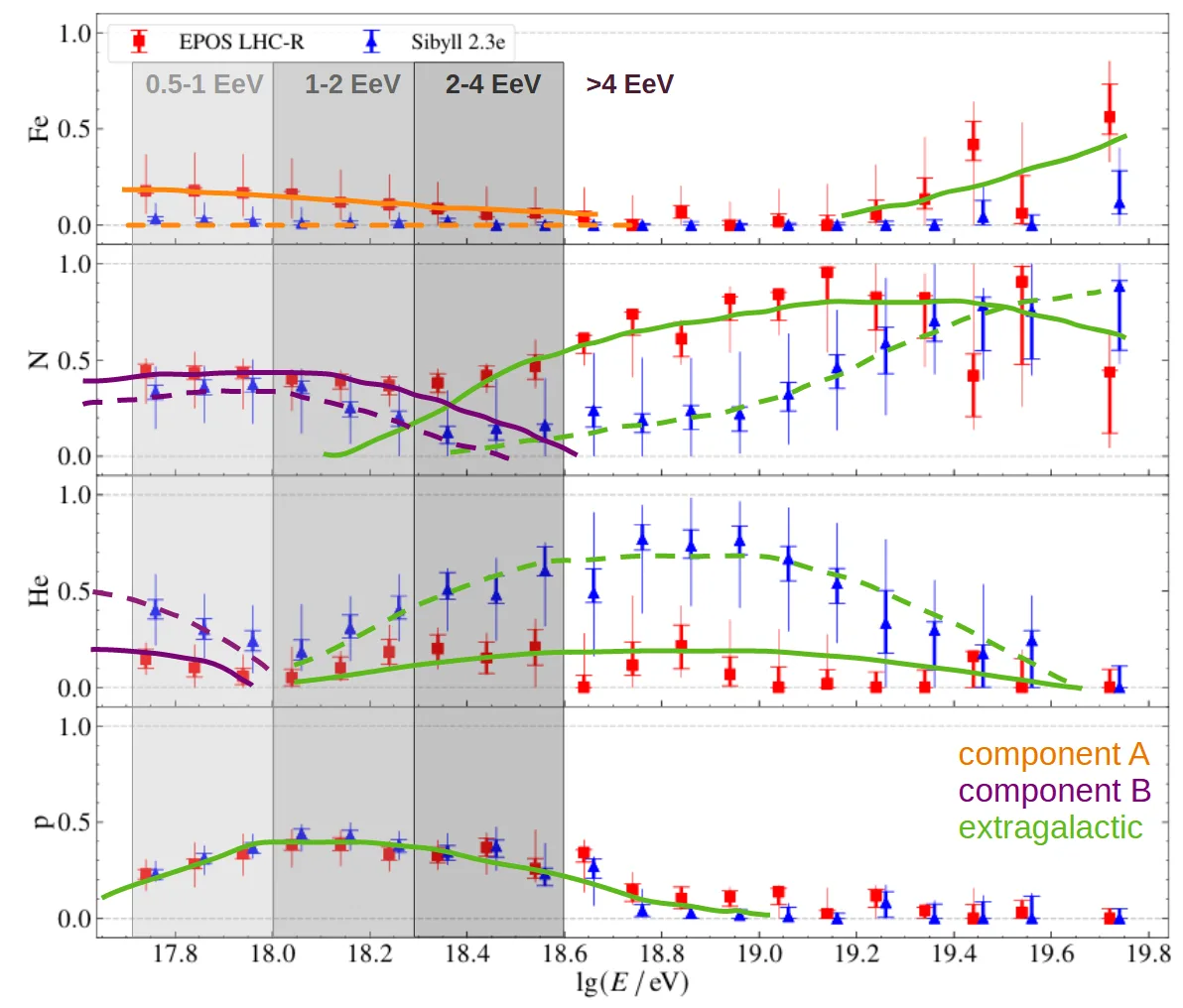
Cosmic rays are tiny charged particles that constantly hit Earth from all directions. Previously, it was thought that the most energetic ones are born in our Galaxy. But now, by measuring from which side of the sky slightly more arrive, scientists have realized that the needle of this "cosmic compass" points somewhere unexpected.
Several "particle factories" inside the Galaxy were tested: the center, microquasars, star clusters. None of them fit, because they would produce too much anisotropy. However, a model where a small fraction of particles (15%, 10%, and 5% at different energies) is still galactic, while the rest come from distant galaxies, matched the data perfectly. This means the transition to extragalactic rays begins earlier than previously thought.
The microquasar Cygnus X-3, one of the candidate sources for component B, is located at a distance of about 9.4 kpc, but its age is estimated to be less than 0.4 million years. This is insufficient for particles with energies below 1 EeV to reach Earth, even if the source were powerful enough.
The idea that cosmic rays might come from active galactic nuclei or microquasars resonates with science fiction plots where powerful astrophysical objects serve as natural accelerators. For example, in Alastair Reynolds's novel 'Revelation Space', relativistic jets are mentioned that can accelerate particles to extreme energies.