The 'kink' refers to a sharp change in the energy spectrum of cosmic rays, specifically a steepening of the spectrum at around 3 PeV (petaelectronvolts), known as the 'knee'. Below this energy, the flux of cosmic rays decreases as a power law, but above it, the decrease becomes steeper. This feature indicates a change in the sources or propagation mechanisms of cosmic rays, likely marking the maximum energy to which supernova remnants can accelerate particles. The knee is a key observational constraint for models of galactic cosmic ray acceleration.
History
The knee was first discovered in 1958 by the Italian physicist Giuseppe Cocconi and his colleagues, who analyzed extensive air shower data. Its precise origin remains an active area of research, with multiple experiments like KASCADE and IceTop contributing to its characterization.
How it works
Cosmic rays are charged particles, mostly protons and heavier nuclei, accelerated by shock waves in supernova remnants. The maximum energy a particle can reach depends on the magnetic field strength and the size of the acceleration region. For protons, this limit is around 3 PeV, so the knee is interpreted as the point where the contribution from galactic sources begins to decline. Heavier nuclei, with higher charges, can reach higher energies, so the knee is actually a superposition of knees for different elements, as confirmed by recent measurements showing that the spectrum breaks at energies proportional to the nuclear charge.
In practice
Understanding the knee helps calibrate cosmic ray detectors and improves models of galactic cosmic ray propagation, which is essential for assessing radiation risks for astronauts and satellites.
Fun fact
The knee is not a single sharp feature but a series of breaks, one for each nuclear species, with the break energy scaling linearly with the atomic number Z, so iron nuclei have a knee at about 26 times higher energy than protons.
The night sky looks serene, but it is actually pierced by an invisible rain of charged particles: cosmic rays. Scientists have long tried to figure out where the most energetic ones are born. Until recently, it was thought that our Galaxy supplies particles up to about 4 EeV, the so-called "ankle" in the spectrum.
In 1054, a star flared up in the constellation Taurus. The light of its death was so bright that it was visible in daylight for nearly a month, and Chinese astronomers recorded it in their chronicles. Today, the Crab Nebula is spreading over that spot, and its claws are clouds of gas still being whipped up by the dead star at its center.
Cosmic rays are particles that race across our Galaxy at enormous speeds. Their energies can be millions of times higher than those of particles in the most powerful accelerator on Earth. But the higher the energy, the fewer such particles there are: the plot of their numbers shows a noticeable kink, which is called the knee.
Cosmic rays do not travel in straight lines. Charged particles accelerated to enormous speeds loop through the Galaxy's magnetic field like dust motes in a gust of wind. It's usually assumed that they simply scatter along and across field lines.
In an orchestra, each musician plays their own part, but at a certain moment all instruments pause on a single note. Cosmic rays behave somewhat like this — particles flying toward us from distant stars.
When many excited atoms are gathered together, they often fire light in concert, like a crowd clapping in rhythm. This well-known phenomenon is called Dicke superradiance. But the authors of the new study asked: what happens if the atoms are not identical and each one feels its neighbors?
Every second, invisible projectiles from the depths of space pierce through us. These are cosmic rays — atomic nuclei accelerated to speeds nearly indistinguishable from the speed of light. Their energy is hundreds of millions of times greater than what our most powerful accelerators can achieve. Where does this monstrous force come from?
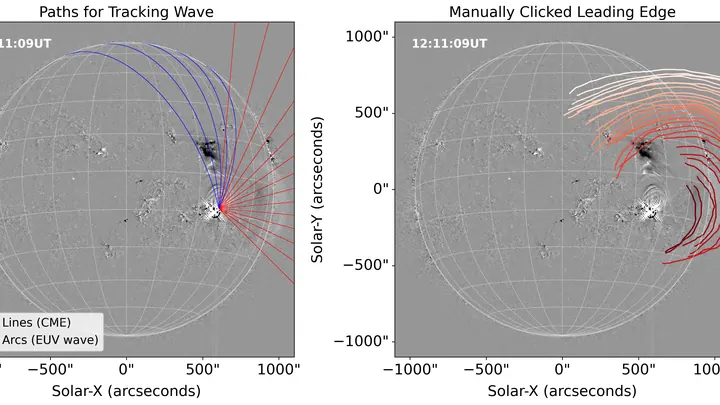
A shock wave in the Sun's corona is like the sonic boom from an airplane, except instead of air there is scorching plasma, and instead of sound there is a jump in density and magnetic field. On March 10, 2024, such a wave swept across the western part of the solar disk.
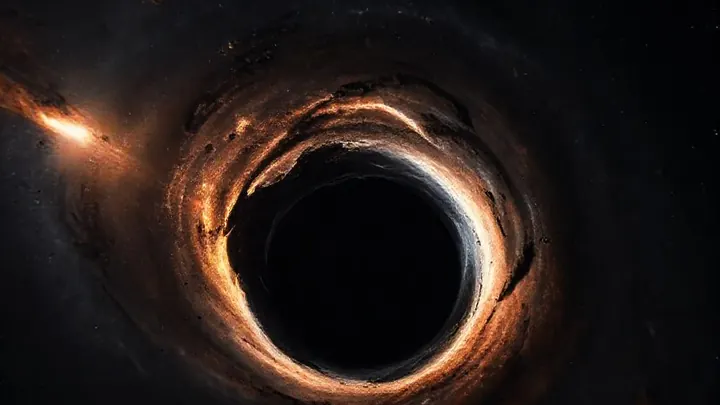
When two black holes collide, they send out gravitational waves and ring like a massive bell. The fading sound, or ringdown, carries the imprint of the final black hole. But if dark energy, the force accelerating the universe, changes over time, it can cling to the black hole like a thin paint layer.
The kaon is a long-lived particle by microcosm standards: it lives for billionths of a second before breaking apart into lighter particles. In the KOTO experiment in Japan, physicists catch the rarest variants of such decays. One of them is when a kaon transforms into two neutral pions plus another particle X, which immediately decays into two photons (particles of light).
Cosmic rays are charged particles that constantly bombard Earth from deep space. When one of these particles enters the atmosphere, it collides with air nuclei and spawns a whole cascade of secondary particles: electrons, muons, photons.
A flashlight shines through fog, and its light changes color slightly. From that change, you can tell what the fog is made of. That's how astronomers study cold gas around X-ray sources: iron atoms in the gas absorb and re-emit X-rays at a very specific energy, like a fingerprint. But there's a catch: if you strip a few electrons from the atom, the line shifts.
When a massive star exhausts its thermonuclear fuel, its core collapses, and the outer layers are ejected into space at speeds of thousands of kilometers per second. This is how a supernova remnant is born — an expanding cloud of shock-compressed gas spanning light-years.
Cosmic rays are atomic nuclei accelerated to near-light speeds. They arrive at Earth from all directions, and their composition tells us what's happening in the far reaches of the Galaxy.
At night over the Siberian taiga, a faint blue light sometimes flickers. It's not the aurora borealis but a cosmic-ray shower: a single particle from deep space slams into the atmosphere and shatters into millions of secondary particles. They race toward the ground in a broad front, like a ripple from a stone dropped into water, and make the air glow.
Cosmic rays are charged particles that fly to us from the depths of the Galaxy. If you plot how many particles arrive at each energy, the line runs smooth, then suddenly drops sharply.
In the quiet harbor of the Local Bubble, a rarefied cavity of hot gas around the Sun, an explosion recently thundered. A supernova went off tens of parsecs away, and its echo still lingers in the neighborhood, reshaping the cosmic-ray landscape.
High above Antarctica, a balloon carried an instrument that caught electrons from space. These particles come from distant stellar explosions and other powerful events. The instrument measured their energy, like the force of an impact. And in one energy range, there were more impacts than calculations predicted.