The Cosmic Compass: Why the Galaxy Gives Up Earlier Than We Thought ✛
The night sky looks serene, but it is actually pierced by an invisible rain of charged particles: cosmic rays. Scientists have long tried to figure out where the most energetic ones are born. Until recently, it was thought that our Galaxy supplies particles up to about 4 EeV, the so-called "ankle" in the spectrum. But new data are forcing a rethink of that boundary.
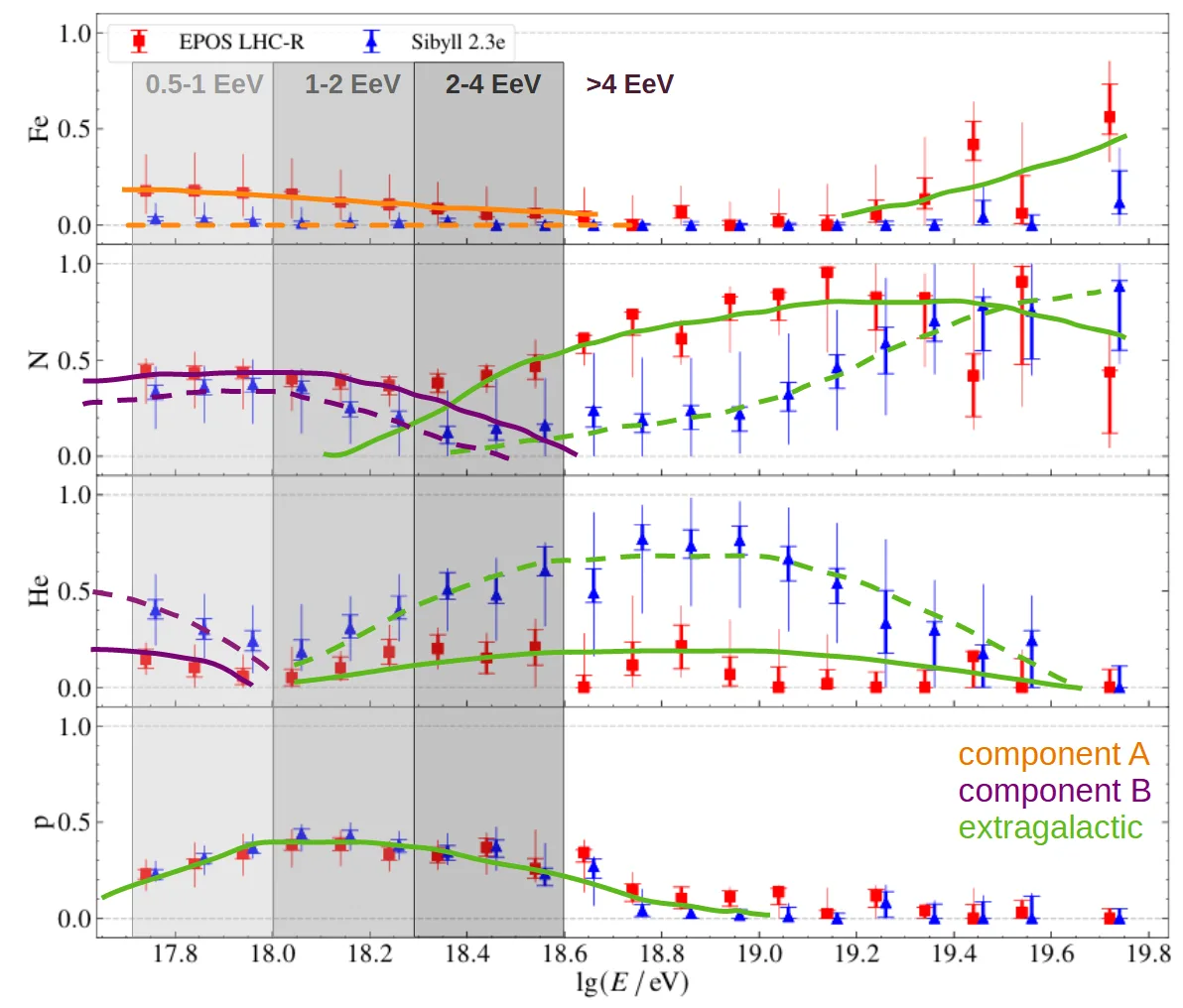
Astrophysicists built a model with three components: galactic iron, extragalactic particles, and a mysterious "component B," intermediate nuclei whose origin was the key question. Comparing predictions with Pierre Auger Observatory data, they found that a purely extragalactic explanation fails because below 4 EeV the compass needle points toward the Galactic center. But galactic sources also fall short: simulations show they would produce too much trembling of the needle.
For example, the microquasar Cygnus X-3, located 9.4 kiloparsecs away, could not have delivered particles of the required energies over its short lifetime of just 0.4 million years. And the Galactic center would demand a luminosity comparable to its entire energy budget. Even the most powerful "particle factories" cannot explain the observed pattern.
The solution turned out to be elegant: a tail of galactic iron (15%, 10%, and 5% in three energy bins) plus an isotropic extragalactic component B. This model fits all data perfectly: χ²/ndf = 11.1/6 versus 59.8/6 for the alternative. This means the transition from galactic to extragalactic rays begins already at the energy of the second knee, not at the ankle.
Now the cosmic compass points to a new direction for future research: pin down the composition of particles in this range and measure the full dipole vector. Perhaps within a few years we will learn which distant galaxies are sending us their charged greetings.
The microquasar Cygnus X-3, one of the candidate sources for component B, is located at a distance of about 9.4 kpc, but its age is estimated to be less than 0.4 million years. This is insufficient for particles with energies below 1 EeV to reach Earth, even if the source were powerful enough.
The idea that cosmic rays might come from active galactic nuclei or microquasars resonates with science fiction plots where powerful astrophysical objects serve as natural accelerators. For example, in Alastair Reynolds's novel 'Revelation Space', relativistic jets are mentioned that can accelerate particles to extreme energies.