A Galactic Imprint on Cosmic Rays: Why the Transition to Extragalactic Sources Begins Earlier ✛
Context
The question of where galactic cosmic rays end and extragalactic ones begin has remained open for several decades. The cosmic-ray spectrum has characteristic breaks: the knee at 3–5 PeV, the second knee at 0.1–0.4 EeV, and the ankle at 4 EeV. While the knee is associated with the cutoff of the proton component, and above 8 EeV extragalactic particles dominate, the range between the second knee and the ankle lacks a clear interpretation. Previous work either assumed a continuation of the galactic population or introduced an additional 'component B' of unclear origin. New data on composition and anisotropy, as well as the discovery of galactic PeVatron sources such as the microquasar Cygnus X-3, have renewed interest in this problem.
Methods
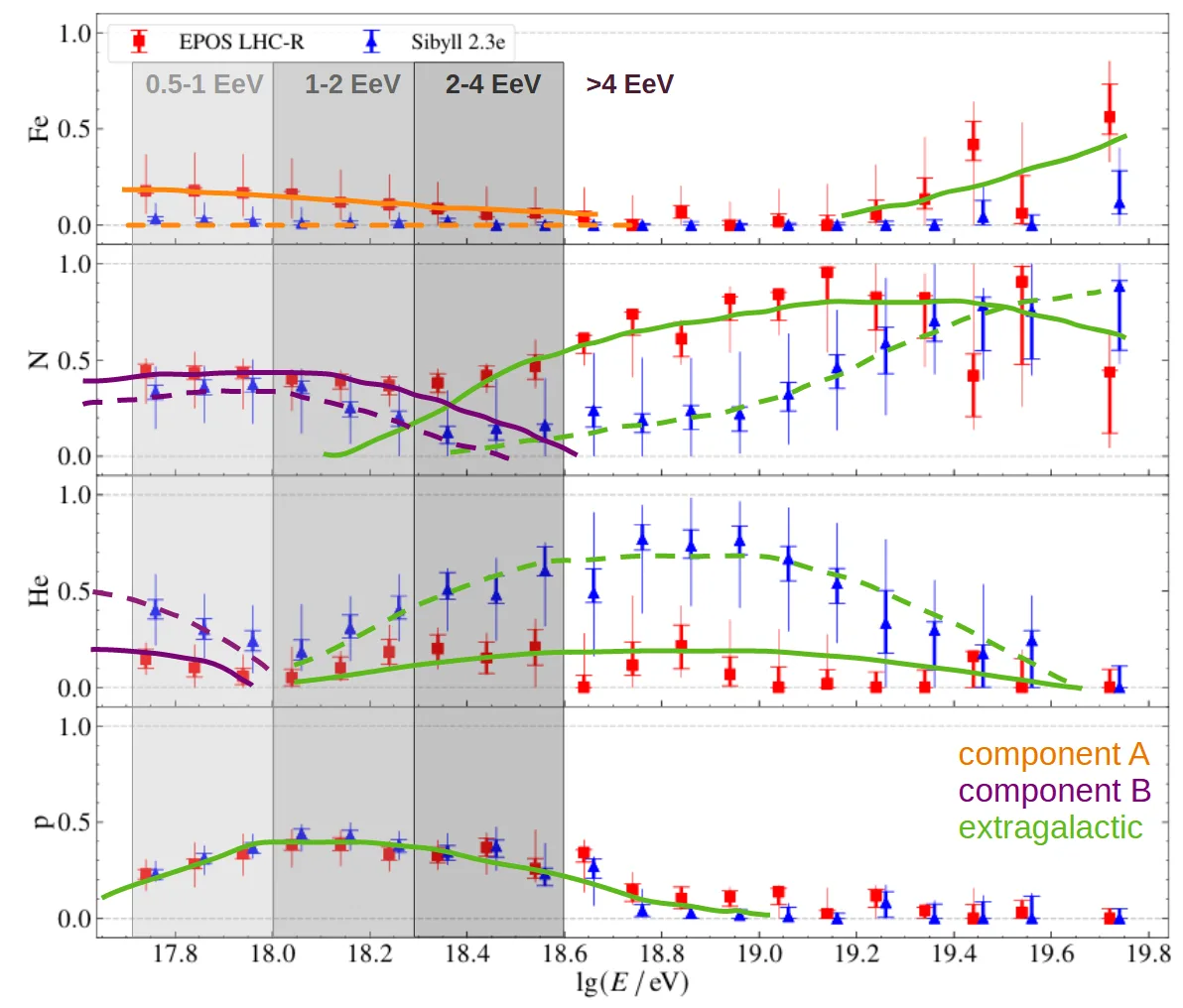
The authors constructed a three-component model of the cosmic-ray flux: galactic component A (iron, dominating at the second knee), an extragalactic component (following the large-scale structure of the universe), and component B (intermediate nuclei, mainly nitrogen), whose origin was to be determined. For each component, they calculated the expected amplitude and phase of the dipole anisotropy, taking into account models of the galactic magnetic field (UF23 and JF12+Planck). These predictions were then compared with measurements from the Pierre Auger Observatory in three energy bins: 0.5–1, 1–2, and 2–4 EeV. To test the realism of galactic scenarios, they used direct simulations of particle propagation from candidate sources—the Galactic Center, Cygnus X-1, Cygnus X-3, Westerlund 1, and the supernova remnant G65.3+5.7—using the CRPropa3.2 code.
Results
It turned out that a purely extragalactic explanation for component B cannot reproduce the observed change in the dipole direction: below 4 EeV, the phase points toward the Galactic Center, whereas extragalactic sources give a stable direction away from it. Furthermore, the measured dipole amplitude of about 0.4% in the 0.5–1 EeV bin is too large for extragalactic protons even when accounting for the Compton–Getting effect. This requires at least a small galactic contribution. In the scenario without iron, component B must be anisotropic and galactic, with dipole amplitudes ranging from 1% below 2 EeV to 10% in the 2–4 EeV bin. However, simulations showed that none of the considered galactic sources or their populations can produce such a small anisotropy: the predicted amplitudes exceed the upper limits by more than 3σ. For example, the Galactic Center yields a dipole exceeding the allowed level in all bins, and Cygnus X-3 does so in all bins below 2 EeV. Additional energy estimates showed that even the most powerful candidates, such as Cygnus X-3 or the Galactic Center, would require luminosities comparable to or exceeding their total energy budgets. In contrast, the scenario with a galactic iron tail (15%, 10%, and 5% in the three bins) and an isotropic extragalactic component B describes all data well: χ²/ndf = 11.1/6 versus 59.8/6 for a purely isotropic component B without iron.
Implications
This work is the first to systematically use dipole anisotropy to distinguish between the galactic and extragalactic origin of component B, combining data on composition, spectrum, and arrival directions. Unlike previous studies that relied on outdated magnetic field models and smaller statistics, this work applies modern models UF23 and JF12+Planck and accounts for the Compton–Getting effect. It shows that galactic sources, including recently discovered PeVatron objects, cannot provide the observed flux of intermediate nuclei without contradicting anisotropy. This strengthens the case for a transition from galactic to extragalactic rays already at the energy of the second knee, rather than at the ankle.
Future development
The key uncertainty lies in the composition of cosmic rays in the 0.5–4 EeV range, especially the fraction of iron. Future high-resolution measurements of the depth of shower maximum, for example with the HEAT extension of the Pierre Auger Observatory or IceCube, will help clarify whether the iron tail persists above 0.5 EeV. Additional data on the full dipole vector (including declination) below 4 EeV will strongly constrain possible directions toward individual galactic sources. Observations of diffuse gamma-ray emission are also promising and could confirm or refute the extragalactic nature of component B.
Impact
The results affect models of particle acceleration in galactic PeVatron sources, limiting their contribution to the cosmic-ray flux above 0.5 EeV. They are also important for interpreting data from the Pierre Auger Observatory and for planning future experiments such as SWGO and PEPS.
Next steps
It is necessary to refine the mass composition of cosmic rays in the 0.5–4 EeV range using improved models of hadronic interactions and new measurements. It is also important to obtain full information on the dipole direction below 4 EeV to place stricter constraints on individual galactic sources.
Key open problems
This work is directly related to the unresolved problem of the origin of ultra-high-energy cosmic rays and determining the energy of the transition from galactic to extragalactic sources. It also touches on the question of the maximum acceleration energy in galactic objects and the composition of the extragalactic population, which remains open in particle astrophysics.
The knowledge machine's view
This section is addressed to the author of the paper and their colleagues. Neighbouring works were found by meaning-based search across our archive, not by word overlap. We do not review: we show the field around the work.
What the work does
The authors built a three-component model of cosmic rays and calculated predictions for dipole anisotropy from galactic and extragalactic sources, comparing them with Pierre Auger Observatory data in the 0.5–4 EeV range. They showed that galactic candidates produce too much anisotropy, while a purely extragalactic component B fails to explain the dipole phase, leading to the conclusion of a galactic iron tail and extragalactic intermediate-mass nuclei.
Where its strength is
The strength of the work lies in the detailed comparison of anisotropy predictions from specific galactic sources with observational constraints, which allows many scenarios to be quantitatively ruled out and justifies the transition to extragalactic rays already at the energy of the second knee.
Where it could go next
- It might be interesting to compare the obtained transition picture with the results of seamless modeling of spectrum and composition in a neighboring paper, to check the compatibility of component parameters.based on: Milky Way passes the baton: seamless transition of cosmic rays arXiv:2606.02748v1
- There is a nearby analysis linking galactic metal enrichment to cosmic rays; one could consider the influence of extragalactic intermediate-mass nuclei on chemical evolution.based on: Cosmic Cross-Pollination: How Galaxies Enrich Their Neighbors with Metals arXiv:2607.24929v1
- To test the hypothesis of a pulsar contribution to the galactic component, one could refer to the analysis of spectral fingerprints in the archive.based on: Fingerprints in the Spectrum: Pulsars vs. Dark Matter arXiv:1303.6118
Worth trying
- Test how anisotropy predictions change when using an alternative magnetic field model from paper 2601.02801.
- Estimate the contribution of recently discovered PeVatron sources, similar to those considered in 2608.09336, to component B.
- Compare the expected anisotropy from intermediate-mass nuclei with hotspot data from 2510.06193.
Nearby works in our archive
- Milky Way passes the baton: seamless transition of cosmic rayssimilarity 0.53
- Cosmic Cross-Pollination: How Galaxies Enrich Their Neighbors with Metalssimilarity 0.52
- The Universe Is Not Standing Stillsimilarity 0.52
- Solar Storm Illuminated Magnetic Fields in Spacesimilarity 0.52
- Cosmic Accelerators: Where High-Energy Electrons Come Fromsimilarity 0.52
- The Cosmic-Ray Knee: Why the Energy Spectrum Bendssimilarity 0.51
- Fingerprints in the Spectrum: Pulsars vs. Dark Mattersimilarity 0.51
The archive is sparse around this work: the closest review is only 0.53, against a usual 0.64. It looks like few have drilled nearby.
The microquasar Cygnus X-3, one of the candidate sources for component B, is located at a distance of about 9.4 kpc, but its age is estimated to be less than 0.4 million years. This is insufficient for particles with energies below 1 EeV to reach Earth, even if the source were powerful enough.
The idea that cosmic rays might come from active galactic nuclei or microquasars resonates with science fiction plots where powerful astrophysical objects serve as natural accelerators. For example, in Alastair Reynolds's novel 'Revelation Space', relativistic jets are mentioned that can accelerate particles to extreme energies.
Key numbers
- ankle energy: 4 EeV
- dipole amplitude below 1 EeV: 0.4%
- upper limit on the contribution of galactic sources: 25% of the total flux
- required luminosity of Cygnus X-3: 1037 erg/s
- required luminosity of the Galactic Center: 6×1040 erg/s