Electrons as Points on a Map: Neural Network Sees Their Connections ✛
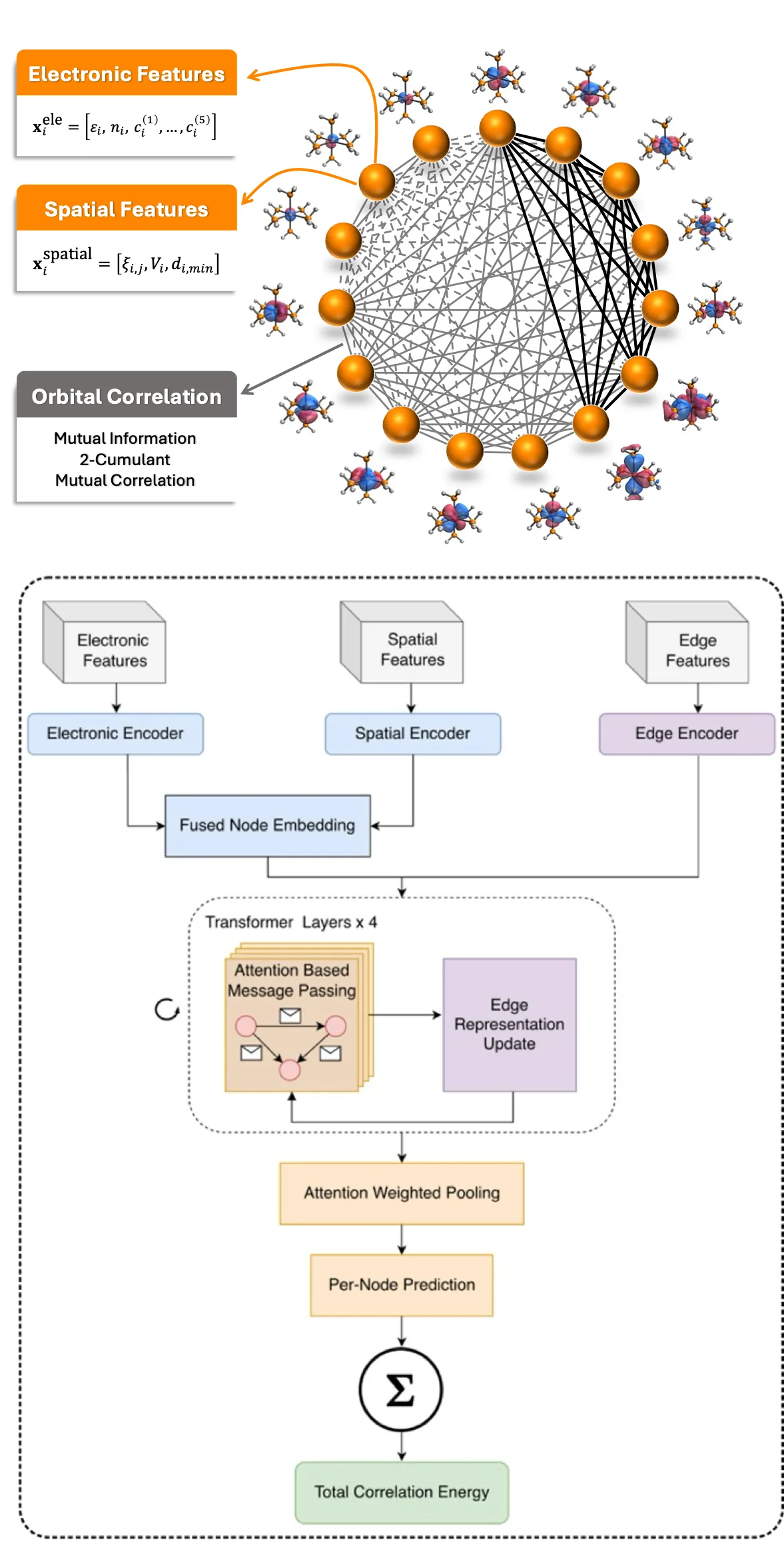
Imagine a map where instead of cities you have orbitals, and the roads between them are entanglement. A new neural network builds such a map for a molecule and uses it to predict the electron correlation energy. Correlation is when electrons influence each other, and this influence determines how a molecule breaks apart or what state it takes.
Previously, an accurate calculation required enumerating a huge number of configurations, like a courier trying every possible route. The neural network learns from examples where the energy is already known, and then predicts it for new molecules. The features of the orbitals are their energy and occupancy, and the edges of the graph show how strongly the orbitals are entangled: the thicker the road, the stronger the connection.
What the work showed: it became clear that the orbital entanglement map alone is sufficient for accurate prediction. There is no need to know the coordinates of atoms, only the connections between electron clouds. This speeds up the search for new materials and catalysts where spin states are important.
The prediction error for spin gaps in iron complexes was less than 1 kcal/mol, which is roughly the energy released by burning a single match, distributed over a mole of substance.