An orbital is a mathematical function that describes the location and wave-like behavior of an electron in an atom or molecule. It defines the probability distribution of finding an electron in a given region of space, replacing the older idea of fixed, planet-like electron paths. Orbitals come in various shapes (s, p, d, f) and energy levels, and their arrangement determines the chemical properties of elements and how atoms bond to form molecules.
History
The concept was developed in the 1920s by Erwin Schrödinger and Max Born, building on Niels Bohr's earlier atomic model. The term 'orbital' was coined by Robert S. Mulliken in 1932.
How it works
The orbital is a solution to the Schrödinger equation for an electron in a potential field created by the nucleus and other electrons. The square of the wave function gives the probability density of the electron's position. In molecules, orbitals combine to form bonding and antibonding orbitals, which dictate molecular structure and reactivity. In solids, orbitals overlap to form bands, explaining electrical conductivity and other bulk properties.
In practice
Orbitals are fundamental to quantum chemistry, materials science, and semiconductor physics, guiding the design of new molecules, drugs, and electronic devices.
Fun fact
The shapes of orbitals are not arbitrary; they arise from the symmetries of the underlying quantum mechanical equations, and the 'fuzzy' electron cloud of an orbital can be directly imaged using scanning tunneling microscopy.
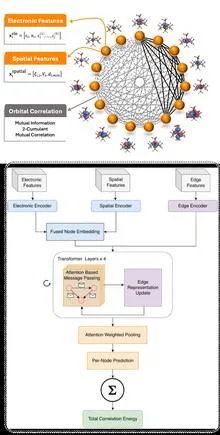
A cartographer who draws not mountains and rivers but invisible bonds between electrons: that's one way to describe the new neural network. Instead of atomic coordinates, it takes molecular orbitals and draws a graph where nodes are orbitals and edges are measures of their quantum entanglement.
A stellarator fusion reactor resembles an intricately twisted magnetic cocoon. Its job is to confine superheated plasma so that hydrogen nuclei fuse and release energy. But the cocoon's three-dimensional shape creates gaps: some particles escape, especially the fastest ones, which carry most of the heat.
A thrown stone follows a smooth arc: its path is easy to predict. But if the stone skips across water, the trajectory becomes jagged and far more interesting. Quantum particles behave much the same way when their state is not a calm wave with fixed energy but a turbulent mix of several waves at once.
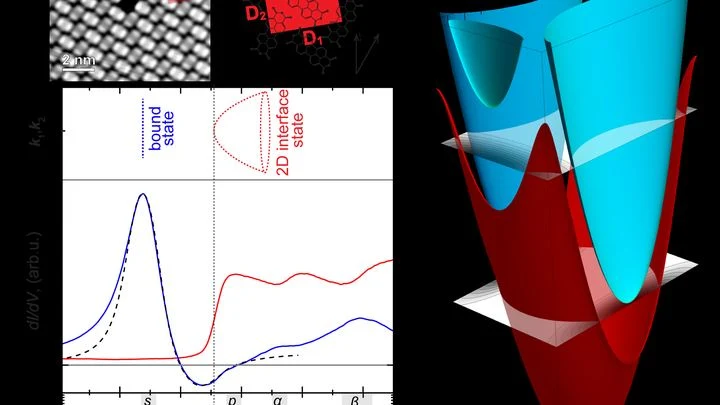
A wafer-thin film of organic molecules was grown on a silicon substrate. In this film, as if on a sheet of graph paper, tiny "pens"—artificial atoms — were laid out with the tip of a scanning tunneling microscope.
When light knocks an electron out of a molecule, the remaining electrons don't just sit still: they rearrange, like passengers in a train car when one gets off at a stop. In ordinary molecules, this rearrangement is barely noticeable, but in chiral molecules, mirror images like left and right hands, it can make the orbitals rotate.
According to the laws of the microworld, an electron obeying the Dirac equation trembles even at complete rest. This is Zitterbewegung — an oscillation with an amplitude of trillionths of a millimeter, like a spinning top on an invisible axis.