Orbital Graphs: How a Neural Network Reads Electron Entanglement ✛
Context
Computational chemistry is torn between speed and accuracy: classical methods are fast but fail to describe strong correlation, while multiconfigurational approaches are accurate but exponentially expensive. Machine-learned interatomic potentials (MLIPs) have learned to predict potential energy surfaces but typically ignore explicit electronic structure and static correlation. Alongside this work on the archive are studies on predicting material properties without a laboratory, on machine learning exchange couplings in crystals, and on neural network potentials that sense strain in detail. OrbGNN follows in the vein of wavefunction-based ML models but shifts the focus from atomic coordinates to orbital interactions, opening a path to describing multiconfigurational effects.
Methods
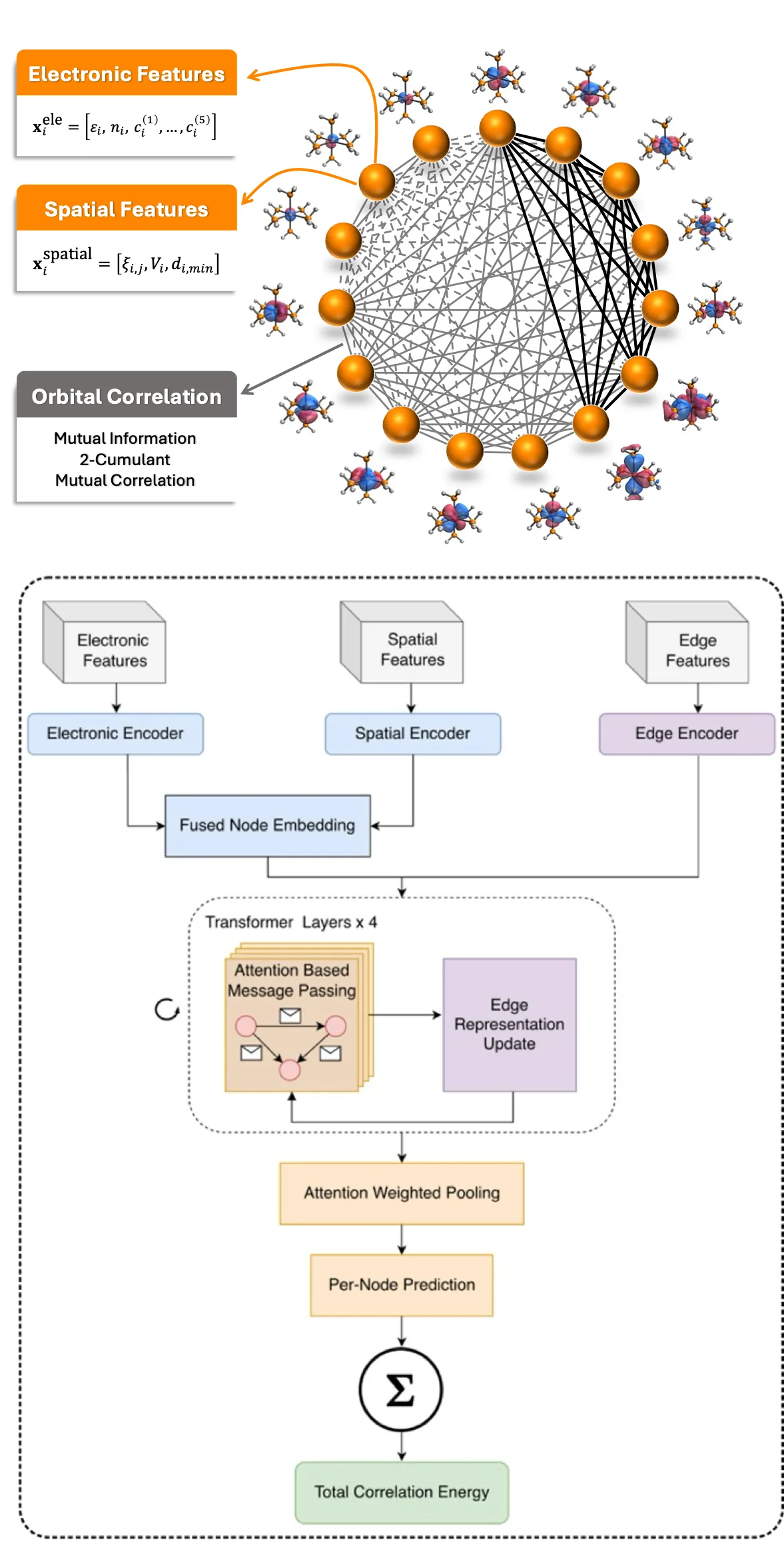
The authors construct an orbital graph for each molecule: nodes are molecular orbitals with features (Hartree–Fock energy, natural orbital occupation numbers from DMRG, atomic orbital contributions, distance from the orbital centroid to the nearest nucleus, weighted nuclear potential). Edges encode pairwise orbital connectivity through three metrics: mutual information, the norm of the two-particle cumulant, and mutual correlation. The architecture is a graph transformer with bidirectional message passing and attention. Training data are generated by DMRG calculations (bond dimension 100 for diatomics, 200 for iron complexes) with ANO-RCC basis sets. Target values are the difference between CASSCF/CASPT2 and Hartree–Fock energies, i.e., the correlation contribution. For N2 dissociation, 500 geometries are taken (0.7–2.8 Å); for 18 diatomic molecules, 100 geometries per molecule; for five Fe(II) complexes, 25 geometries of Fe–L bond stretching.
Results
On the N2 dissociation curve, all three connectivity metrics give a mean absolute error (MAE) below 0.38 mEh (subchemical accuracy): cumulant 0.2038 mEh, mutual correlation 0.2052 mEh, mutual information 0.2473 mEh. Errors are larger at short bonds (up to 1.1 Å), where entanglement is small. For 18 diatomic molecules, the overall MAE is 0.742 mEh (ANO-RCC-MB) and 0.773 mEh (ANO-RCC-DZ), with accuracy maintained across different bond types. For five octahedral complexes [Fe(L)6]2+ (L = NH3, CO, HCN, CNH, PH3), OrbGNN predicts spin gaps with MAE less than 1 kcal/mol, correctly reproducing the ordering of high-spin and low-spin states. The model was trained on active spaces of varying size (from CAS(6,5) to CAS(10,12)) and demonstrated the ability to capture dynamic correlation without explicit virtual orbital features.
Implications
OrbGNN shows that orbital graphs with entanglement metrics carry enough information to predict correlation energy even in strongly correlated systems. Unlike neighboring works that rely on atomic coordinates or universal potentials, here the representation is built directly from the wavefunction, making the model physically transparent and transferable. This is a first step toward replacing expensive multiconfigurational calculations with a fast surrogate model for screening transition metals and bond-breaking processes.
Future development
Immediate next steps include expanding training data beyond local scans of the potential energy surface: diverse metals, oxidation states, ligands, and active space sizes. Plans include automatic active space search and integration with equivariant MLIPs for simultaneous learning of atomic and electronic structure. Adding information about virtual orbitals may improve CASPT2 predictions.
Impact
The method could accelerate high-throughput screening of transition metal complexes and catalysts where spin state accuracy matters. It also lays the groundwork for hybrid models combining MLIPs and wavefunction methods.
Next steps
Expand the dataset to complexes with different metals and ligands, implement automatic active space selection, and test transferability to excited states and bond-breaking reactions.
Key open problems
This work directly addresses the scalability problem of multiconfigurational methods: how to predict strong correlation energy without exponential cost growth. Open questions remain about transferring the model to systems with many strongly correlated orbitals and incorporating dynamic correlation without explicit virtual orbitals.
The knowledge machine's view
This section is addressed to the author of the paper and their colleagues. Neighbouring works were found by meaning-based search across our archive, not by word overlap. We do not review: we show the field around the work.
What the work does
This paper introduces OrbGNN, a graph neural network that predicts the energy of static electron correlation from orbital graphs, where nodes are molecular orbitals and edges are entanglement measures (mutual information, two-particle cumulant, mutual correlation). The model is trained on DMRG data for the dissociation of N2, 18 diatomic molecules, and five iron(II) complexes, achieving errors below chemical accuracy (less than 1 kcal/mol for spin gaps).
Where its strength is
Shifting the focus from atomic coordinates to orbital interactions and quantum entanglement allows the model to explicitly capture static correlation, opening a path to describing multiconfigurational effects that conventional MLIPs cannot access.
Where it could go next
- It might be interesting to see how the ideas for predicting material properties without a laboratory from 2503.03837 can be adapted to extend OrbGNN to broader classes of compounds, using orbital features instead of atomic ones.based on: Scientific Lego: Predicting Material Properties Without a Lab arXiv:2503.03837
- A related approach comes from 2606.28458 on machine learning exchange couplings in crystals: one could try transferring orbital graphs to periodic systems where magnetic interactions matter.based on: Magnetic Ballet of Crystals: AI Eavesdrops on Exchange Bond Angles arXiv:2606.28458
- The experience from 2606.08287 on stress-sensitive neural network potentials could be useful: add information about geometric distortions to OrbGNN's features to better describe spin transitions in transition metal complexes.based on: A neural network that senses stress in parts of any shape arXiv:2606.08287
Worth trying
- Test transferring the trained OrbGNN to complexes of other transition metals, using the prediction of material properties without a laboratory from 2503.03837 as a starting point.
- Check whether adding features that describe virtual orbitals improves accuracy for stretched bonds, by analogy with the inclusion of polarization in 2606.16922.
- Use entanglement metrics to cluster orbitals and build hierarchical graphs, inspired by reading molecules via carbon signatures from 2604.27070.
Nearby works in our archive
- Neural Network Learns to Read Molecules by Their Carbon Signaturesimilarity 0.63
- Magnetic Ballet of Crystals: AI Eavesdrops on Exchange Bond Anglessimilarity 0.55
- A Map of Brain Agingsimilarity 0.55
- Neural Network by Ear: How to Capture a Particle's Energysimilarity 0.55
- Neural Network Charts a Precise Gravitational Map of Galaxiessimilarity 0.54
- A neural network that senses stress in parts of any shapesimilarity 0.54
- Scientific Lego: Predicting Material Properties Without a Labsimilarity 0.53
The closest work in the archive sits at 0.63 by meaning — the usual level for our corpus.
The prediction error for spin gaps in iron complexes was less than 1 kcal/mol, which is roughly the energy released by burning a single match, distributed over a mole of substance.
Key numbers
- subchemical accuracy: less than 1 kJ/mol (0.38 mEh)
- MAE for N2 (cumulant): 0.2038 mEh
- MAE for 18 diatomics (ANO-RCC-DZ): 0.773 mEh
- MAE for Fe(II) spin gaps: less than 1 kcal/mol
- DMRG bond dimension for diatomics: 100