Electron correlation refers to the way electrons in a molecule or solid do not move independently but adjust their motions to avoid each other due to their mutual repulsion. In a simple picture, each electron moves in the average field of all others, but correlation captures the instantaneous, quantum-mechanical interplay where the position of one electron influences the probability of finding another nearby. This effect is fundamental to understanding chemical bonding, magnetism, and superconductivity, and it becomes especially important in systems with many electrons, like transition metals or strongly interacting materials.
History
The concept of electron correlation emerged in the 1930s with the development of quantum chemistry. Walter Heitler and Fritz London introduced the idea of correlated electron motion in the hydrogen molecule, and later, in the 1950s, the Hartree-Fock method was formalized, making the missing correlation energy explicit. The term 'electron correlation' was popularized by Per-Olov Löwdin in the 1950s.
How it works
In quantum mechanics, electrons are described by wavefunctions that spread over space. If electrons were independent, the total wavefunction would be a simple product of single-electron states. But because electrons repel each other, their motions become entangled: the wavefunction must be a superposition of many such products, with amplitudes that suppress configurations where two electrons are close together. This is captured mathematically by methods like configuration interaction or coupled cluster theory, which mix in excited-state configurations. The correlation energy—the difference between the exact energy and the mean-field (Hartree-Fock) energy—is a measure of how much the electrons' motions are coordinated. In time-dependent processes, such as laser-driven electron dynamics, correlation manifests as the simultaneous response of multiple electrons, leading to effects like charge migration or the emission of correlated electron pairs.
In practice
Electron correlation is essential for accurate predictions in computational chemistry, such as reaction rates and molecular spectra, and for designing materials with specific electronic properties, like superconductors or quantum dots. It also plays a role in developing quantum computing algorithms that simulate correlated electron systems.
Fun fact
In some strongly correlated materials, electrons can 'freeze' into a regular pattern, turning a metal into an insulator—a phenomenon called a Mott transition—which is purely a result of electron correlation.
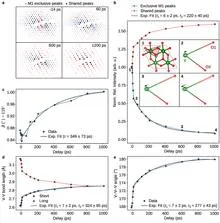
The camera captures not a race but a dance of atoms. In vanadium dioxide, the transition from an insulating to a metallic state occurs within trillionths of a second, yet until now no one had seen exactly how the vanadium and oxygen atoms move. Now, ultrafast electron diffraction has captured this route frame by frame.
Picture a long thread trapped inside a sphere with charged walls. The thread is the virus's RNA; the sphere is its protein shell. The thread tries to settle so that its charges sit as close as possible to opposite charges on the wall.
Two electrons that leave a metal needle tip almost simultaneously start to repel each other, like two people trying to squeeze through a narrow door at the same time. The closer they are, the more they get in each other's way.
$$10^{-35}$$ seconds. A tiny instant during which the Universe manages to expand by a factor of $$10^{26}$$. Immediately after, it goes through thousands of rapid transformations — like a ball bouncing along a chain of tunnels. This cascade is the essence of chain inflation, first proposed by Alan Guth.
A guitar string keeps vibrating even after the musician lets it go, and that vibration changes the sound the listener hears. Magnetic moments in a crystal behave much the same way: they align into a strict antiferromagnetic order (neighbors point in opposite directions), but they never completely freeze.
A surfer glides across the ocean surface until a big wave comes, and then they're flying forward. Similarly, a free electron interacts with light: usually the energy exchange is barely noticeable, but if the surrounding medium begins to oscillate rhythmically, each wave crest pushes the particle harder and harder.
A sheet of paper with square grid, one with diamond grid, and one with honeycomb — three different universes for an ant. Change the sheet, and the rules of movement change. That's roughly how electrons experience the crystal lattice: geometry dictates whether they become little magnets, superconductors, or something else. In ordinary materials, the lattice is as rigid as if engraved.
Two grains of salt fall into a glass of water. They dissolve, and sodium and chloride ions spread throughout the volume. The schoolbook truth is simple: like charges repel, opposite charges attract. But recent experiments with tiny spheres in liquids have revealed a picture that breaks this rule.
Picture a crowded hall where each person is a molecule, and their private conversation is the motion of electrons within it. Normally, everyone talks to themselves, and the overall buzz is chaotic. But if a bright spotlight is turned on in the center, it begins to conduct the crowd: people synchronize their movements, even though the light merely reflects off the walls.
A deuterium molecule, two atoms of heavy hydrogen, falls apart under a laser pulse. One electron is ripped away, leaving an ion behind. At that moment, they are still linked: the direction of one immediately tells you which way the other went. This link is called quantum entanglement.
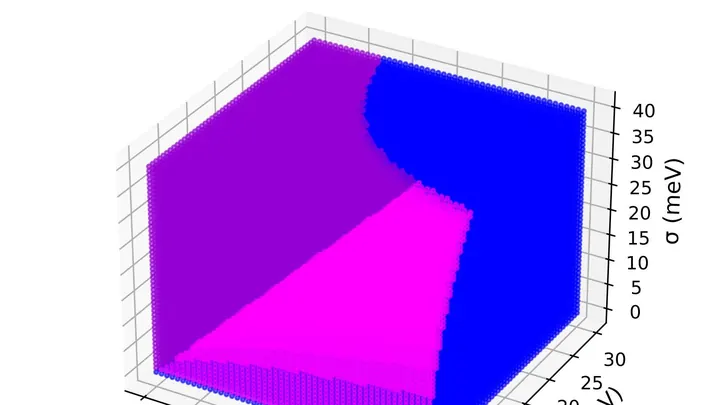
In the world of superconductors, electrons don't like to be alone. They typically pair up into Cooper pairs and move without resistance, like figure skaters holding hands. But you can make them dance in fours. The authors of this work propose a scheme where Cooper quartets, groups of four electrons exchanging partners in a rapid rhythm, are born.
Near black holes and neutron stars, plasma churns like water in a boiling kettle. But this 'kettle' has no walls — only magnetic fields that twist and tear. At the tears, thin sheets form where magnetic field lines reconnect, giving particles a kick like a surfer catching a wave.
A water molecule, finding itself near a carbon ring, starts to vibrate, and immediately falls under the sway of an invisible conductor. The ring's electron cloud, like a maestro, dampens some vibrations while amplifying others.
A laser strikes a strontium atom, and two electrons fly out at once. Previously, it was thought that in such double ionization each electron acts on its own: one is knocked out first, the second later, randomly.
When light knocks an electron out of a molecule, the remaining electrons don't just sit still: they rearrange, like passengers in a train car when one gets off at a stop. In ordinary molecules, this rearrangement is barely noticeable, but in chiral molecules, mirror images like left and right hands, it can make the orbitals rotate.
A stone falls into water, and ripples spread outward. In the quantum world, a magnetic impurity (that pebble) in a metal perturbs the surrounding electrons, and they form a special cloud around it. This is called the Kondo cloud. Like ripples on water in the dark, it long remained elusive.