A Map of Entanglement Instead of a Map of Atoms: Neural Network Reads Electronic Bonds ✛
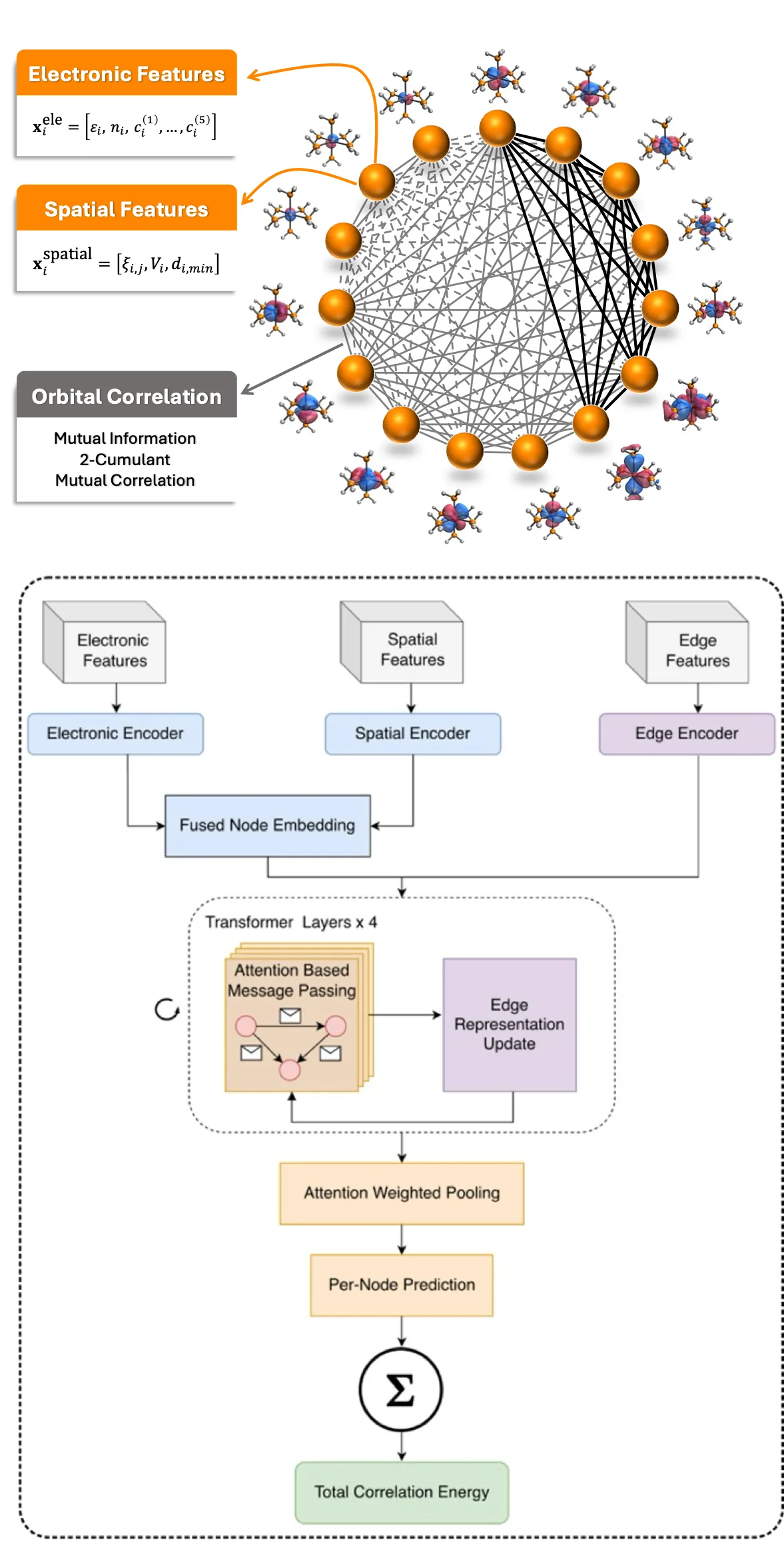
A cartographer who draws not mountains and rivers but invisible bonds between electrons: that's one way to describe the new neural network. Instead of atomic coordinates, it takes molecular orbitals and draws a graph where nodes are orbitals and edges are measures of their quantum entanglement. Such a map lets you predict the energy of strong electron correlation, the very thing that determines how a chemical bond breaks and what spin state a metal complex adopts.
Previously, accurate calculations of such systems required multiconfigurational methods, which become exponentially more expensive as the number of electrons grows. Machine-learned potentials trained on atomic coordinates are fast but blind to subtle entanglement effects. OrbGNN changes the perspective: it learns not from molecular geometry but from electronic structure. Node features include orbital energies, occupation numbers from DMRG (a wavefunction compression method), and atomic orbital contributions. Edges encode three metrics: mutual information, the norm of the two-particle cumulant, and mutual correlation.
The model proved transferable. For 18 diatomic molecules, the overall error was 0.742 mEh in the minimal basis, and for five octahedral iron(II) complexes, spin gaps were predicted to within less than 1 kcal/mol. That's roughly the energy released by burning a single match, spread over a mole of substance. The ordering of high-spin and low-spin states was reproduced correctly.
The key takeaway: an orbital graph with entanglement metrics carries enough information to replace an expensive calculation. It was unclear whether one could predict strong correlation energy without seeing atomic coordinates. It turns out you can, if you look at the map of orbital connections. This approach is a first step toward fast screening of transition metal complexes where spin states matter, for instance in catalysts.
The orbital entanglement map doesn't replace the atomic map; it complements it. In the future, both maps could merge into a single model that learns simultaneously from molecular geometry and electronic structure. That would make materials property calculations faster and understanding deeper.
The prediction error for spin gaps in iron complexes was less than 1 kcal/mol, which is roughly the energy released by burning a single match, distributed over a mole of substance.