Seeing Chemistry Inside an Object Without Cutting It Open ✛
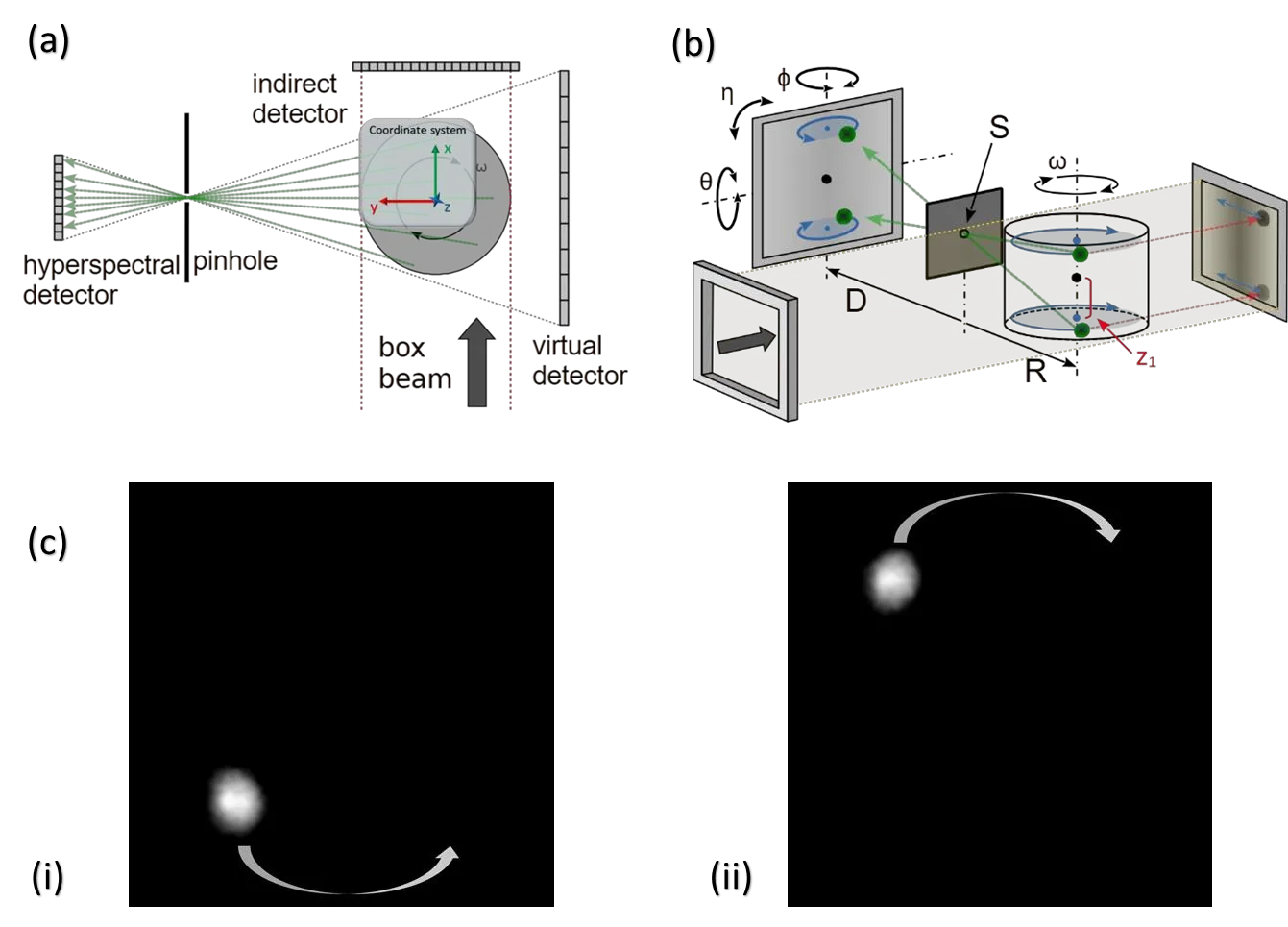
In a dark room, a sunbeam passes through a pinhole in cardboard, and an inverted image of the street appears on the wall. That's how a pinhole camera works: the tiny hole itself selects the rays coming from each point of the scene. Scientists applied this idea to X-rays, but made the camera see not shape, but chemical composition.
Usually, to find out what elements an object consists of, you scan it with a thin beam point by point, which is slow, like drawing a portrait by poking a needle into canvas. In the new method, the sample is illuminated as a whole, and its glow, the secondary X-ray radiation that atoms emit after excitation, passes through the pinhole and hits a detector. This detector records the energy of each photon, much as an ear distinguishes notes in a chord. Thus, in a single frame, information about all elements is collected at once.
The method was tested on a zebrafish embryo stained with silver: the map showed where the dye accumulated and where it is almost absent. On a piece of rock consisting of granite and serpentinite, barium was found only in granite, while iron was in serpentinite. Previously, to combine structure and chemistry this way, you had to scan twice and then align the data. Now everything is done in a single experiment.
The accumulation time for one fluorescence projection was 150–170 seconds, with 121 projections in total, about 5.5 hours per dataset. The phase-contrast tomography with 5000 projections took a comparable time.
The idea of seeing the chemical composition of a volume without destroying it evokes the tricorder from 'Star Trek', which scans an object and gives an elemental analysis. F3CT is a step toward such a device, though it still requires a synchrotron.